



CMS's CY 2027 Medicare Physician Fee Schedule Final Rule was released the rule on November 4, 2026. This final rule will reduce reimbursement for same-day services. The reductions are in effect as of January 1, 2027.
Practices should note the changes to the cuts were less severe than originally proposed. CMS had initially suggested reimbursing services performed during the same day as the initial visit at 50% of its total value. In this final rule, the same day visits and procedures would be paid at 80% of their total value, but only for those with zero (0) days in global procedure codes.
Below you'll find information regarding changes made to the rules, what CMS has said and what you should review prior to January 1.
Quick Answer
- When a separately identifiable office/outpatient E/M visit is billed on the same day as a 0-day global procedure, the most expensive service is paid at 100% and every other same-day service is paid at 80%.
- CMS has described this as a 20% reduction for the lower cost service.
- As proposed by CMS, you would have been paid 50% for your second service which would have included coverage of 0-, 10-, and 90-day global surgical/procedures. CMS dropped both the 10- and 90-day global surgeries/procedures.
- The 100% payment is for either the procedure/surgery or the E/M visit. The E/M is not always the one discounted.
- No exceptions were listed in the fact sheet. It was unclear if vaccinations, annual wellness visits, etc., would be impacted.
- CMS indicated there will be no additional documentation requirements. Your supporting documentation for Modifier 25 must still stand on its own.
The Final Rule at a Glance
| Item | Final CY 2027 policy | What the practice should know |
|---|---|---|
| Scope | Separately identifiable office/outpatient E/M + 0-day global procedure, same day | The same physician, or a physician of the same specialty in the same group practice |
| Highest-paid service | 100% | Procedure or E/M, whichever pays more |
| Other same-day service | 80% | Down from the proposed 50% |
| 10- and 90-day globals | Dropped from the final rule | Proposed, not finalized |
| Effective date | On or after January 1, 2027 | Plan by date of service |
| Press release wording | 20% reduction for the lower-cost service | Same policy, stated as a reduction |
What Changed from the Proposal
| Proposed | Final | |
|---|---|---|
| Procedures covered | 0-, 10-, and 90-day global | 0-day global only |
| Payment for the other service | 50% | 80% |
| Highest-paid service | 100% | 100% |
CMS claims it made two major changes to its original proposal based on public comment, by limiting the initial application to all 0 day global, and increasing the pay rate for the second service to 80% instead of 50%.
How the 80% Rule Works
According to the fact sheet, the Centers for Medicare and Medicaid Services (CMS) states their basis of belief in the efficiency that exists when a single provider (physician or group of physicians) treats the same patient for both an Evaluation/Management (E/M) Service and a Procedure, where the global period of the Procedure includes all related services provided by the same physician (or physician(s)) within the time frame defined by the procedure's global period. CMS also assumes this creates duplicate payments under today's methodology. According to the press release, the changes will be used to eliminate the duplication in "clinical work" paid for through the procedure itself.
In practical application, how the rules work out looks like this:
- Medicare identifies the most expensive service of the day, surgical or E/M.
- That service is paid at 100%.
- Every other same-day service is paid at 80%.
For every $100 of Medicare allowed amount on the lower-paid service, $80 is paid. Your actual numbers depend on your own allowed amounts, so we are not offering a dollar example.
Why the E/M Is Not Always the Service Reduced
The CMS states "the most expensive service (either surgery or E/M) will be paid at 100%". The E/M service will get paid 80% if it was paid less than the surgical service. The surgical service gets to keep 100% of its fee if it was paid less than the E/M service.
Why the 0-Day Global Scope Matters
Each procedure contains a global indicator to determine the global scope of a particular code. In order to be included as one of the services subject to the new rules regarding physician services; only codes with a 0-Day global period are included. Procedures that have a 10- or 90-day global period are excluded from this new policy. Use your copy of the Medicare Physician Fee Schedule to find the global period associated with each cpt code.
What CMS Has and Has Not Said
The CMS fact sheet is a summary. Several questions practices will ask are not answered in it.
| Question | What the CMS documents say |
|---|---|
| Which procedures are covered? | 0-day global only |
| How much is the reduction? | 20% on the lower-cost service (80% payment) |
| Were 10- and 90-day globals dropped? | Yes |
| Does it apply to same-day vaccine administration? | Not affected on their own. The reduction applies only when the procedure has a 0-day global period. Vaccine administration codes and AWV codes G0438 and G0439 carry an XXX global indicator, so they do not trigger it. |
| Does it apply to annual wellness visits or other Part B preventive services? | Not affected on their own. The reduction applies only when the procedure has a 0-day global period. Vaccine administration codes and AWV codes G0438 and G0439 carry an XXX global indicator, so they do not trigger it. |
| Are different specialties in the same group exempt? | Yes. Same-day services by physicians of different specialties in the same group are not subject to the reduction. |
| How does it interact with existing multiple-procedure reductions? | Not stated |
| Will CMS publish claims-processing instructions? | Not stated in the fact sheet |
| New documentation requirements? | None described |
If you're informed that vaccinations or preventive visits are automatically exempt; treat this information as unverified until either the CMS Rule Text or your MAC states otherwise.
A same day visit will be considered only for billing purposes if one of the procedures being billed for has a global indicator of 0. Therefore, always begin by checking the global indicator of the code.
Modifier 25 Documentation: Still the Foundation
CMS announced that they would make no changes to the documentation requirements of Medicare, but with the new 80% rule, every claim submitted under modifier 25 will now include a lower reimbursement for the secondary services performed, while an undocumented E/M service may lead to both denied claims and/or audits.
According to the American Academy of Family Physicians (AAFP), who provides their member guidance based on the CPT definitions, modifier 25 represents "a significant, separately identifiable" evaluation and management service(s) by the same provider on the same date as a procedure. In reference to what constitutes a significant and distinct E/M from a procedure according to AAFP:
- The E/M must represent a level of significance which is beyond what was necessary to perform the procedure itself, thus requiring additional effort beyond that normally expended during the routine activities surrounding preparation or follow-up related to the procedure.
- Separate diagnoses are not required as long as there has been some form of added value provided by the physician over and above what is typically expected as part of the standard pre- or post-procedure care.
- The decision to perform a minor procedure is included in the procedure’s payment and is not a separate E/M.
- Each service should be documented such that the supporting documentation can stand alone; furthermore, it is recommended that separate documentation be maintained for both the problem-orientated E/M and the procedural note.
Who This Affects
Providers. Providers of services that charge for both an Evaluation & Management (E/M) service and a 0-day global procedure performed by the same provider for the same patient during the same day. Those providers who perform fewer same-day procedures, will experience this policy less.
Patients. There has been no discussion regarding cost sharing for patients in the Fact Sheet released by CMS. The Fact Sheet states that CMS's objective in implementing this policy is to reduce duplicate payments made for "work" included in the valuation of a procedure's fee.
Payers. The 80% rule is a Medicare Policy. Before determining if your Commercial Payer(s) have adopted the 80% rule check their written policies to determine if they have adopted the Medicare Policy.
How This Connects to Your G2211 Billing
The same E/M visits that require you to consider how to bill G2211 are also the visits where the removal of G2211 affects whether you can add modifier B1 or B2 to an E/M visit billed. Review your Modifier B1/B2 billing claims at the same time as you convert from G2211. See G2211 Is Gone: What Replaces It in 2027 and Our G2211 Billing Guide 2026. As is true with G2211 today, modifier B1 is usually prohibited from being added to an E/M visit that includes modifier 25. The only exceptions to this prohibition include the addition of modifier 25 when the E/M visit is billed on the same date as either an Annual Wellness Visit (AWV), Vaccine Administration (VA), or another Preventive Service offered under Medicare Part B.
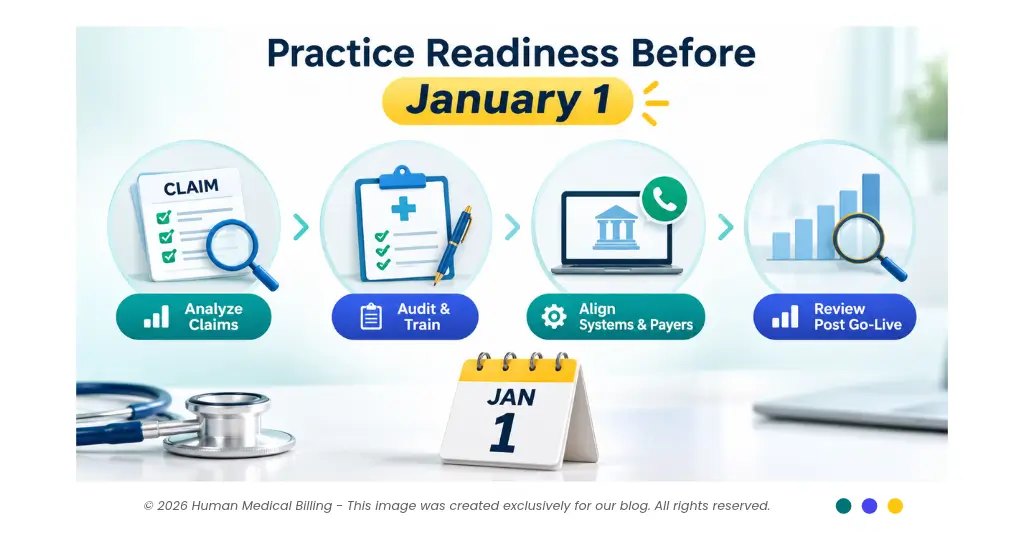
What Your Practice Should Do Before January 1
Claims analysis:
- Pull all Medicare claims where an E/M visit with Modifier 25 was also billed on the same date as a procedure.
- Determine the global indicator for each procedure code and pull out those codes with a 0-day global indicator.
- Identify if the allowed amounts for both services billed are equal or less than the other; determine the lower-paid service.
- Model an 80% payment rate on that lower-paid service (utilising your own allowed amount) as a "what if" scenario and NOT a forecast.
Documentation and compliance:
- Audit a sample of Modifier 25 documentation to ensure it meets the "separate identifiable service" criteria described above.
- Do not drop modifier 25 to avoid the reduction. Bill what the record supports.
- Take all coder training in-house and include clinician education regarding when an evaluation/management (E/M) visit has been rendered independently of their decision to do a minor procedure.
Systems and payer follow-up:
- Contact your MAC for information on the remaining issues with vaccine administrations, preventative services, same-group specialties, and multiple procedures within the same surgical session.
- Check the commercial payer's policy on same-day payments.
After go-live:
- Review January and February remittance reports for the 80% loss by each CPT Code for this issue.
- Document and track your Medicare and commercial same-day claims separately
Frequently Asked Questions
The new rules state that when you bill for a separate identifiable office/outpatient e/m visit in conjunction with a procedure (that has a 0-day global period), the more expensive of the two services will be reimbursed at 100%, and every other same-day service is paid at 80%.
In the proposal by CMS, all secondary services would have been reimbursed at 50%, and CMS had proposed reimbursement for 0-10- and 90-day global procedures. In the final rule, CMS decided to reimburse the secondary service at 80%, but limited coverage to 0-day global procedures only.
No. CMS removed these from consideration in the final rule.
No. The service that was more expensive is paid at 100%, regardless if it's the procedure or the e/m visit.
Not affected on their own. The reduction applies only when the procedure has a 0-day global period. Vaccine administration codes and AWV codes G0438 and G0439 carry an XXX global indicator, so they do not trigger it.
It is effective on or after January 1, 2027.
No. Use it when your documentation supports a significant, separately identifiable E/M service.
It will be in effect on or after January 1, 2027.
No. The use of modifier 25 should continue as long as you are able to document that the e/m service was significant and separately identifiable from the other services provided during the visit.
A Final Check Before January 1
This final rule is less severe than proposed. However, it has a common claim type. The working part is finding the number of your 0-day (same day) global procedures billed with e/m visits for the same day, creating your own 80% reimbursement based upon your own claims data, and improving the documentation to support the use of modifier 25.
Human Medical Billing works with practices on coding, claim submission, and denial management. Worried about how the same-day rule hits your revenue? We can run a same-day billing analysis on your claims. Contact us.
Sources:
- CMS, Calendar Year (CY) 2027 Medicare Physician Fee Schedule Final Rule (fact sheet), November 4, 2026: https://www.cms.gov/newsroom/fact-sheets/calendar-year-cy-2027-medicare-physician-fee-schedule-final-rule
- CMS press release, November 4, 2026: https://www.cms.gov/newsroom/press-releases/cms-finalizes-cy-2027-physician-fee-schedule-shift-sick-care-healthcare-curb-waste
- AAFP, How to use modifier 25 (documentation and CPT definition only): https://www.aafp.org/practice-operations/billing-and-coding/evaluation-management/how-to-use-modifier-25

Contact Human Medical Billing to schedule a compliance readiness review or learn more about our end-to-end billing and regulatory support services.