



The G2211 HCPCs coding is an additional Medicare add-on that allows providers to get paid for their cognitive work on longitudinal care. The G2211 Guide to Billing explains who may use this coding, the type of visits that will be considered eligible for billing using the G2211 coding and where Modifier 25 causes the claims to sink. Additionally, the G2211 Coding Guide highlights what CMS has proposed doing with regards to the G2211 coding for payments beginning January 2027.
Presently, you would attach the G2211 coding to a qualifying Office Visit, Outpatient Encounter, Home/Residence encounter E/M service if you are acting as the patient's primary focus or managing one (serious or complex) medical issue over time. In 2027, CMS has proposed making G2211 a modifier. A proposal does not equate to finalized policy therefore do not alter your claims now.
Quick Answer
- G2211 is an add-on to a service that can be billed only as part of a covered E/M service; It may never be used as a stand-alone service.
- Today’s eligible base codes are: Codes 99202 through 99205; Codes 99211 through 99215; And, beginning January 1, 2026, the Home/Residence codes: 99341, 99342, 99344, 99345, and 99347 thru 99350.
- MODIFIER 25: In addition to Part B Preventive Services, Immunization Administration, and Annual Wellness Visits, the Medicare program will deny G2211 if the base E/M includes Modifier 25.
- PROPOSED FOR 2027: The proposed use of MOD1 at 16% of the Base E/M and MOD2 at 32% of the Base E/M by certain ACO Practitioners.
G2211 Background: Where the Add-On Came From
What does G2211 represent? G2211 is a HCPCS (Healthcare Common Procedure Coding System) Add-On Code. You can bill this add-on code in addition to an Eligible Established Patient Visit Level to receive reimbursement from Medicare. To be able to bill for this add-on code, you need to serve as the primary provider of care for the patient; or provide extended care for one serious and/or complex medical condition. The add-on code was developed by CMS to allow providers to receive payment for the time spent providing continued, ongoing care and developing the mental relationship with the patient over the course of multiple visits.
Here is the timeline, checked against CMS documents:
| Date | What happened |
|---|---|
| CY 2021 PFS final rule | CMS finalizes separate payment for the add-on |
| 2021 to 2023 | Congress delays payment by statute |
| January 1, 2024 | G2211 becomes separately payable |
| January 1, 2025 | Modifier 25 exception starts for preventive services, vaccines, and Annual Wellness Visits |
| January 1, 2026 | Home or residence visits join the eligible list, and CMS revises the descriptor |
| January 1, 2027 (proposed) | MOD1 and MOD2 would replace G2211 |
G2211 Billing Guide for 2026: The Rules Today
Who can bill it? Any practitioner who bills eligible E/M visits can, in any specialty. CMS doesn’t restrict the code by specialty.
Here are the base codes CMS allows:
| Setting | Base codes | Eligible since |
|---|---|---|
| Office or outpatient | 99202 to 99205, 99211 to 99215 | January 1, 2024 |
| Home or residence | 99341, 99342, 99344, 99345, 99347, 99348, 99349, 99350 | January 1, 2026 |
Notice where the CMS Codes are absent. The codes of Home (8) are missing from this list; therefore, the CPT Codes of 99343 & 99346 are NOT on this list.
The Longitudinal Care Test is next. If you are the Continuing Focal Point for all Services, i.e., if you are the Patient's Regular Doctor. Then, you can bill G2211. Additionally, bill G2211 for managing a Serious/Complex Condition over time such as Sickle Cell Disease or HIV.
If a Family Physician bills for an Office Visit to see a patient with Sinus Congestion; then they will bill for G2211 because the additional time worked sits in their ongoing relationship with that patient-not in the diagnosis.
An Infectious Disease Physician sees a patient with HIV and the patient states he/she missed some of his/her doses. That visit would qualify as a G2211, too.
CMS provides Billing Teams one very direct Instruction: "Do Not Report G2211 Without Reporting an Associated Office and Outpatient Evaluation and Management Service." CMS does not require Documentation beyond what is required for billing. Reviewers will verify whether the G2211 was Medically Reasonable and Necessary, as well as review your Diagnoses, Assessment, Plan, etc.
Modifier 25 and G2211: Where Claims Break
Let's dissect this information. The use of Modifier 25 indicates that an Evaluation/Management (E/M) service was separately identifiable from another procedure/service performed on the same date. Therefore, Medicare will deny payment for G2211, because G2211 is included in the base E/M code.
Will Medicare pay for G2211 if a modifier 25 is used? Yes. However, Medicare will only pay for G2211 if the modifier 25 service meets one of two exceptions. First, it has to be an allowed Part B Preventive Service. Second, it could also be Immunization Administration; or an Annual Wellness Visit. These exceptions took effect on January 1, 2025.
The G2211 billing guide rule is easy to understand, but the mistakes are repetitive. Be aware of the following:
- The use of G2211 when there is an absence of an E/M service on the claim.
- The addition of G2211 to a visit which uses modifier 25 for a minor procedure.
- The combination of G2211 with a CPT code in one of the three family categories; i.e., office, outpatient, and/or home/residence.
- The inclusion of this code on all visits until you verify if the Continuing Relationship Test has been met.
The vast majority of modifier 25 denials can be identified by an experienced coder prior to the payers’ processing of them. Therefore, many physician groups assign their review of modifier 25 claims to third party medical coding companies. Even if a denial still occurs after the practice has utilized a denial management service, with a well defined process to handle appeals, this will help expedite resolution of the issue.
What CMS Proposes for 2027 (Proposed, Not Final)
The centers for medicare & medicaid services (“CMS”) proposed the cy 2027 physician fee schedule on July 14, 2026; the proposed rule was posted in the Federal Register on july 16, 2026. All comments were due on or before September 14, 2026. As such, all items listed below are proposals which may begin as of January 1, 2027; at the time of drafting CMS has yet to finalize its proposed regulations.
Here is what CMS proposes:
- MOD1 replaces G2211. So, you'd just tack it onto the E/M base code like you do G2211 today. This will increase payment for the E/M by 16%, which is consistent across every level, as opposed to adding a flat amount.
- MOD2 for ACOs. Only participants of a Shared Savings Program ACO (or Participant Providers of a LEAD Model ACO) can use this. MOD2 increases the E/M by 32%, remains optional, but affects ALL patients you see regardless of whether they are assigned to you.
- Modifier 25 limits stay. CMS wants to retain the current limits in their proposed MOD1 and MOD2 modifications and seeks comments regarding whether these modifiers can be used with 0-, 10- or 90-day global procedures.
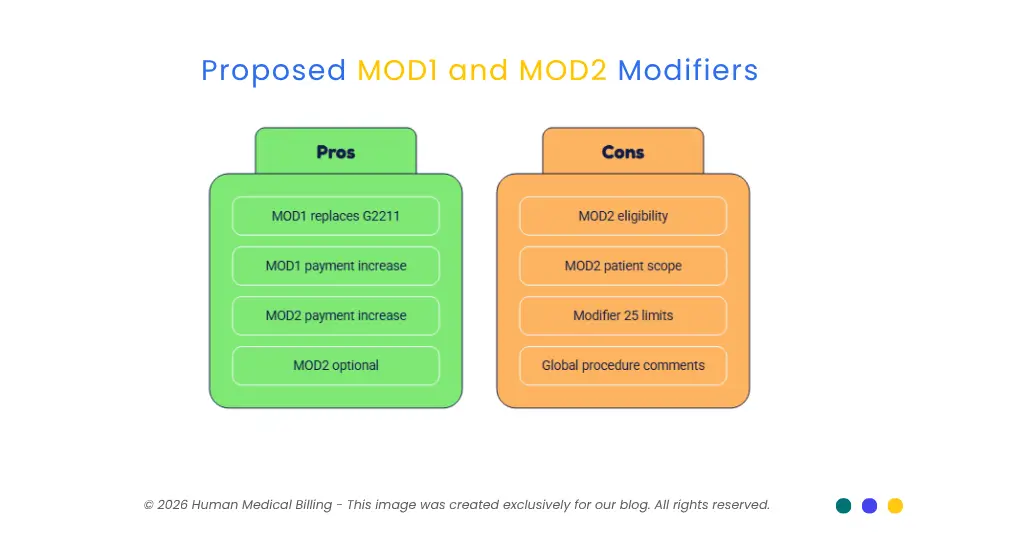
The proposed amounts are dependent upon which EM/primary care base code is selected; therefore, do your own number crunching after CMS issues a final ruling. The same rule also proposes to pay the more expensive same-day service at 100 percent and the less expensive at 50 percent when an EM/visit and a global procedure occur on the same day.
What This Means for Patients and Payers
Patients experience G2211 on this date. The Centers for Medicare & Medicaid Services (CMS) states that patients are responsible for their deductibles and coinsurances with each claim they file as G2211 will be added to the total of what is called cost sharing for the patient.The payers have a totally different view under the proposed rule. CMS stated that MOD2 claims will be considered toward assigning beneficiaries to track; create benchmarks from past data; and use for performance measurements in the Shared Savings Programs.
What Should Your Practice Do Now?
Go through all visits using these same procedures. This is how Human Medical Billing audits its G2211 claims.
Can You Bill G2211? Follow These Steps
- Can this be billed as part of a Preventive Service Code (e.g., 99202 – 99205; 99211 – 99215; Home/Residence Codes) if so move on to #2.
- If Modifier 25 exists confirm the second service meets criteria for either a Part B preventive service, Vaccine Administration or Annual Wellness Visit. If not then go back to Step #1.
- Confirm you are the Focal Point for Continuing Care, or have managed one Serious or Complex Condition Over Time. If not, move on to step #4.
- if the Note Supports the Claim, then Bill G2211.
- flag all claims in 2027 (Proposed) that currently contain G2211.
Frequently Asked Questions
Only if the other service that was billed, is a Part B Preventive Service, Immunization Administration, or Annual Wellness Visit. If this does not apply Medicare will deny the claim.
The Centers for Medicare & Medicaid Services (CMS) proposed replacing G2211 with Modifer (MOD-01), which would pay out at 16% of the base Evaluation and Management (E/M). At this time there are no plans to finalize this proposal.
Providers who are part of a Shared Savings Program Accountable Care Organization (ACO), and Participant Providers of a Learning Health System (LEAD) Model ACO. The CMS has proposed paying 32% of the base E/M.
G2211 will pay for Continuing Care but only for a "clean" claim. Follow the below G2211 billing guide for use as an additional check list; base code first, modifier 25 second, relationship test third. Until the CMS releases the final rule treat every 2027 line item as a "proposal", and do not update your claim edit rules until after that time. At Human Medical Billing we offer complete Healthcare Revenue Cycle Management Services (coding thru denial) and therefore all of these claims are left in a "clean" state and returned paid. If you would like another review of your Modifier 25 claims please contact us.

Contact Human Medical Billing to schedule a compliance readiness review or learn more about our end-to-end billing and regulatory support services.