



The 2027 Medicare Physician Fee Schedule Proposed Rule reduces what physicians are paid by Medicare for each Relative Value Unit (RVU) as well as the way in which billing teams will be required to report Same Day Visits and E/M Coding effective January 1, 2027. On July 14, 2026, CMS issued the Proposed Rule. Comments will close on September 14, 2026. This Proposed Rule affects almost all claims that your practice files through Medicare Part B in 2027, whether those claims are for routine office visits or same day procedures billed with E/M codes.
Quick Answer
- Medicare has proposed cutting the 2027 conversion factor by 1.19% to $33.17 and 1.69% to $32.84 for all other Medicare providers compared to 2026 conversion factors.
- CMS is planning on replacing the G2211 add-on code with a percentage-based modifier equaling 16% of the base E/M code fee for most physicians. For some ACO clinicians that percentage will be 32%.
- For same day E/M services billed along with a service billed under a Global Period, they will receive 50% of the payment for each individual service (they will no longer receive full payment for each service)
- Comments regarding this proposal are to be submitted to CMS by Sept 14, 2026. The final ruling is expected in fall for a January 1, 2027 start.
What's Driving the 2027 Medicare Physician Fee Schedule Cuts?
The short story: A temporary increase will disappear. Congress provided an additional 2.5% boost to the conversion factor to be applied to all physician payments for calendar year 2026 via the Working Families Tax Cut Act. That increase ends after the last day of 2025; there are no provisions in the proposed regulation that replace that increased payment.
The statutory increases (a minimum of 0.75%, and a maximum of 0.25%) continue to apply by CMS as long as they are statutorily required. Those statutory increases would also include an additional 0.53% reduction based upon Budget Neutrality. The total amount added to the base Medicare payment (the sum of those increases) will still result in less than what your practice currently receives. That is why a rule with multiple positive line items results in an overall decrease in payment.
What's Actually Changing in the 2027 Medicare Physician Fee Schedule
Three changes will affect your billing team.
Conversion factor
The conversion factor is what is being used as a basis to determine the new qualifying APM rate of $33.17 (a decrease of $0.40) compared to the previous $33.57. The non-qualifying rate also decreases to $32.84 (0.56 less than before). Since every charge submitted to the physician fee schedule has to go through these numbers, it would be fair to say that all claims are affected by this.
G2211 becomes a modifier
The new code for Modifier G2211 is going to be an Add-On Code; The Centers for Medicare & Medicaid Services (CMS) are proposing to eliminate the flat rate G2211 add-on code, and in its place create a percentage modifier that is tied directly to the base E/M code. As part of the proposed change, all modifiers will pay 16 percent of the amount associated with each E/M code.
In contrast, clinicians who have qualified ACOs as either Lead Accountable Care Organizations or those participating in other types of ACOs as defined by Medicare Shared Savings Program (MSSP), will receive a 32 percent modifier. Once this modification has been finalized by CMS, coders will be required to modify their method of application regarding this add-on. Practices that rely on outside vendors to provide medical coding services should contact their vendors to verify that their vendor is currently tracking the proposed modified add-on structure.
Same-day E/M and procedure cuts
Beginning with physicians (and other physicians within the same medical group), when an attending physician bills for a separate E/M service for which there is a different date of service than a 0- 10- 90-day "global" surgery, CMS pays the higher priced service at 100% and reduces payment for the lower-priced E/M visit from 100% to 50%. The greatest burden will fall upon those specialties that frequently use modifier -25 along side their minor surgical procedures; e.g., Dermatology, Ophthalmology, Orthopedic Surgery etc.
Where This Leaves Patients and Telehealth Billing
Telemedicine was also steady in terms of policy as well. The Consolidated Appropriations Act of 2026 extends geographic and originating site waivers until CY 2027. Therefore, virtual visits will have the same billing flexibilities that patient’s became accustomed to over the last several years. However, even with this consistency, billing departments should check on the place of service codes and modifier usage as the telehealth payments follow similar payment regulations as G2211 and Same-Day Visits.
Additionally, from an operational standpoint, while telemedicine may be consistent, when the physician fee schedule (PFS) is adjusted downward (i.e., less reimbursement per service), historically some physicians evaluate their ability to see additional Medicare patients based on their current practice size, before having to adjust their number of Medicare patients seen.
How This Hits Your Billing Team
Lower per-service payments mean the same number of claims result in lower revenues. This forces a well-run billing department to shift its priorities when it comes to how important each piece is for clean first pass claims.
Clean First Pass Claims Matter More
A denied or delayed claim now costs a greater percentage of the payment on the table.
Modifer –25 Documentation Must Be Better Than Ever Before
Payers are already looking at this modifier with a fine tooth comb; now they have one additional reason to do so as a result of the new same day rule.
Accounts Receivable Follow-Up Can’t be Laid Back
When the margin gets thinner, an accounts receivable claim older than 30 days is doing much more harm than it ever did, which is exactly where a professional dedicated medical account receivable service earns its keep.
Underpaid Checks Become Routine vs Audit
Practices that don’t continually review the amount being processed against the new fee schedule will lose money through simple processing errors no one will detect.
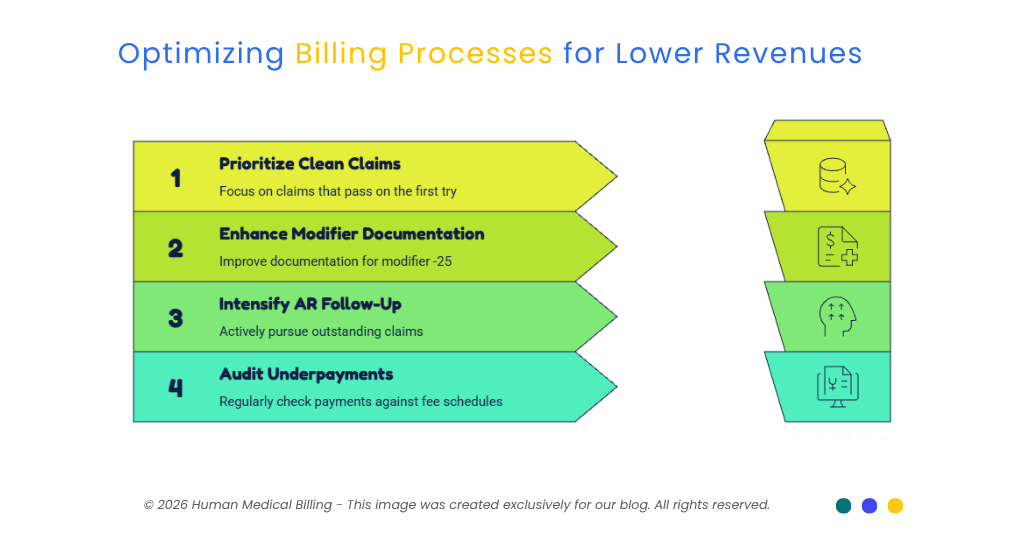
Billing departments that use denial management services to identify and address these types of issues prior to piling up will feel the effects of this reduction less than those billing departments that are reacting to claims individually.
What Should Your Practice Do Now?
- Model your top 20 CPT codes using both proposed conversion factor rates to understand how they will affect each CPT code prior to Jan.
- Audit your modifier -25 use now. Pull a random sample of previous claims and review them to see whether there is supporting documentation for separate payment per the current rules (as the addition of a global period policy will increase scrutiny).
- Flag all global-period procedure that has an associated E/M visit in your billing system; this way when the 50% reduction occurs, you will be able to identify these claims in your system.
- Submit your comment(s) to CMS regarding the G2211 or same day E/M proposal by Sept. 14, 2026, if either impacts your specialty significantly. Specialty societies are reviewed and respond to feedback from CMS before rules are finalized.
- Review the configuration of your existing Healthcare Revenue Cycle Management Services (whether you utilize internal resources or outsource), to ensure it provides reporting capabilities at the claim level as well as the ability to report variations in payment amounts based upon CPT codes
What will this mean for your daily billing routine? The need to process smaller check payments per claim and the potential for fewer coding errors due to less space to enter codes; potentially a reduced opportunity to track claims for follow-up.
Frequently Asked Questions
CMS states that if the proposed fee schedule is finalized then it would be effective with physician services rendered on or after January 1, 2027. They also state they plan to finalize their proposal in the Fall of 2026.
No. The basic conversion factor cut applies to everyone, however, some specialties that have a large number of E/M-plus-procedure same day bills, or are very dependent upon G2211, could see a larger shift one way or another.
The payment concept isn’t being eliminated; rather, the current HCPCS code format is being replaced by a modifier tied to an E/M code for a higher fee for selected ACO participant providers.
Yes. Billing teams should begin auditing documentation for modifier -25 immediately; they should also compare their top billed codes to the proposed conversion factors and identify same day global period bills within their workflows so that when the changes occur, no one will be caught off guard.

Contact Human Medical Billing to schedule a compliance readiness review or learn more about our end-to-end billing and regulatory support services.