



CMS released the Q3 2026 version of the NCCI Add-on Codes (AOC) edit update on April 20, 2026. This edit is scheduled for implementation on July 1, 2026. The NCCI AOCs determine which add-on procedures can be billed in conjunction with primary services under Medicare Part B. Any changes to these pairs may result in CO-97 denial if the claims scrubber has not been updated. For example, if you bill ESRD, radiology or therapy services then you have limited time to prepare.
What Are the NCCI Q3 2026 Changes?
- CMS released Version Q3 – 2026 of the NCCI Add-On Code edits that are in effect as of July 1, 2026. The updates include new codes, deleted codes and the addition of modifier indicators for both practitioners and hospital outpatient claim types.
- The separate transmittal CR 14354, R13588CP removes the need for an AX Modifier on ESRD PPS claims as of July 1, 2026; however, there is a system implementation date of July 6, 2026.
- Billing departments must download and validate their claim scrubbers with the latest Q3 version of edit files prior to July 1 to prevent delayed or non-payment of claims.
- Effective July 1, ESRD providers are no longer required to report the AX Modifier on TDAPA, TPNIES & CRA TPNIES claims - instead, CMS will automatically apply add-on payments based solely on the revenue code.
What Are NCCI Add-On Code Edits?
The NCCI program is made up of both coding policies and edits that relate to the same provider performing the same service for the same patient in the same date of service. There are also specific edit rules regarding add-on code edits to determine what types of AOC's can be paid in addition to your base or primary service.
An Add-On Code (AOC) is an HCPCS/CPT code that identifies a service performed in conjunction by the same practitioner at the time of a primary service. Generally speaking, AOCs are never eligible for reimbursement when they represent the sole service provided. The CMS defines AOCs as either Type 1, Type 2, or Type 3 based upon how the AOC may relate to acceptable primary codes.
CMS makes adjustments to AOC edits as part of their yearly update; however, they can also provide quarterly updates. Because Q3 2026 is a quarterly update, there is no time for a provider's billing team to wait until the next year. Changes go into effect on July 1st, so all claims filed on or after that date will be processed using the new edit tables.
What Changed in Version Q3-2026
CMS released an updated version (Version Q3-2026) of the NCCI AOC edit file on April 20, 2026. CMS releases new versions of all of its NCCI PTP published edit files every quarter. These include additions, deletions, and quarterly updates to the correct coding edits contained in columns one/two for PTPs; and the mutually exclusive codes contained in the PTP for practitioner and hospital outpatient PPS.
For Q3 2026, the AOC File will contain two sets of modifications: New code pairs will be included. Some old pairs will be deleted. Modifiers will have their indicators changed. Effective Quarter 2 2026, the new format was implemented by CMS. This is as a fixed width text file; however, CMS is also providing an excel version of the add on code (AOC) file in addition to the fixed-width text format. The new dual format of the AOC files will continue into Q3. Therefore, you should verify with your scrubber vendor that they are reading the modified format appropriately prior to July 1.
Secondly and equally time sensitive change comes by way of CR14354. The title for this CR is "Completion of Changes to Remove Reliance on the AX Modifier to Accurately Pay End Stage Renal Disease Claims," with an effective date of July 1, 2026, and a system implementation date of July 6, 2026.
How the ESRD AX Modifier Change Works
CMS has traditionally required the use of the AX modifier - "item furnished in conjunction with dialysis services". When dialysis units receive services from ESRD facilities that are eligible for a Transitional Drug Add-on Payment Adjustment (TDAPA) or Transitional Payment for New and Innovative Equipment and Supplies (TPNIES) or CRA TPNIES; if you did not use an AX Modifier on your claim you would lose the additional payment.
Beginning July 1, this entire process is going to be reversed. The ESRD facility no longer needs to append an "AX" Modifier to claims eligible for certain Add-On Payment Adjustments under the ESRD PPS. Instead, CMS will trigger the TDAPA when a combination of both a HCPCS Code on the TDAPA List AND Revenue Code 0636 are present. TPNIES payment will also be triggered by a combination of the TPNIES List AND Revenue Code 027X. Additionally, CRA TPNIES will be triggered by Home Dialysis Equipment Revenue Codes - 0823, 0833, 0843, 0853, and 0889.
The changes to how you process claims will look like this: The use of the AX modifier has been phased out for those three claim types. Beginning JULY 1, 2026 (unless otherwise directed), ESRD providers cannot bill any renal dialysis services with the AX modifier. If you use the AX Modifier after July 6, it may cause billing errors that delay payments instead of protecting your add-on payment.
Impact on Billing Teams and Revenue Integrity
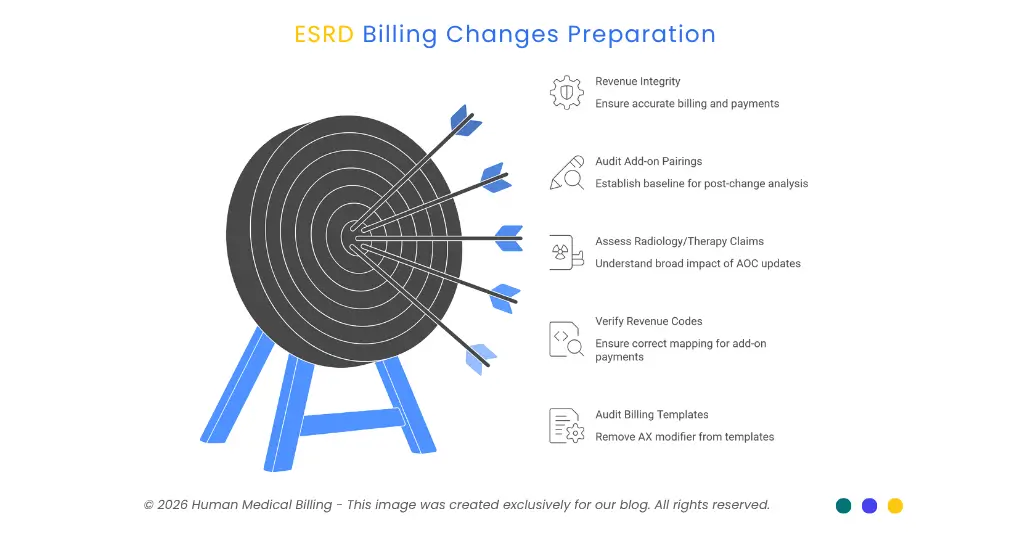
Regardless of whether you handle ESRD billing internally as part of a larger internal business office or have contracted out your ESRD billing to an outside third party revenue cycle vendor, all of the above changes should be listed as actions your organization needs to undertake prior to June 30.
Steps to Take Before July 1, 2026
Step #1.
Obtain the most current version (Q3 2026) of the NCCI AOC edit file from the CMS Add-On Code Edits web page, review additions/deletions to ensure they match your typical billed procedures.
Step #2.
Notify your claims scrubber vendor and confirm they will be using the correct AOC tables (i.e., Q3 2026) when processing claims. Obtain written confirmation that they understand what is required. Claims scrubbers using the Q2 2026 AOC table file after July 1 may incorrectly determine which add-ons bundle.
Step #3.
Audit your ESRD billing templates to remove the AX modifier from any macro or charge template(s) used for submitting TDAPA, TPNIES, and CRA TPNIES claims. Replace the AX Modifier with the applicable revenue code trigger.
Step #4.
Verify that your revenue codes are properly mapped. For ESRD claims to receive the proper add-on categories payment adjustments, they must contain the correct revenue code pairs for each add-on category.
Step #5.
Assess any radiology or therapy claims where add-on codes are being used. The Q3 AOC Update affects practitioner and hospital outpatient claim types broadly, not solely ESRD.
Step #6.
Run a 30 day Pre-Implementation audit on your add-on code pairings to establish a baseline. If you see a significant increase in CO-97 denials after July 1, you will have access to "clean" pre-change data to assist in appealing denied claims.
Teams working with Human Medical Billing through healthcare revenue cycle management services should confirm their billing partner has already incorporated the updated Q3 edit files into their claim-editing workflow.
Frequently Asked Questions
CMS has released Version Q3-2026 of the NCCI Add-On Code edit file as of July 1, 2026. This version includes all additions and deletions, including changes in modifier indicators that affect both practitioner and hospital outpatient claim types. All billing personnel must have the updated AOC file loaded prior to July 1 to prevent CO-97 denials.
As of July 1, 2026, ESRD Facilities shall no longer report the AX modifier in order to have the TDAPA, TPNIES, and CRA TPNIES Add-On Payments applied. CMS will instead automatically make these adjustments by combining the appropriate HCPCS codes with a valid revenue code. Billing the AX modifier after July 1 may cause claim errors.
The effective date for patient claims is July 1, 2026. The implementation date for the CMS System will be July 6, 2026, based upon CR 14354 (Transmittal R13588CP).
CO-97 is one of the most common denial codes that result from either incorrect bundling or add-on code pairing errors due to NCCI edits. By July 1, 2026, if your AOC edit tables are not current, you may begin to see CO-97 denials on Add-On codes with all three types of services including Radiology, Therapy, and ESRD.
Get Ahead of July 1 Before the Window Closes
Two months does not leave enough time for vendors updates or your internal testing. The NCCI NCCI add-on code edits for Q3 2026 are mandatory reading – as these edits will be applied on an enforceable date. All ESRD providers who have AX modifier language included in their billing templates must remove this language today. Every provider who bills with Add-On Codes should verify that their claim scrubber is reading version Q3 -2026.
The staff at Human Medical Billing is aware of all NCCI releases by quarter to ensure that its medical coding services will be updated as necessary. If you are having trouble with the process of double checking your billing process prior to July 1st, or if CO-97 claims are starting to show up in your denial management services, please contact us using the Contact Us Page. Being proactive about identifying potential problems early on will protect your revenue from the time the first claim enters into the newly created edit tables.

Contact Human Medical Billing to schedule a compliance readiness review or learn more about our end-to-end billing and regulatory support services.