

The Q2 2026 HCPCS Level II quarterly update became effective on April 1st, 2026. It is one of the larger updates that have occurred within a quarter recently. There were 36 new HCPCS Level II codes, as well as 17 new proprietary laboratory analysis (PLA) codes and six new C-Codes which cover hypoglossal nerve neurostimulators used for obstructive sleep apnea treatment. Some of those changes are retroactively effective January 1, 2026. Medicare Administrative Contractors had until April 6, 2026, to implement all changes. Therefore, if you have not yet reviewed existing claim workflow processes with your billing staff and compared them to the above-mentioned update, we would recommend that you review these processes immediately.
What's in the Q2 2026 HCPCS Update?
- CMS has issued an additional 36 new HCPCS Level II supply and drug codes, effective April 1, 2026
- The 17 new PLA codes (0614U through 0630U) have been activated for use in laboratory analysis billing
- The six new C-codes (C8007 through C8012), that were established to describe hypoglossal nerve neurostimulation procedures retroactively from January 1, 2026
- Q0238 is a new code for TYENNE (Tocilizumab-aazg) for COVID-19 treatment, with its corresponding IV admin codes M0233 and M0234
- Claims containing outdated codes will not be automatically adjusted by MACs
What Is the Q2 2026 HCPCS Level II Update?
HCPCS Level II codes are alphanumeric codes developed by CMS for all products, supplies, drugs, and services that do NOT fall into the CPT Code categories. CMS updates these codes every quarter to keep pace with new product introductions; new drugs receiving approval, and coverage changes driven by clinical or policy developments.
The April 2026 quarterly update is one such update, which was authorized by CMS Transmittal 13648, Change Request 14392 (revised via Transmittal 13673 on March 6, 2026). This is an update of multiple billing categories as it will include changes to procedure status, short descriptor changes, payment policy indicator changes and retroactive corrections that date back to January 1, 2026.
It is this retroactive portion of the update that is most important to billing teams. Any hypoglossal nerve neurostimulator procedures on or after January 1, 2026, - utilizing previous code numbers may be subject to claim revision due to use of outdated coding.
What Changed on April 1, 2026?
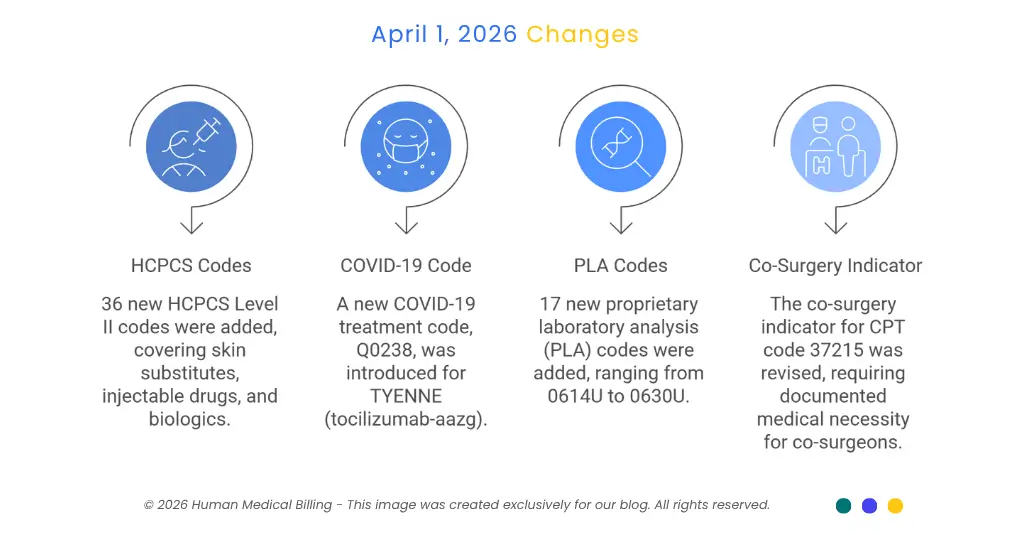
Below is an outline of what changed, and the new items added.
1. 36 New HCPCS Level II Codes
The 36 new codes span skin substitutes, injectable drugs, and biologics. Notable additions include:
- G0681 through G0684: Application of non-sheet skin substitutes (carrier/MAC-priced)
- J1553: Injection of yimmugo 100 mg
- J3404: Injection of zopapogene per therapeutic dose
- J9277: Pembrolizumab with berahyaluronidase 1 mg
- J9601: Injection of linvoseltamab-gcpt 1 mg
- Q4418 through Q4440: New wound care and membrane products billed per square centimeter
- Q5161 and Q5162: New biosimilar denosumab codes
2. New COVID-19 Treatment Code
As of April 1, 2026; Q0238 defines use of TYENNE (tocilizumab-aazg) for treatment of COVID-19. The associated intravenous administration codes for this procedure are M0233 and M0234. As such, facilities utilizing TYENNE (tocilizumab-aazg) to treat COVID-19 patients will need to confirm their systems have updated the correct codes prior to submission of claims. AAPC referenced this in a previous publication (MLN Matters Article MM14390).
3. 17 New PLA Codes
Transmittal 13639 Change Request 14371 includes 17 new proprietary laboratory analysis (PLA) codes (0614U through 0630U), as of April 1, 2026. Laboratory tests referred to as PLA are defined by one manufacturer or laboratory testing service. Laboratories providing proprietary tests must confirm that the lab test being performed is properly coded and payers requirements are met prior to submitting the test result.
4. Co-Surgery Indicator Revision for CPT 37215
As a result of an updated co-surgery indicator for CPT code 37215 (Transcatheter Carotid Stenting with Embolic Protection), co-surgeons will now receive payment if they have documented medical necessity. Therefore, claims submitted for reimbursement under CPT code 37215 which contain a co-surgeon require this additional documentation or risk being denied.
The Hypoglossal Neurostimulator C-Codes: A Closer Look
One of the most important clinical updates from this Q2 release was CMS establishing six C-codes specifically for hypoglossal nerve neurostimulator procedures, effective January 1, 2026, with inclusion in the April Integrated Outpatient Code Editor update. They are designed for use in the hospital outpatient environment to offer a better way to document the implantation, revision, replacement, and removal of hypoglossal nerve stimulator systems.
Here is how the codes break down:
| Code | Description |
|---|---|
| C8007 | Open implantation of hypoglossal nerve neurostimulator array and pulse generator (no separate distal respiratory sensor required) |
| C8008 | Revision or replacement of hypoglossal nerve neurostimulator array, with connection to existing pulse generator |
| C8009 | Removal of hypoglossal nerve neurostimulator array and pulse generator |
| C8011 | Open implantation of hypoglossal nerve(s) neurostimulator electrode array(s) and receiver, including external power source and all system components |
| C8012 | Revision or replacement of hypoglossal nerve(s) neurostimulator electrode array(s) and receiver |
| C8013 | Removal of hypoglossal nerve(s) neurostimulator electrode array(s) and receiver |
They replace broader legacy CPT codes for documentation of these procedures in hospital outpatient environments. As such, sleep surgical programs and other facilities doing hypoglossal nerve stimulation for obstructive sleep apnea need to begin using them as soon as possible. Also, sleep surgical programs should have reviewed all claims submitted after January 1, 2026
How Does This Affect Your Billing Team?
Providers who utilized outdated codes during the time period of January 1 – March 31, 2026, to bill for hypoglossal nerve neurostimulator procedures (outpatient) will be required to submit those claims again using the most current codes (C Codes). MAC systems will not automatically correct those submissions.
Lab providers also face similar challenges. New PLA code numbers (0614U through 0630U) represent unique tests manufactured by each respective provider. When lab providers use incorrect PLA codes; or fail to utilize existing PLA codes when available, it can result in erroneous payments/denials.
Having effective denial management services is essential when dealing with quarterly coding updates. Without structured processes, claims impacted by quarterly coding changes will continue to go unnoticed by claim teams resulting in lost revenues.
Pharmacy & Billing teams Must coordinate on drug side: Pharmacy and billing teams will have to work together because if a drug gets a new HCPCS code and your charge description master still reflects the old code, you're going to have problems.
What Should Your Practice Do Now?
April 6th MAC implementation deadline has passed: claims are now being processed under new codes
Action steps for billing teams
1. Pull a claims audit
Pull an audit of claims for hypoglossal nerve neurostimulator procedures processed in the hospital outpatient setting from January 1, 2026 through march 31, 2026 and identify claims submitted utilizing outdated cpt codes.
2. Update your charge description master
Update your charge description master to include all 36 new HCPCS Level II codes, the six c-codes and 17 new PLA codes (0614u through 0630u).
3. Flag CPT 37215 co-surgery claims
Verify that prior to submitting cpt 37215 co-surgery claims supporting medical necessity documentation is attached.
4. Review Q0238, M0233, and M0234
If your facility provides tocilizumab-aazg treatment to COVID-19 patients verify that the above referenced codes have been appropriately mapped within your billing system.
5. Notify your lab billing team
Notify your lab billing team regarding the new PLA code series. Each laboratory test must be assigned to the corresponding code from the 0614u through 0630u range.
6. Review the retroactive corrections
Review the retroactive correction in transmittal 13648 to determine if there may be an adverse effect on malpractice RVUs or bilateral indicators associated with the list cpt codes.
Frequently Asked Questions
It's a quarterly update by CMS to the Healthcare Common Procedure Coding System (HCPCS), effective April 1, 2026. In this update, there were 36 new supply & drug codes, 17 new PLA codes, 6 new C-code hypoglossal nerve neurostimulator procedure codes and the co-surgery indicator was revised for CPT Code 37215.
No. CMS has stated they will not automatically correct claims that include outdated code data. Therefore, it is up to the billing team to identify which claims need to be corrected and manually resubmitted.
The CMS made the six C-code retroactively effective at the beginning of the calendar year. Therefore, all hospitals that are billed as an outpatient department for this procedure on or after January 1 will need to check their previous bills for the correct coding.
PLA codes are used to identify proprietary lab Tests that are linked to a specific manufacturer or laboratory. The 17 new codes in the 0614U through 0630U range represent the first time there has been a way to bill these proprietary tests. All laboratories that were using unlisted codes prior to this date should be switching to use the correct PLA code today.
The Q2 2026 HCPCS update is more complicated than the average quarterly release, with the retroactive C-codes, the PLA code additions, and the co-surgery indicator change for CPT 37215. Practices that are slow to move run very real risks of claim errors and payment delays. The team at Human Medical Billing works with providers on this type of quarterly update process, making sure code sets stay current and claims go out clean. If your team could use integrated support in managing these types of changes, check out our healthcare revenue cycle management services or get in touch through our Contact Us page. Our medical coding services are built to keep your revenue cycle moving, even when CMS keeps the updates coming.

Contact Human Medical Billing to schedule a compliance readiness review or learn more about our end-to-end billing and regulatory support services.