



Beginning with the federal government's watchful eye on chronic care management billing, there will be an audit by the U.S. Department of Health & Human Services Office of Inspector General (HHS OIG), which was officially announced as such on March 16th, 2026. The HHS OIG will audit all Medicare Part B payments made to physicians for chronic care management services, in order to determine if the conditions billed are indeed at least two qualifying chronic conditions.
All of this begins within the medical records of each practice. Each time a physician submits a CCM claim, they need to document evidence that the patient has at least two qualifying chronic conditions. There also needs to be documentation of the patient giving their consent for CCM; documentation of a comprehensive care plan being developed for the patient; and documentation of the number of minutes spent logging information about the patient.
Quick Answer
- Beginning on March 16, 2026, OIG will conduct an audit of the Chronic Condition Management (CCM) program to identify whether or not CMS is paying correctly for services under this program by estimating its completion date as FY28.
- The focus of the audit is Part B payments made during the time frame when the patient did not meet the two-or-more chronic condition requirements.
- A claim must have documentation of an initiating visit prior to beginning treatment; documented consent from the beneficiary at the initiation of service; documentation of a written care plan specific to the beneficiary’s needs; and time logs demonstrating that the provider has spent sufficient time with each patient.
- Before receiving a records request, you can correct your documentation to prevent potential issues in meeting the above requirements.
Status check: OIG has announced this audit. It hasn’t published findings, and it hasn’t changed any CCM billing rule.
Why OIG Is Looking at CCM Now
Medicare has been making separate payments for CCM since it was added to the Physician Fee Schedule on January 1, 2015. The Office of Inspector General states that Part B payments for CCM have increased at an alarming rate during calendar years 2019-2024 and the increase has placed this service on the OIG audit list.
Although this is not the first time OIG has looked into this area; previously in 2019 (Report A-07-17-05101), OIG reviewed CCM claims submitted by physicians and outpatient facilities between 2015 and 2016 with total claim costs of approximately $103.5 million. Overpayments totaling $640,452 were identified on 20,165 CCM claims. Due to several billing restrictions associated with the new service, OIG deemed CCM as high-risk. Subsequent reports (Report A-07-19-05122) continued to demonstrate that Medicare had made overpayment errors regarding CCM claims.
Additional enforcement is adding additional pressure. On June 24th, 2024, three Bluestone Physician Services Entities reached an agreement to settle allegations related to claims for the CCM code 99490 and the Domiciliary Rest Home Visit Code, 99337 for calendar years 2015-2019. Total settlement payment was $14,902,000.
What the New Audit Targets
OIG project OAS-26-09-007 will evaluate Part B CCM (Chronic Care Management) claims that have the potential of being in violation of the multiple chronic conditions rule. Currently this work is ongoing.
CMS defines an eligible patient as a patient with two or more chronic conditions which are expected to last 12 months or until death, and those conditions place the patient at risk of either death, acute exacerbation/decompensation or functional decline. CMS has listed several examples of such conditions including diabetes, hypertension, COPD, depression and cardiovascular disease.
Qualifying Chronic Conditions:
Any two qualifying chronic conditions based on meeting the two requirements stated above: the 12 month and risk of death, acute exacerbation/decompensation or functional decline. Both the 12 month and risk criteria should be documented in the patient’s medical records; otherwise an auditor will find them missing.
Proving eligibility is where you begin when developing compliant chronic care management billing. Eligibility does not depend upon the number of minutes billed. For example, a patient with only one chronic condition and a lengthy telephone log does not qualify under these rules.
Why this matters: The compliance audit is focused on demonstrating eligibility; therefore no matter how many minutes of documentation exist in a claimant’s log book there is nothing that can replace a medical record which was never established as documenting two qualified chronic conditions.
Chronic Care Management Billing Risks for Providers
Each CCM code carries its own time rule. Mix them up and the claim breaks. Here is the CMS breakdown:
| Code | Who does the work | Time per calendar month |
|---|---|---|
| 99490 | Clinical staff | First 20 minutes |
| +99439 | Clinical staff | Each added 20 minutes |
| 99491 | Billing practitioner, personally | First 30 minutes |
| +99437 | Billing practitioner, personally | Each added 30 minutes |
| 99487 | Clinical staff (complex CCM) | First 60 minutes |
| +99489 | Clinical staff (complex CCM) | Each added 30 minutes |
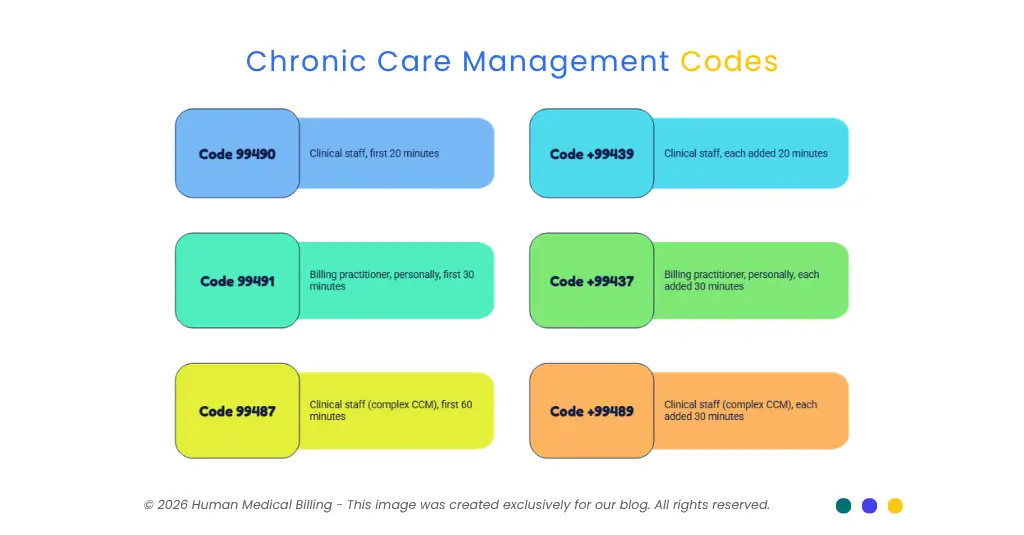
Complex CCM is billed based on moderate or higher levels of medical decision making by the billing physician. Staff are only counted for their time when they work directly under the billing physicians' direct supervision. When the billing physician uses his/her own time for either 99490, 99439, or both; the billing physician can bill for 99491.
The CMS considers all clinical staff to be "general supervising" therefore no requirement exists for the billing physician to physically sit next to the staff. Document your documentation of the billing physician's supervisory direction in the charts anyway. Auditors will have a very difficult time seeing you having an auditable hallway conversation.
Watch these concurrent billing limits before each claim goes out:
- Both Standard CCM and Complex CCM cannot be submitted with the same Patient on the Same Month.
- CCM is prohibited from occurring during a date range containing one of G0181/G0182/CPT codes 90951 thru 90970.
- The minutes used to bill CCM cannot also be counted towards the billing of another code.
- Simultaneously either Remote Physiological Monitoring (RPM) or Remote Therapeutic Monitoring (RTM) can occur while CCM is being performed; however, neither RPM nor RTM can occur at the same time as CCM.
The use of a Time Log allows Coders to detect errors in Code Selection before it occurs. Medical Coding Services will assist coders to detect these errors prior to submitting claims.
What This Means for Patients and Payers
(Patient liability is subject to the cost-sharing requirements of CCM. The Centers for Medicare & Medicaid Services (CMS) wants you to advise the beneficiary about their potential costs prior to sending out your invoice. Some patients may also be covered by Medigap, which may help with those costs. A 2019 audit conducted by the Office of Inspector General (OIG) determined that the OIG had overbilled the Medicare program anywhere from $6.38 per day (based on a daily rate of $15.80) up to $5,806.25 per week ($173,495 in total for the year) on its claim denials due to cost sharing.)
The CCM Service may only be billed once by each Practitioner to an individual Patient within a single calendar month. Duplicate billing can cause problems. Of the 14,078 duplicate claims submitted as part of this review, totaling $436,877 in overpayment, represented claims that were billed to the same Patient and during the same time frame.
You should inform the patient that they are able to terminate CCM service at any point, but that termination will not take effect until the last day of the current calendar month. This right should also be documented in the consent form. Also document whether or not another practice has already billed CCM for that particular patient. If duplicate claims continue to appear in your denial management system, consider using denial management services to identify when the duplication began occurring.
What Should Your Practice Do Now?
The next step is to start with a sampling of CCM charts and run them through all the items on this checklist. For a strong chronic care management (CCM) billing strategy to work, there should be at least one dated entry behind every item listed below.
CCM Documentation Checklist
- Record the patient's two or more qualifying conditions; confirm the 12 month expectations; record the level of risk of the patient.
- Confirm an initial visit was documented for every new patient and every patient who had not been seen by you in the last 12 months; confirm CCM was discussed during that initial visit.
- Document the patient’s consent for CCM: document their understanding of what services will be available under CCM; document any shared costs associated with CCM; document which billing provider will be responsible for CCM for that patient for that month; document how the patient can opt-out of CCM if they so desire; document whether the patient wants to participate in CCM.
- Develop an electronic comprehensive care plan for the patient; update it as necessary; disseminate it within your organization and outside of your organization to other involved providers.
- Verify that the patient has 24 hour a day / 7 days a week access to a clinician or trained clinical support personnel for urgent issues.
- Log each activity with the date; name of the individual performing the service/task; type of service/task performed; amount of time spent in minutes. An audit would not find anything to review from a single total monthly log.
- Only include billing provider or clinical support personnel time.
- Screen each submitted claim using these same concurrent billing limitations.
Here is the bottom line: a compliant CCM chart tells the whole story without anyone explaining it.
Frequently Asked Questions
The Office of Inspector General (OIG) is to review Medicare Part B CCM claims for payment that may have met the "multiple chronic conditions" requirements; it announced this audit on March 16, 2026.
The OIG has estimated completion of the audit by Fiscal Year 2028.
CPT code 99490 covers the first twenty (20) minutes of clinical staff time per calendar month; add 99439 for each additional twenty (20) minutes.
Yes. Obtain consent (written or verbally) prior to billing and document this process. A patient only needs to give one time consent for CCM services as long as they continue to see the same CCM practitioner.
CMS offers an APCM Bundle that can be billed monthly via codes G0556-G0558. The payment of the bundle does not include any additional charge based on the number of minutes spent. Medicare will pay level 2 if the patient has two or more chronic conditions. However, as noted above, you should review all the requirements prior to using these codes.
OIG announces audit - not verdict; rules remain the same. Auditors will be reviewing your CCM records much closer than in previous audits. Review the CCM's for one of your patients this month by using the check list i provided. We provide billing services to medical providers that allows them to have another pair of eyes on their coding and documentation before an auditor takes a look.

Contact Human Medical Billing to schedule a compliance readiness review or learn more about our end-to-end billing and regulatory support services.