
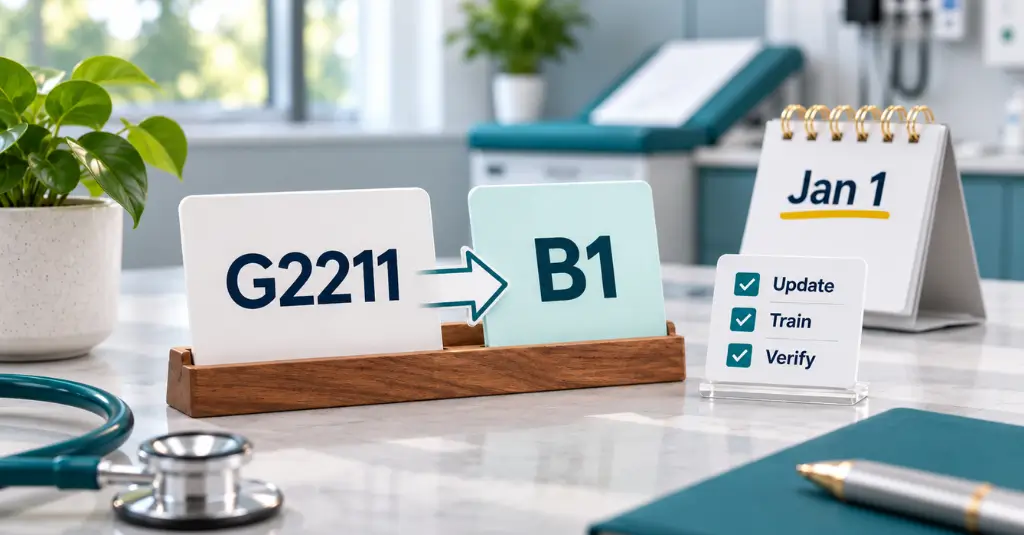


On November 4, 2026, CMS published the final rule for the Medicare Physician Fee Schedule for CY 2027. A modifier that is attached to the E/M code itself takes the place of HCPCS code G2211. The regulation takes effect on or after January 1, 2027.
This is important for planning because the payment will not disappear. The way you report it is different, and before the new year, all practices that have been billing G2211 must update their charge master and EHR.
Here is what CMS finalized, what B1 pays compared with G2211, what the final rule says on the open billing questions, and what to check before January 1.
Quick Answer
- G2211 becomes Modifier B1, which is appended to the corresponding E/M base code and increases its payment by 16%.
- When using Modifier B2 on an E/M service, there will be an additional 32% adjustment paid to the practitioner. Eligibility is limited to practitioners in a Shared Savings Program ACO and Participant Providers in a Long-term Enhanced ACO Design (LEAD) Model ACO.
- Increases are based on percentages versus dollar amounts. CMS says this keeps an equal percentage increase across all E/M levels.
- Use of Modifier B2 is optional. Claims can include billing for all beneficiaries served by a participating ACO participant or provider (not just those assigned to the ACO), and these B2 claims will count toward the ACO's spending calculations.
- CMS finalized the changes as proposed. The placeholder names MOD1 and MOD2 are now called B1 and B2.
- G2211 is not payable on a 2027 date of service. Report B1 or B2 on the E/M line instead. G2211 will still need to be reported for the 2026 date of service that is submitted for billing after January 1.
- The conversion factor is also decreased under the same rule. For qualifying APM participant, it is now $32.95 and for non-qualifying APM clinician, it is $32.63.
The Final Rule at a Glance
| Item | Final CY 2027 policy | What the practice should know |
|---|---|---|
| G2211 | Transitions to a modifier | Stops being a separate add-on line |
| Modifier B1 | +16% of the associated E/M code | The standard replacement |
| Modifier B2 | +32% of the associated E/M code | Shared Savings Program ACO and LEAD Model participants only |
| Rule release | November 4, 2026 | CMS fact sheet and press release |
| Effective date | On or after January 1, 2027 | Plan your system change before then |
| Conversion factor (non-QP) | $32.63, down $0.77 (2.31%) from $33.40 | Applies to clinicians who are not QPs |
| Conversion factor (QP) | $32.95, down $0.62 (1.83%) from $33.57 | Applies to qualifying APM participants |
| Same-day E/M and 0-day global procedure | Second service paid at 80% | Narrower than CMS's 50% proposal. Applies only when a modifier 25 E/M and a 0-day global procedure are billed the same day by the same physician, or a same-specialty physician in the group. Different-specialty visits in the group aren't reduced. |
What CMS Finalized for G2211
In the CY 2021 fee schedule final rule, CMS established a separate payment for the office/outpatient E/M visit complexity add-on, G2211. Medicare started funding it on January 1, 2024, after Congress postponed it in the Consolidated Appropriations Act of 2021. When the same-day service was an annual wellness visit, a vaccine administration, or another Part B preventive service in 2025, CMS permitted it on visits billed with modifier 25.
CMS completed the two suggested changes for CY 2027:
- G2211 becomes a modifier appended to the corresponding E/M base code. It was finalized by CMS as modifier B1.
- In some ACOs, a second modifier, B2, acknowledges additional expenses for clinicians.
The placeholder names MOD1 and MOD2 were used in the proposed rule. They are referred to as B1 and B2 in the final rule.
According to CMS, the switch to a percentage will result in "more streamlined billing" that is simpler for beneficiaries to comprehend.
Why “Gone” Means “Converted”
As its own line on the claim, G2211 disappears. The concept of payment does not. Instead of using a flat add-on, B1 pays for the same longitudinal care using a percentage of the E/M code.
The add-on scales with the visit level because B1 is 16% of the E/M payment. Under B1, there is $16 for every $100 base E/M payment. Whether the visit was a level 2 or level 5, a flat G2211 paid the same amount.
When Can You Use B1?
B1 is used in exactly the same situations as G2211. The practitioner must be the patient's continuing focal point for all necessary care, or they must provide ongoing care for a single serious or complex condition. It applies to home or residential E/M codes, including telehealth visits, and office/outpatient E/M codes (99202 to 99205, 99211 to 99215). It is not paid separately to RHCs and FQHCs.
What B1 Pays Compared with G2211
G2211 paid about $17.37 per visit nationwide in 2026, regardless of the degree of the visit. B1 increases the E/M payout by 16% in 2027. That is roughly $9.24 for a 99212, $14.72 for a 99213, $20.99 for a 99214, and $29.34 for a 99215 at national non-facility rates. B1 only pays more than G2211 for visits totaling more than roughly $108, or 99214 and 99215. In 2027, practices that primarily billed G2211 on 99212 and 99213 visits will see a decrease. Verify your local rates in your MAC's 2027 fee schedule, as they are national values prior to geographic modification.
B1 vs. B2: Which Modifier Applies
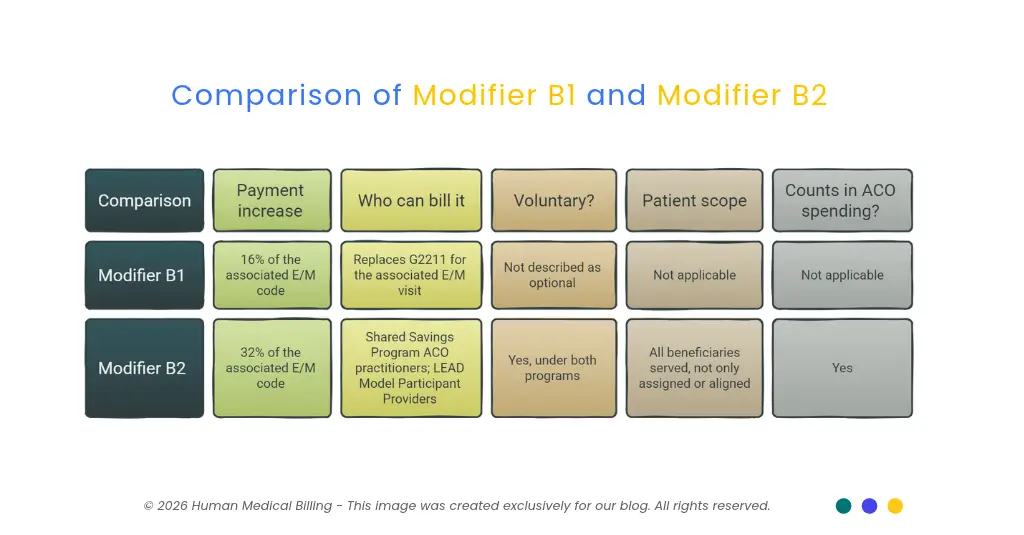
| Comparison | Modifier B1 | Modifier B2 |
|---|---|---|
| Payment increase | 16% of the associated E/M code | 32% of the associated E/M code |
| Who can bill it | Replaces G2211 for the associated E/M visit | Shared Savings Program ACO practitioners; LEAD Model Participant Providers |
| Voluntary? | Not described as optional | Yes, under both programs |
| Patient scope | Not applicable | All beneficiaries served, not only assigned or aligned |
| Counts in ACO spending? | Not applicable | Yes |
Why B2 Counts Against the ACO
CMS states that B2 claims are included in beneficiary assignment calculations, historical benchmark expenditures, and performance year expenditures for both the Shared Savings Program and the LEAD Model. Before the practice bills B2 revenue generally, ACO leadership should ask how it will interact with benchmark and shared savings estimates. We are not providing a monetary estimate of that effect, and the fact sheet does not include one.
What the Final Rule Says
| Question | Answer |
|---|---|
| Is G2211 replaced by a modifier? | Yes: B1, appended to the E/M base code |
| What are the payment rates? | B1: 16%. B2: 32% |
| Who qualifies for B2? | Shared Savings Program ACO practitioners; LEAD Model Participant Providers |
| G2211 on a 2027 date of service | Not payable. Use B1 (or B2) on the E/M line instead. |
| 2026 date of service billed after January 1 | Keep billing G2211. The change follows the date of service, not the billing date. |
| New documentation requirements | None. B1 uses the same clinical criteria as G2211. |
| Modifier 25 | The same limit carries over. B1 and B2 are not payable on a modifier 25 visit unless the same-day service is an annual wellness visit, a vaccine administration or another Part B preventive service, including the Initial Preventive Physical Exam. |
The Payment Backdrop: Base Rates Fall in 2027
B1 arrives in a year when the conversion factor declines. The qualifying APM conversion factor is $32.95, which is expected to drop from $33.57 by $0.62 (1.83%). The non-qualifying APM factor has decreased from $33.40 to $32.63, a decrease of $0.77 (2.31%).
A statutory update of +0.75% (qualifying) and +0.25% (non-qualifying), an expected −0.12% adjustment for work RVU adjustments, and the termination of the one-year 2.50% raise Congress approved for 2026 are the main sources of the drop. According to CMS, the present statute essentially calls for a 2.50% drop when compared to CY 2026.
B1 won't feel like a rise for a lot of practices. While the underlying rate declines, the longitudinal care payment is maintained.
A Related Change That Touches the Same Visits
CMS will pay the most costly treatment at 100% and the other at 80% when a separately identifiable office/outpatient E/M visit is billed on the same day as a 0-day global procedure. CMS eased this from its proposal, which would have reached 10- and 90-day global procedures and compensated the second service at 50%.
Only when an E/M billed with modifier 25 occurs on the same day as a 0-day global treatment performed by the same doctor or a doctor in the same specialty within the same group is the payment reduction applicable. Visits by doctors of different specialties in the same group on the same day are not reduced.
Examine such claims right away if your practice invoices G2211 in addition to same-day procedures. Both changes affect the same visits.
Who This Affects
Providers. Updated charge master entries, EHR rules, and claim scrubber logic are required for every practice billing G2211. B1 and B2 have no work RVUs of their own, whereas G2211 has 0.33 work RVUs. ACO participants must also determine if and when to use B2. Before January, organizations that base physician compensation on wRVU production should examine their formulas.
Patients. According to the CMS press release, authorized ACOs may lower or do away with Part B cost-sharing for a variety of goods and services for assigned beneficiaries beginning on April 1, 2027.
Payers. B1 and B2 are Medicare fee schedule policies. Check the written policy of any other payer before making any changes to how you charge them.
What Your Practice Should Do Before January 1
Billing and systems:
- Find every place G2211 lives: charge master, EHR order sets, superbills, claim scrubber rules, and auto-attach logic.
- Create date-of-service logic: B1 or B2 for dates of service in 2027; G2211 for dates of service in 2026, including claims billed after January 1.
- Find out if your EHR vendor supports modifiers B1 and B2 in its 2027 release.
- Prevent the sending of G2211 on service dates in 2027. It cannot be paid.
- Check visits billed with modifier 25: B1 and B2 are only payable on them if the same-day service is a Part B preventive service, an annual wellness visit or a vaccination.
Compliance:
- Keep documenting longitudinal care as required by your compliance policy. There are no additional documentation requirements because B1 employs the same clinical criteria as G2211.
- Before using B2, confirm your participation in LEAD or the Shared Savings Program. There is a risk to compliance if it is billed without eligibility.
ACO participants:
- Ask your ACO about the impact of B2 on shared savings and benchmarks.
- Choose a standard B2 policy for your medical staff.
After go-live:
- Review January and February remittances for unexpected rejections or denials tied to G2211, B1, or B2.
- Track payer-by-payer acceptance of the new modifiers.
Frequently Asked Questions
Modifier B1: In order to increase its payment by 16%, CMS finalized G2211 as a modifier appended to the corresponding E/M base code.
16% of the E/M code is paid by B1. Only ACO practitioners in the Shared Savings Program and LEAD Model Participant Providers are eligible for B2, which pays 32%.
No. CMS describes B2 as voluntary under both programs.
Yes. B2 can be billed for all beneficiaries the participant or provider serves, not only assigned or aligned ones.
The final rule is effective on or after January 1, 2027.
Not payable. Use B1 (or B2) on the E/M line instead.
Keep billing G2211. Changes are based upon date of service, not date billed.
None. B1 uses the same clinical criteria as G2211.
Only when the same-day service is an annual wellness visit, a vaccine administration or another Part B preventive service, including the Initial Preventive Physical Exam.
A Final Check Before January 1
The G2211 modification has actual payment implications and is a reporting change. B1 takes the longitudinal care payment and maintains that as a percent. B2 adds a higher rate for ACO clinicians, with consequences for ACO spending. Simultaneously, there will be reductions in same-day visit payments, and the conversion factor will decline.
Finding the location of G2211 in your systems and verifying your eligibility for B2 are the practical priorities.
Human Medical Billing can assist your practice with accounts receivable, medical billing for Medicare, including changes to the way your practice bills Medicare for services provided, and denials. Not sure how to update your charge master and EHR templates before January 1? Talk to our team.
Related reading: G2211 Billing Guide 2026: Modifier 25 and 2027 Proposal · 2027 Medicare Physician Fee Schedule: What It Cuts
Sources:
- CMS, Calendar Year (CY) 2027 Medicare Physician Fee Schedule Final Rule (fact sheet), November 4, 2026: https://www.cms.gov/newsroom/fact-sheets/calendar-year-cy-2027-medicare-physician-fee-schedule-final-rule
- CMS press release, November 4, 2026: https://www.cms.gov/newsroom/press-releases/cms-finalizes-cy-2027-physician-fee-schedule-shift-sick-care-healthcare-curb-waste
- Federal Register final rule: https://www.federalregister.gov/d/2026-22743 (Published in the Federal Register November 9, 2026)

Contact Human Medical Billing to schedule a compliance readiness review or learn more about our end-to-end billing and regulatory support services.