



The modification of payment with modifier 25 is also being discussed in regard to 2027. The CY 2027 Physician Fee Schedule Proposed Rule (CMS-1848-P) proposes that CMS will pay all services billed by a physician on the same day as either a global procedure (0, 10, or 90 days) with a modifier 25 E/M visit at 100% of the total value of the bill. All other services billed on the same day as an E/M visit with a modifier 25 will be paid at 50% of their respective values. This is a proposal, not current Medicare policy, and the comment period closed September 14, 2026. Here is what the proposal says, who it hits hardest, and what your billing team can do now.
Quick Answer
- CMS is proposing a pay rate for the highest paid same-day service (i.e., those services listed in the top tier) be paid at 100% of the allowed amount; all other same-day services would be paid at 50% of the allowed amount.
- CMS will cover separately identifiable office/outpatient Evaluation & Management (E/M) visit(s) billed with modifier 25 appended to 0-, 10- or 90-day global surgical/procedural claims.
- Nothing changes regarding same-day E/M coverage until 2027.
How Modifier 25 Works Today
Modifier 25 indicates to Medicare that the same physician performed an additional, separately identifiable Evaluation & Management (E/M) service on the same date as the medical/surgical procedure. Global Surgery rules bundle typical pre- and post-operative care associated with each surgical/procedure code into one single payment for the surgery/procedure itself.
Therefore, if you are going to get paid for both a same-day E/M service and a surgical/procedure code, then you need to append the modifier to the E/M service claim and have documentation in your patient's chart that shows there was a separate evaluation by you for a different reason than the reason for the procedure. If this does not occur, then your claim will likely receive a denial and may also be subject to audit.
Let’s break down the three global periods:
- 0-Day: minor procedures & endoscopies. Only the day of the procedure is covered by this package.
- 10-Day: Other minor procedures. This package includes both the day of the procedure and ten (10) days thereafter.
- 90-Day: Major Surgery. Includes three (3) separate time periods; one (1) calendar day prior to the date of service, the date of service itself, and ninety (90) days postoperative.
For an operative procedure billed as 90-Day Post-Operative Care, Modifier 57 is used to indicate that a visit led to the decision for surgery. Do not confuse modifiers 25 & 57 when filing claims.
The Modifier 25 Payment Reduction CMS Proposed for 2027
Here is the proposal at a glance:
- Who: The same doctor or one practicing with the same group of doctors.
- What: An outpatient / office E/M billed as separate from (on the same date) as a 0-, 10- or 90- day "global" procedure.
- Pay: The most costly procedure on the day will be paid at 100% and all procedures and/or E/M services performed on that date will receive an additional 50%.
Why is CMS trying to do this? According to CMS, the E/M services are already part of the "global" package for E/M services, therefore an E/M service that is separately reported using modifier 25 will most likely overlap/duplicate payments.
The 50% value is consistent with what was proposed by CMS during CY 2019 as well as their long standing Multiple Procedure Payment Reduction (MPPR).
Will all same-day E/Ms be reduced under the proposal? Not at all. CMS states they would pay in full the highest paid service, and the lower paid service would then be reduced by 50%, which could potentially be the procedure.
To better understand how this proposal may affect individual practices we need to use some hypothetical numbers that have no relation to actual Medicare fees. Let's say a procedure has a maximum allowable fee of $150.00 and an E/M service provided with a modifier 25 also has a maximum allowable fee of $100.00. Prior to the proposal, you collected $250.00 total from these two services. Under the new proposal, if the E/M service is payable through modifier 25, you would collect $200.00 ($150 + $50) since the E/M service has been reduced to 50% of its original allowable. Conversely, if the procedure had been the more expensive service, it would have paid in full, and the E/M service would have taken the 50%.
It is difficult to predict exactly how much loss will occur at a specific practice level due to the varying allowable amounts for different codes as well as the local economy where services are performed. Therefore, do not attempt to calculate practice level losses based upon estimates of changes; utilize your own claims data.
| Item | Current rule | Proposed for 2027 (not final) |
|---|---|---|
| Same-day E/M with minor procedure | Paid in full when modifier 25 is supported | Highest-paid service at 100%, others at 50% |
| Claim identification | Modifier 25 on the E/M | Modifier 25 on the E/M |
| Documentation | Separately identifiable work | No new standard proposed |
| Status | In effect | Comment period closed Sept. 14, 2026 |
Impact on Providers and Billing Teams
The proposed regulation suggests that otolaryngology, dermatology, and podiatry will be impacted the most negatively. Physician assistants, hand surgeons, and colon/rectal surgeons will experience less of an impact. Model the potential modifier 25 payment decrease as soon as possible if you practice in one of these specialties.
You are likely to experience this decrease in reimbursement sooner if you frequently treat a new problem with a minor procedure during the same patient encounter. Below are examples of common, repetitive visits. As always, whether or not a given example represents a valid claim under this policy ultimately will depend upon the specific information contained within the claim's supporting medical records and the use of modifier by the physician at the time he/she submits his/her claim.
- Dermatologist: the physician assesses and documents separately identifiable (e.g., chronically managed) skin conditions; later biopsies a completely different lesion during the same office visit.
- Otolaryngologist: the physician addresses a new complaint and performs a simple ear procedure on the same date.
CMS did not suggest any changes to current guidelines for documenting separately identifiable services when using modifier 25. Therefore, your notes continue to need to reflect separately identifiable services.
Medicare vs. Commercial Payers
The proposal is for Medicare. But don't think that commercial insurance companies are going to follow. There could be some that watch what CMS does at the end as they consider it.
Track your Medicare and your commercial claims separately so you can see which portion of your Modifier 25 volume is impacted by this proposal. One practice has a high percentage of their patients on commercial insurance and would have a very different exposure than another practice with the majority of patients being Medicare. You won't know the extent of the impact for either until you track them separately.
What Should Your Practice Do Now?
What does this mean for your practice? Know your numbers (and cms will too) before cms starts acting. The bottom line:
Pull the data, correct your notes, and continue to code based on what is documented in the patient's chart.
Next Steps
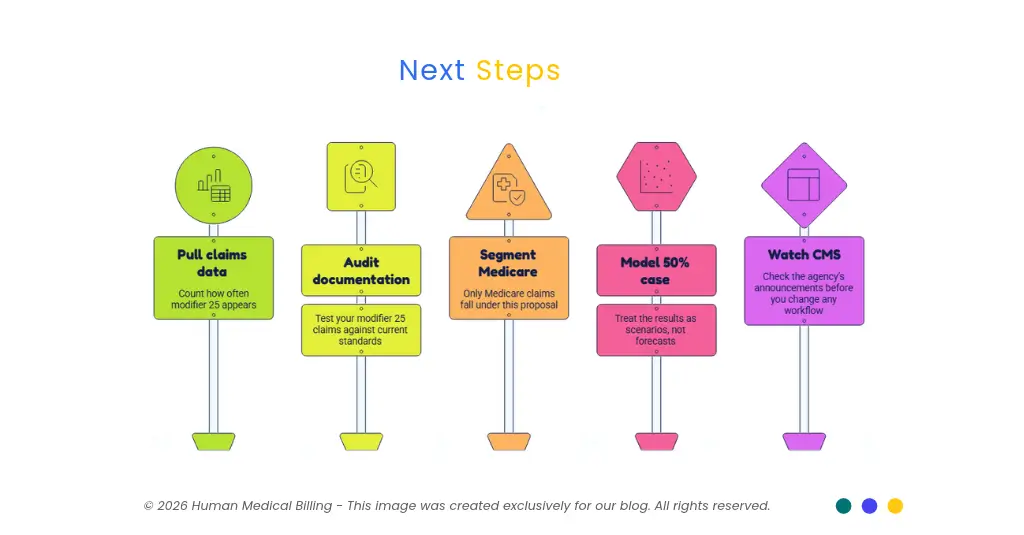
- Pull all of your claims data. Determine how many times modifier 25 appears when combined with 0-, 10-, and 90-day global procedures by payer, provider and code. Look up each code’s global indicator using the Medicare Physician Fee Schedule lookup tool.
- Audit your documentation. Compare your use of modifier 25 to current standards; have a certified coder or medical coding services team assess where you are weak.
- Segment Medicare from commercial claims. Only medicare claims are included in the proposed policy.
- Model the 50% scenario. Use these results as "what ifs" rather than predictions.
- Monitor cms. Wait until cms announces changes before making any changes to workflows — the policy could still be changed.
Mistakes to Avoid
- finalizing the proposed policy as current policy.
- cutting an equal percentage from all same day e/m services; reducing lower paid service rates.
- reporting a supportable claim without modifier 25 to avert reduction; report what is in record to support the claim.
- using modifier 25 when modifier 57 should be used.
Coding follows the documented service, not the payment outcome. That rule holds whether CMS finalizes 50% or drops the idea.
Frequently Asked Questions
No. The 50% reduction is a proposal for CY 2027 PFS Proposed Rule that has yet to be approved by CMS.
No. The proposed 50% reduction will only apply to those separately billable E/M services (office/outpatient) that are reported with Modifier 25 on the same date of service as a 0-, 10- or 90-day global procedure, provided by the same physician or group.
No. The highest cost service gets 100% and all others will get 50%. This can sometimes be the procedure.
No. Use it as long as there are adequate supporting documents in your chart.
As of today, the modifier 25 payment cut back may be modified by CMS before it goes into effect, or it may go away just like the 2019 version. It would make sense to understand your current charges. Human Medical Billing provides coding, claim submission and denial management for many medical billing clients, therefore your same day claims will receive attention. If you believe this proposal may impact your claims; please contact us.

Contact Human Medical Billing to schedule a compliance readiness review or learn more about our end-to-end billing and regulatory support services.