



Planning for podiatry Medicare reimbursements in 2027 has taken a serious turn. The American Podiatric Medical Association (APMA) formally submitted their comments regarding this issue to the Centers for Medicare & Medicaid Services (CMS) on September 14, 2026. APMA estimates that if CMS adopts its proposed changes to the calendar year 2027 Medicare Physician Fee Schedule as currently written, total podiatric Medicare payments will be reduced by approximately six percent. This number was provided by APMA, not by CMS. While CMS has issued a proposed rule, no action has been finalized at this time.
Podiatry billing personnel have one major area of concern: the proposed fifty percent reduction in physician payments for "same day" services billed using modifier 25. Prior to the issuance of the final regulation, all podiatrists should begin reviewing their current billing patterns. As such, it would also be prudent to begin running reports.
Quick Answer
- CY 2027 Proposed Rule Could Cut Podiatric Medicare Payments By Approximately Six Percent Overall
- That’s based on an APMA estimate; it’s not a finding made by CMS.
- The largest part of that estimate comes from a proposed 50% payment reduction to be applied to same-day Evaluation/Management (E/M) services when billed with Modifier 25 along with a procedure.
- Public comments were accepted until September 14, 2026. The Final Rule typically follows shortly thereafter in early November prior to the January 1st effective date for Podiatry Practices.
- Timely collection of data regarding each practice’s same-day E/M and procedures will allow them to determine how much money they may lose as soon as possible after the rule takes effect.
What CMS Actually Proposed
Proposal not final rule: the information listed above represents the proposed rule for cy 2027 medicare physician fee schedule which was published by cms on july 14th, 2026. Comments were accepted until september 14th, 2026. A final rule will be issued sometime in 2026. It is common practice that cms may make changes to the proposed rule prior to the issuance of a final rule.
CMS will offer another set of conversion factors for 2027 -- one for clinicians who are participating in some form of an Alternative Payment Model (APM) that qualifies them as such, and one for all others. The non-qualifying conversion factor would be reduced from $33.5875 to approximately $33.03, or approximately 1.68 percent. This provides a general idea on what you can expect with this years conversions. Podiatry had a four percent increase in payments for 2026 due to a combination of the conversion factor increase in the previous budget law and other changes. In contrast, the 2027 proposed changes move in the exact opposite direction. It is this portion of the 2027 proposals regarding Modifier 25 where APMA has its greatest opposition.
What's New: The Modifier 25 Same-Day Payment Cut
The mechanism is as follows. For physicians who bill for an office visit (E/M), and perform a procedure with a global period of 0, 10 or 90 days on the same date, report this service using modifier 25;CMS has historically paid these two services almost their total billed charges. In the proposed CY 2027 changes, CMS will make some adjustment to this process. First, they will determine which of the two services had the higher charge amount. Then, CMS will pay that service at its usual charge amount, but CMS will pay all other services billed on that date, including the E/M visit, at half of their charged amounts.
Current Rule vs. Proposed Rule
| Current | Proposed | |
|---|---|---|
| Same-day E/M + procedure | E/M with Modifier 25 pays near its full rate alongside the procedure | Only the highest-paid service that day gets full payment |
| Everything else billed that day | Paid at or near full rate | Cut to 50 percent, including the E/M visit |
| Applies to | Same-day E/M visits with any procedure | Office/outpatient E/M billed same day with a zero-, 10-, or 90-day global procedure, same physician or group |
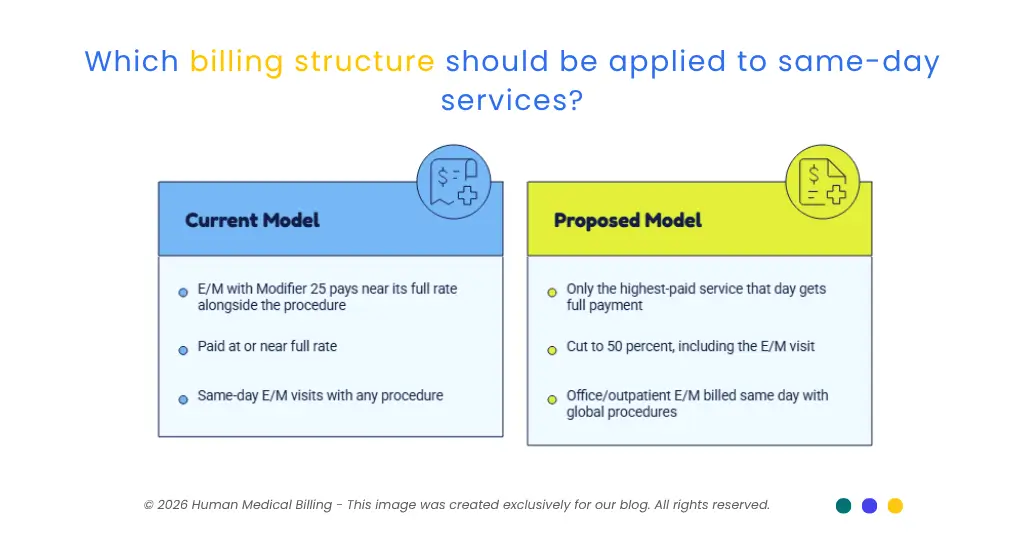
CMS states that the existing configuration will count E/M services twice because the services are included within the payment of the related procedures. The American Podiatric Medical Association (APMA) disagrees with CMS' position stating the reduction in service was made arbitrarily, and does not support its reduction from 100% to 50% based upon "any" statistical data.
Why This Lands Hard on Podiatry Billing Teams
The reason why Podiatry billing teams are affected by this policy is due to high levels of same-day care; the majority of Podiatric patients have a same day evaluation and treatment. For example, when a diabetic foot wound patient comes into see their podiatrist, they get evaluated as well as the wound debrided, so that podiatrist can evaluate another area or condition. The above scenario is common in the field of Podiatry, because many patients come in for a procedure (nail removal) and need to be evaluated for some other condition. Therefore, the exact pattern targeted in the proposed rules is one of an Evaluation and Management (E/M) service provided for a new problem or symptom in addition to a procedure done on the same day as a previous service for a different issue.
The area of Podiatry Medicare Reimbursement Planning for Billing Managers to most closely monitor is that component. The use of modifier 25 is common in podiatry as it is an integral way to provide and bill for services. Therefore, podiatrists will be hit disproportionately hard by a 50% reduction in the E/M portion of this combination compared with specialists where E/M and procedure services are performed less frequently at the same visit.
Other Issues APMA Flagged in Its Comments
Beginning with Modifier 25 as the most visible of all the areas that APMA addressed, billing staff will also need to be aware of additional items referenced by APMA as well.
1. Practice Expense Methodology
The way CMS will calculate non-labor costs associated with operating a practice is being changed; this has implications for payments related to the cost of performing procedures (beyond modifier 25) and other services.
2. Global Surgical Services
This multi-year review by CMS of what is included in global surgical service periods may have significant impacts on the payments made for post-operative visits.
3. Code Valuation
The method used to determine the value of new and revised CPT Codes is changing continually and includes the current request for information by CMS regarding the valuation process.
4. Skin Substitutes
The payment policies for skin substitute products are continuing to evolve as evidenced by recent final rules changes issued for 2026.
5. Remote Monitoring
Some proposed updates to remote therapeutic and physiologic monitoring codes utilized by some podiatric offices for wound care follow up.
6. MIPS Requirements
Modifications to MIPS reporting categories and metrics, while part of the overall CY 2027 cuts, are also included within the same CY 2027 Final Rule.
All of the above do not include a specific dollar amount at this time. While APMA expressed concerns about each one, in their comment letter they provided no estimated dollars as was done for the Modifier 25.
What Should Your Practice Do Now?
There are no final rules to fix; however, you may be able to prepare your podiatry Medicare reimbursement data prior to the adoption of the new rules. This section explains where you need to begin preparing your data for podiatry Medicare reimbursement 2027.
- Gather reports of all same-day E/M and procedures performed. Determine how frequently your office uses Modifier 25 when billing an E/M service and a procedure on the same date of service for each provider and for each CPT code.
- Determine how many same-day E/M services have global periods of 0 days (zero), 10 days, and 90 days. Since these are the only three global periods targeted in the proposal, this information should be reviewed as part of your preparation.
- Do not reduce charges by fifty percent based upon the proposed regulation. The proposed regulation has not been adopted into law, and applying the reduction to your projected income will provide you with incorrect information.
- Review the final regulation. The final Medicare Physician Fee Schedule Regulation is typically published in November of each year with the reductions becoming effective January 1 of the next year.
- Coordinate with your billing company. Reviewing coding prior to the publication of the final regulation provides you with adequate time to alter documentation and workflow in case the reduction in modifier 25 is implemented.
Frequently Asked Questions
No. This represents APMA’s estimates of the total reduction amount from both the CY 2027 proposed rule if the proposed changes are included in the final rule. CMS has made no announcement regarding these numbers; the rules may be changed prior to being finalized.
Modifier 25 alerts a payer that an additional, separately identifiable evaluation & management (E/M) service occurred during the course of one day with the procedure. If the CY 2027 proposal becomes effective, only the highest value services will be paid at 100%, while all other services performed in conjunction with that procedure, which includes E/M visits, will be reduced by 50%.
The CMS deadline for comments was September 14, 2026. Typically, CMS publishes its final Medicare physician fee schedule by November of each year. The new payment rates will become effective on January 1 of the subsequent year.
No. The six percent estimated loss is an average calculation of the total losses among all podiatric physicians; it is not a certain amount of money lost by each podiatric physician or practice. Ultimately, the actual effect depends upon the volume of same-day Modifier 25 billing a specific practice performs as well as other elements within the proposed regulations such as the conversion factor and coding values.
What happens in the next few months is important to your podiatry practice’s 2027 plan for Medicare reimbursement of podiatric services. By the time CMS makes its final decision regarding whether to implement the proposed reduction (cut) of Modifier 25 use, reduce the proposed cut, or completely drop the proposed cut; practices who have already determined what their same day billing practices are, will be prepared regardless of which direction CMS takes.
At Human Medical Billing we work with podiatry practices in all areas of coder accuracy and in the tracking of payer policies to ensure that your billing team will be prepared when a final rule becomes effective. For an idea of how your podiatry practice uses Modifier 25 in comparison to this proposal, a Podiatry Billing & Medicare Readiness Review would be a great place to start prior to CMS making its final ruling.

Contact Human Medical Billing to schedule a compliance readiness review or learn more about our end-to-end billing and regulatory support services.