



The 2027 Medicare Open Enrollment will be open for selection from October 15th of 2026 to December 7th of 2026. Most changes selected during this enrollment period will become effective January 1st. That means that the changes a returning patient selects will land directly at the front desk and billing office of your practice. Your registration staff may not notice the new coverage a patient has chosen (new plan, new provider network, new requirements for referrals and/or authorizations) until they receive the new Medicare card.
This guide does not cover information about selecting plans for patients. It will instead detail what your practice needs to check prior to January as well as after January regarding Medicare eligiblity denials based upon new enrollments and provide ways to preclude unnecessary denials if your practice bills in-house or uses an outside medical billing service.
Quick Answer: Why Should a Medical Practice Care About Open Enrollment?
In January, patients may be able to select a different Medicare Advantage plan than they had in previous months (plan identifiers have changed), and also possibly a different network, possible referrals and authorizations as well. If your practice is using cards from prior years you could experience denied claims and/or delayed service. Every patient needs their active plan verified at each January visit to verify coverage, exact plan name, exact network, whether referrals are required and what type(s) of authorizations are required.
- The Medicare Open Enrollment period will run from October 15th through December 7th, 2026.
- Most selected changes will go into effect on January 1st, 2027.
- Verify all information regarding coverage, the exact plan name, exact network, if referrals are necessary and what types of authorizations are needed before the January visits.
- Closely watch the first couple of weeks in January for early denial patterns.
Open Enrollment Dates for 2027
| Date | What it means for practices |
|---|---|
| October 15, 2026 | Medicare Open Enrollment begins |
| December 7, 2026 | Medicare Open Enrollment ends |
| January 1, 2027 | Selected coverage changes generally take effect |
Please do not confuse when you are able to enroll for a new plan year versus when the coverage actually starts (effective date). It is usually during the fall months that patients make their selections. However, it may be late January/early February before your practice will see those changes on the claims side of things.
This gap provides you with what I refer to as "runway." The Medicare Open Enrollment period for 2027 typically runs for approximately eleven weeks prior to the start of the new plan year. This allows your eligibility team and billing staff enough time to review and modify all applicable processes; train front desk personnel on the process; and implement a system of tracking denied claims so they can prepare for the potential denials from the first patient who comes into your office in January. Any practice that does not begin preparing by the time the first claim is rejected is likely to have already fallen behind at least one month prior to receiving the initial denial.
What Can Change From One Plan Year to the Next?
Changes in Medicare benefits, cost of care, and provider networks occur yearly. The time frame that allows for changing plans is called "Open Enrollment" and does not imply all patients will choose to do so. As a result, even if you read an individual’s prior year medical record you still have no way to determine which patients changed their insurance during this enrollment period. Additionally, changes in network participation may affect your ability to provide services to your patients without notice. Therefore, network participation is especially important as it dictates whether or not your practice accepts the plan your patient has selected.
On September 28th CMS provided additional information regarding market dynamics, including its projections for weighted average MA premium levels. According to CMS, these projected premium levels are expected to decrease from $14.37 in 2026 to $12.00 in 2027 representing a 16.5 percent reduction. Please note that CMS’ projections are based upon average premium levels; therefore CMS’ projections cannot be used to project how patients will respond. Likewise, CMS’ projections will not eliminate the need for your organization to verify whether a patient has selected a particular plan.
Why January Creates RCM Risk
Even if you run the same routine as your staff did in December for this new plan year, there could be issues that arise from a different patient. The items below are things to look at.
1. Outdated Cards:
The patient brings in their old ID Card and/ or old information.
2. Eligible Assumptions:
A returning patients' eligibility is assumed to be the same as the previous years.
3. Plan Id Changes:
Although the name of the plan remains the same, it is possible the Product ID has changed.
4. Patient Network Status:
It is also possible that your office does not participate in the Patient's specific plan or product.
5. Authorization Rules / Referrals:
The requirements for referrals and authorizations may vary from one plan to another.
One wrong payer or Plan entry at registration can lead to denials, delayed payments and incorrect patient balances. Then bills are remade by billing staff. The final word is that an entry made by a front desk will become a chore to be completed by a biller.
Same Carrier Does Not Mean Same Plan
While a patient may continue to use the same insurance company, they could end up in a new Medicare advantage product. This may impact network providers, referrals, prior authorizations, identification of plans/products, costs and what services are covered. Every Plan/product offered by an insurance company does differ; however, without reviewing each Plan/product, you cannot determine how much difference there is.
Just because it says the name of the insurance company on the eligibility data does not mean all necessary information about the specific Plan has been provided. Determine the exact Plan or product through eligibility verification and verify your participation in that specific Plan or product. Will you get paid for participating in every product sold by your contracted Carrier? No. While you have a contract with your Carrier, this does not automatically include all products that the Carrier sells.
What Should Your Practice Do Before January 1?
These are HMB operational recommendations, not CMS requirements.
Seven RCM Checks to Complete
- Instead of relying solely on past data verify if Medicare coverage is valid for each provider visit scheduled in January.
- Make sure to get the actual Medicare Advantage Plan Product Name and Number (not just the Insurance Company Name) to be able to check network providers.
- Re-Verify Network Providers for this new Medicare Advantage Plan.
- Verify Referral Requirements to see if they have changed from what was required when the appointment was made.
- Verify Prior Authorization Requirements. Last years are not always the same as this years.
- Update your Payer/Plan Information in both your Practice Management Software (PM) & Electronic Health Record (EHR), to prevent staff members from using old incorrect information.
- Create a "January Denial Dashboard" which will allow you to track denials by the above categories: Eligibility, Plan ID, Network, Referral, Auth., Member Info, Patient Responsibility.
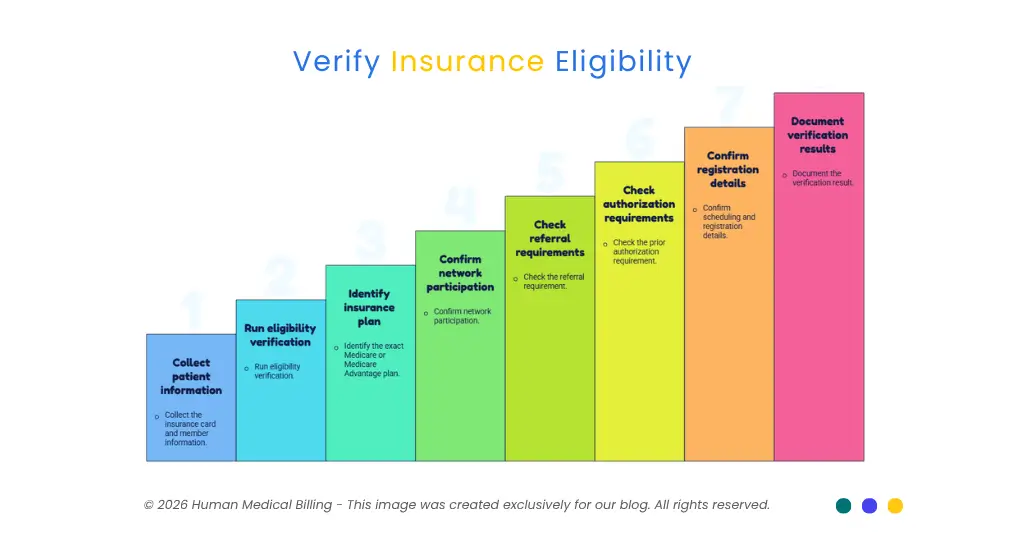
January Front-Desk Workflow
Who is Eligible for This? Your Eligibility Team (with an additional Billing Manager who will review your work each week).<br>Please keep it to one-page:
- 1. Collect the Insurance Card Member Information
- 2. Run Eligibility Verification
- 3. Identify the Exact Medicare or Medicare Advantage Plan
- 4. Confirm Network Participation
- 5. Check Referral Requirement
- 6. Check Prior Authorization Requirements
- 7. Confirm Scheduling and Registration Details
- 8. Document the Result of Verification
What if a step fails? Resolve it before the visit when you can, and note what happened.
What to Track in the First Two Weeks of January
Early warning signs are often found in the first couple of weeks. While all January denials may be associated with Open Enrollment, you will see recurring patterns per plan/payer that can lead to changes to workflows. When a pattern is identified send it to who ever manages your denial process so when they make changes, those changes impact both the registration area as well as the appeal area.
| Metric | What to monitor | Why it matters |
|---|---|---|
| Eligibility failures | Invalid or changed coverage | Shows verification gaps |
| Plan identification errors | Wrong payer or product | Prevents claim routing problems |
| Network issues | Out-of-network responses | Flags plan-specific participation gaps |
| Referral denials | Missing or invalid referrals | Shows workflow gaps |
| Authorization denials | Missing or wrong PA | Flags plan-specific requirements |
| Member information errors | Incorrect IDs or details | Cuts avoidable rejections |
| Patient responsibility variance | Unexpected balances | Flags coverage or benefit changes |
Frequently Asked Questions
The Medicare 2027 enrollment period is from Oct. 15, 2026 – Dec. 7, 2026. All other changes made during this time are usually effective as of Jan. 1, 2027.
Instead of using last year’s information, build an efficient and dependable system to complete necessary eligibility checks by the first week of January. If someone has changed plans (or their family members have) it may be difficult to determine which plans they have now. A simple eligibility check can cost much less than having to recreate a denied claim.
Yes. The same insurance provider can sell multiple types of policies and/or plans. Therefore, make sure to identify the specific policy or product being offered by the insurance provider prior to making treatment decisions based upon that policy.
Not always. As previously stated, there may be risks regarding the accuracy of eligibility, identifying the correct plan, verifying if the physician/supplier is part of the network, referral/authorization requirements and registering for participation in the plan. Track how many of your January appointments result in denials to see trends in your office.
Medicare Open Enrollment 2027 is in place for you to test your processes by January. Human Medical Billing can assist medical offices with Medicare Eligibility, Medicare Advantage billing and Denial Prevention. Do you need someone else to look over an eligibility Verification Workflow? Payer-Plan Record Clean-up? Claims Review in January? Contact us and we will walk through all options. Begin by doing the 7 checks listed above; do this as soon as possible but prior to December 7th so there is space in your schedule.

Contact Human Medical Billing to schedule a compliance readiness review or learn more about our end-to-end billing and regulatory support services.