



If you are seeing quicker turnaround times with your billing team for prior authorization decision approvals from last year, then that is no accident. On Jan. 1, the CMS prior authorization rule for 2026 was enacted as part of the CMS Interoperability and Prior Authorization Final Rule (CMS-0057-F).
The Medicare Advantage Plans, Medicaid and CHIP Fee-for Service Programs, Medicaid and CHIP Managed Care Plans, and all Qualified Health Plan Issuers selling on the Federal Exchange will need to respond to Expedited Requests within 72 hours; Standard Requests in 7 Calendar Days; and provide an actual reason for denial.
Here’s what changed, which patients/clients were impacted by these changes, and what you can do today regarding this issue.
Quick Answer
- Most affected payers will be required to make decisions about standard prior authorization requests by January 1, 2026 (seven calendar days) and for expedited requests within seventy-two hours.
- Qualified health plan issuers who sell their plans through the federal exchange have been exempted from this time frame as they will continue to use the fifteen day standard established in an earlier federal regulation.
- Payers also must provide a specific reason for each denied request and do so via any communication method available such as; portal, fax, e-mail, mail or phone.
- The larger technical piece which is the FHIR-based Prior Authorization API does not take place until January 1, 2027. This has its own set of rules.
Why CMS Built This Rule
In its second part of the recent two-part push for healthcare interoperability, CMS released CMS-0057-F on January 17, 2024. That is not to say the issue being addressed by this regulation is not long-standing; many practices have experienced delayed processing of prior authorizations in one form or another over the past decade. These delays are typically due to requests being submitted via fax machine and/or via phone where the caller waits for their call to be answered versus via an electronic submission.
CMS has indicated that it developed the 2024 CAQH Index’s findings (that approximately 35% of medical prior authorizations were processed electronically) contributed to the delay experience reported by billing staff. CMS’s development of this regulation was intended to impose a time limit upon payers’ decision-making processes related to prior authorization requests and ensure that providers receive a response from a payer if a request is denied.
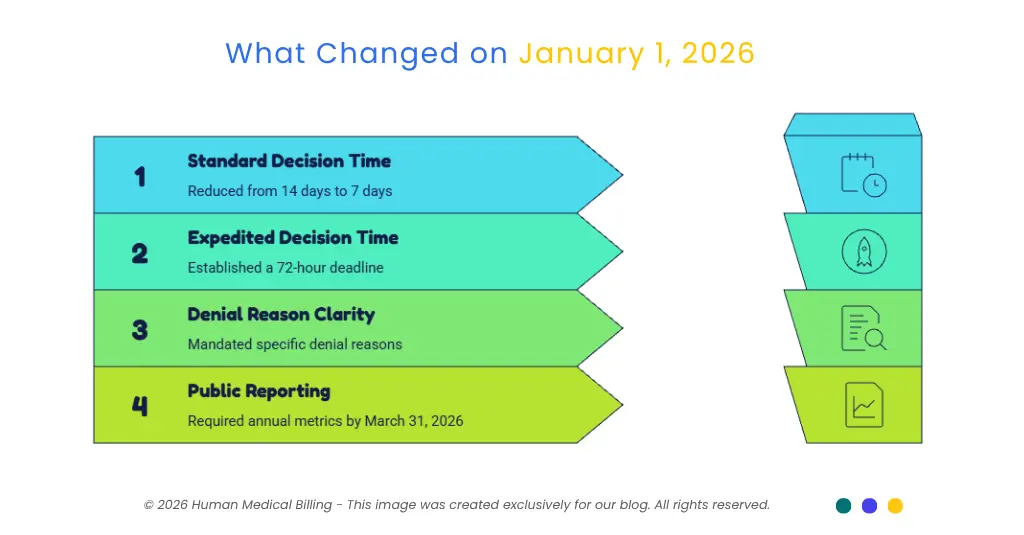
What Changed on January 1, 2026
| What | Before 2026 | Now |
|---|---|---|
| Standard decision time | Up to 14 days in many plans | 7 calendar days |
| Expedited decision time | No consistent federal deadline | 72 hours |
| Denial reason | Often vague or generic | A specific reason, required |
| Public reporting | Not required | Annual metrics posted on payer websites, first set due March 31, 2026 |
The timeline for the technology related to the rule, which includes the Prior Authorization API, Provider Access API, and Payer-to-Payer API, is independent of the other items listed above, and is due by January 1, 2027; therefore, it would be best to track independently from this years’ checklist.
What This Means for Billing Teams
A "faster" timeline does little good unless someone in your billing staff is looking at it. If a payer misses a 72 hour or 7 day window, no magic occurs - somebody needs to notice, document, and contact them.
That begins with a simple log: date received, whether the request is standard or expedited, who made the payment, and date on which the decision was made. After collecting a couple of months’ worth of this information, there are going to be some obvious trends that come out of it.
For example, some payers have consistently taken advantage of their option to get as close to the due date as possible. And other payers have missed those deadlines altogether.
Requiring denial reasons for your appeal process also affects how you manage denials. A prior denial letter may have said ‘not medically necessary’ but had no explanation. Now that it has to explain, it provides your denial management service staff with some solid material to use when they’re trying to determine what documentation was missing initially.
What about Patients and Payers?
The patient is going to be the first to notice the advantage of having an expedited determination made. By having the decision made quicker, patients will spend less time being held-up for treatment or medications; by having a clearer explanation for a denial, patients will know clearly where they need to go from there.
The Payer has new public scrutiny as well. As the yearly rate of approvals and denials becomes available on each payers website, those payers who have higher denial rates or take longer to make determinations will have those statistics out in the open. Those practices that keep their own statistics will now have some negotiating power when dealing with contracts, or escalating disputes with payers, because they will now have quantifiable evidence of their performance prior to this regulation.
What Should Your Practice Do Now?
- Begin a tracking sheet immediately. Document all prior authorization requests in detail including the type of request, submission date and decision date. Prior to documenting, you will have no base-line information to establish if the payer has met the time limit to deny an authorization.
- Train both the front desk staff and prior authorization staff on the denial reason rule. Staff needs to be trained to identify any denials received from payers without specific reasons and escalates these issues.
- Perform a reconciliation of prior authorization data versus claims each month. Compare approved authorizations with the claims submitted using those approvals. Any gaps identified may indicate potential write-off opportunities.
- Identify QHP carve-outs. Federal exchange plans are subject to different rules regarding the 72 hour and 7 day limits. Determine which of your payers are subject to this carve-out.
- Prepare your documentation for 2027 as soon as possible. Although the FHIR API requirement is 12 months away, developing the necessary processes now will help avoid scrambling at a future date.
Frequently Asked Questions
The prior auth rule (the "operational" portion) was part of CMS-0057-F. Payers subject to the prior auth rule have to respond to all standard requests within seven business/Cal days and to expedited requests with-in seventy-two hours; they must provide a specific reason(s) for denying each request.
No. The 72 hour and 7 day rules apply to Medicare Advantage Plans, Medicaid and CHIP Fee-for-Service Plans, and Medicaid and CHIP Managed Care Plans. QHP issuers participating in the federal exchange are exempted from these time lines and will be required to respond to requests for prior authorizations in fifteen business/Cal days.
Although there is no "penalty" automatically applied for being late with the decision-making process; however, the payer will be required to post its metrics publicly each year (and may attract more scrutiny from CMS), should it experience repeated missed deadlines; therefore, practices should keep documentation of all missed deadlines, and utilize those missed deadlines in communications with the payers during the escalation process.
The new rules regarding the timeline for making decisions on prior authorization requests, and the explanations for denials are covered by the 2026 rule. The 2027 rule will require that all payers have built-out fhir based api’s (prior authorization api) to enable electronic exchange of requests and responses for prior authorization; although these two compliance dates are similar in nature, they represent distinct requirements.
If your office is still manually keeping track of prior authorization decisions using either a common spreadsheet that no one keeps updated, or just by memory, then this will be the year things catch-up with you. Tracking in the form of workflow integration to monitor denial appeals (as opposed to relying on payer compliance) are part of what Human Medical Billing does as an alternative to manual tracking of prior authorizations.
If you would like us to assist in developing a system that truly enforces these new timeframes set by the government and insurance carriers, contact us and we can outline how this process would work for your medical billing company.

Contact Human Medical Billing to schedule a compliance readiness review or learn more about our end-to-end billing and regulatory support services.