
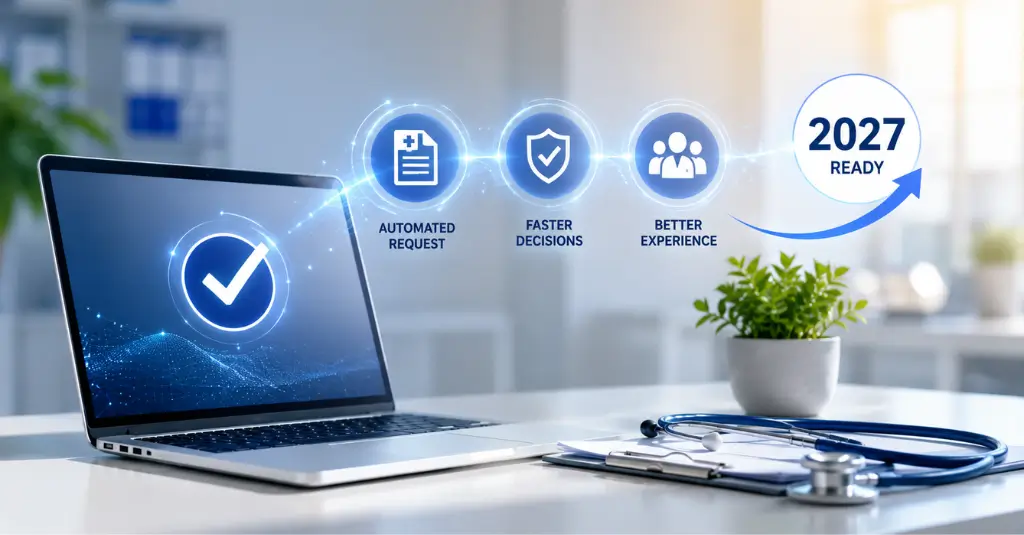


Beginning with the announcement by CMS of 29 healthcare organizations as "Early Adopters" under the Electronic Prior Authorization Acceleration Initiative, the organization is working on a cross-sector collaboration model involving a combination of health systems, EHR developers, physician practices, and digital-health companies to identify workflow challenges and technology issues that will need to be resolved before the electronic prior authorization requirements take effect in January 2027.
This represents an important step toward transitioning away from manual fax or portal-based systems, and moving toward API enabled data exchanges using FHIR based standards.
- There are 29 organizations selected as early adopters by CMS which include the Cleveland Clinic, Epic, athenahealth, and Oracle; for advancing the process of electronic prior authorization.
- The focus is on integrating real world integration challenges prior to the 2027 deadline that will be required for all organizations to comply with.
- These organizations will be working to eliminate the need for manual processing for authorizing and creating an integrated workflow within their clinical systems.
- Payers such as UnitedHealthCare, Aetna, and Cigna have committed to this effort since June of 2024
What Is the Electronic Prior Authorization Acceleration Initiative?
The CMS initiated the Health Tech Ecosystem to fill that gap in order to translate technical feasibility into real-world practice. The CMS Interoperability and Prior Authorization final rule provided the necessary requirements for API-based exchange of healthcare data. This new program will determine how those capabilities work within real world clinical and administrative workflow.
This collaboration will comprise of 29 organizations across 4 different categories. The providers in this collaboration will be Bon Secours Mercy Health, Cleveland Clinic, Froedtert ThedaCare, Ochsner Health, Providence, Rush University System for Health, Sanford Health, and Tennessee Oncology. The EHR Developers in this partnership are athenahealth, eClinicalWorks, Epic, MEDITECH, Modernizing Medicine, Oracle, and TruBridge. The network partners that make up the b.well Connected Health, CommonWell, eHealth Exchange, and Kno2.
These organizations will be part of nine major health plans which signed a landmark pledge in June 2024. The nine major payers are Aetna, Blue Shield of California, Cambia Health Solutions, Cigna, Elevance Health, Highmark Blue Shield, Horizon Blue Cross Blue Shield of New Jersey, Humana, and UnitedHealthcare.
Why CMS Is Pushing Electronic Prior Authorization Now
Manual prior authorization processes result in significant financial burdens to the healthcare system. According to a 2023 AMA physician survey, physicians have completed an average of 41 prior authorization requests per week. Each request takes approximately 13 minutes for staff to process. This translates into almost 9 hours weekly that is spent on administrative tasks and not on caring for patients.
CMS Administrator Dr. Mehmet Oz stated that it is not enough for technology to be adopted by a few; the entire healthcare delivery system has to work as one to provide solutions for real world problems. By reducing the administrative burden and allowing physicians to spend their time with their patients, the Early Adopter Program is designed to improve the timely access to quality care.
January 1, 2027, deadline is based on the CMS Interoperability and Prior Authorization Final Rule. This regulation requires those specific impacted payers to support electronic prior authorization for medical items and services via a standardized format of API-enabled data exchange using FHIR. The regulation defines timelines by which impacted payers will be required to make decisions regarding authorizations as well as requiring impacted payers to report prior authorization metrics publicly.
What Early Adopters Will Actually Do
Participating organizations have to do more than test technology. Organizations are working at a system level to integrate electronic prior authorization (ePA) with both clinical and administrative systems that providers use each and every day. Therefore, they are creating workflows that will reduce or eliminate manual processing (i.e., faxing and/or submitting electronically through portals)
Here is how that looks in reality. Once a physician has ordered services that need to have prior authorization, those requests are sent electronically through the EHR using the standardized API's, which are then processed by the health plan via the same standardized format within defined timeframes, then send the decision made by the health plan back through that same electronic pathway. No phone calls. No faxes. No logging into separate portals.
Early adopter organizations will also be able to see a real time view of authorization status and decisions. The provider will get instant notification in their portal when an authorization is either approved, denied or pending additional information. This increased visibility for the billing team allows them to be able to follow up on claims that were denied due to missing or expired authorization much faster.
| Current Manual Process | Electronic Prior Authorization |
|---|---|
| Average 13 minutes per request | Automated submission through EHR |
| Phone, fax, or portal submission | API-enabled data exchange |
| Limited visibility into status | Real-time status updates |
| Inconsistent timeframes | Defined decision timeframes |
| High denial rates from gaps | Reduced errors through automation |
This shift will have a significant impact on the way that medical billing services teams operate day-to-day. Rather than having to spend time calling around to find out the status of an authorization or logging into portals, staff will be able to focus on denial management services and other revenue cycle-related priorities.
How This Affects Healthcare Providers and Billing Teams
Providers have the greatest opportunity to benefit from streamlined prior authorization. The current process is a manual process that can delay delivery of care, create friction for clinical staff and disrupts the revenue cycle due to expired authorizations and denied claims.
Rush University System for Health (one of the first to implement this) will be testing integration with their clinical workflow and payer system. Cleveland Clinic and Ochsner Health will also be doing the same. Neither Rush nor Cleveland Clinic/Ochsner are small pilot projects; they include thousands of physicians who see millions of patients every year.
Epic, athenahealth, and Oracle (as EHR vendors) are developing the technology for making it possible. The EHR vendor's support is important so that there isn't just something tacked on to your current system in the form of an "electronic prior authorization" workflow. Instead, these will be part of your clinical and administrative applications you utilize daily.
Billing staff using a healthcare revenue cycle management company can see the impact. Automated Prior Authorization reduces claims denied due to missing or expired authorizations. It reduces the amount of time it takes for you to get paid from when you delivered care. It also allows your employees to spend their time focused on difficult patients rather than being bogged down with administrative follow-ups.
Tennessee Oncology has a special significance because many cancer treatments require multiple approvals of imaging studies; treatments; and other specialized medications. Therefore, improving how these are approved could improve patient success with their treatment, speed up the process of approval which would help medical billing services including accounts receivable and in turn speed up how long it takes to get paid for claims once they have been submitted for reimbursement.
What Should Your Practice Do Now?
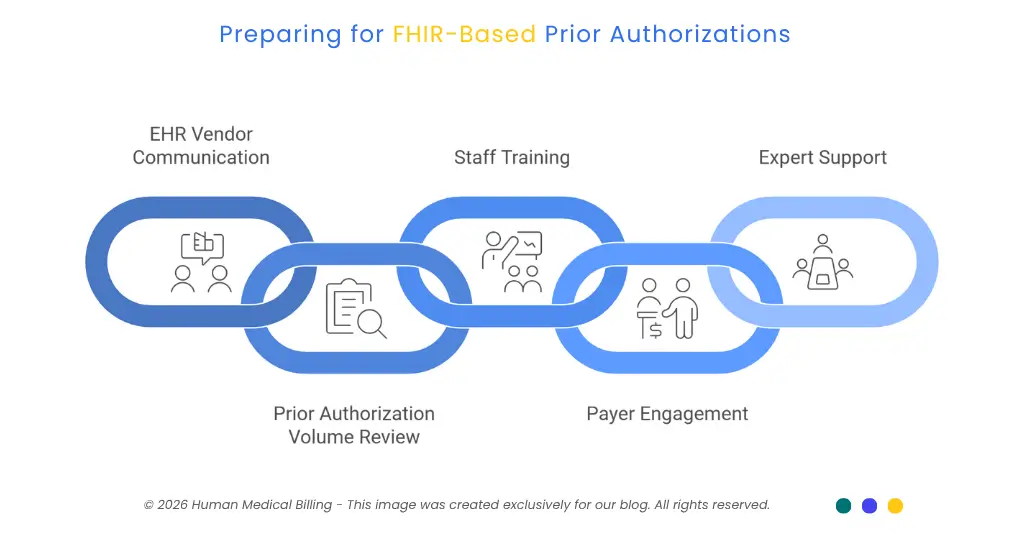
You do not need to wait until 2027 to prepare. Here is what billing teams and practice administrators can do right now.
1. Talk to Your EHR Vendor
Find out if your EHR vendor is one of those who are part of the early adopters or have a timeline for developing a FHIR based prior authorization API. If your vendor is an early adopter (athenahealth, eClinicalWorks, Epic, MEDITECH, Modernizing Medicine, Oracle or TruBridge), then they will be able to assist you with this new process.
2. Review Your Current Prior Authorization Volume
Determine what services currently require the most authorizations and from whom (payors) do you receive the largest volume of prior authorization requests. Establishing this baseline will allow you to assess the effectiveness of these changes with electronic systems in place.
3. Train Staff on What Is Coming
Your administrative and clinical staff will be impacted by how they perform prior authorizations. Begin developing education/training plans for staff regarding expected changes as soon as possible, to ensure your staff are prepared when your electronic health record system provides enhanced prior authorization functionality.
4. Engage With Your Payers
If you have a contract with Aetna, Cigna, UnitedHealthcare, Humana or another payer who has agreed to support this pledge (June 2024) then connect with your Provider relations representative. Inquire as to what their roll-out plan is and if they will be offering pilot programs or an opportunity for early access.
5. Consider Expert Support
Practices that do not have in-house expertise may consider engaging in partnerships with experts that specialize in medical credentialing and medical coding services to assist in navigating the changes and transition. Human Medical Billing is engaged to assist practices to improve their revenue cycle process (including prior authorizations), by utilizing AI based workflow automation that integrates with electronic health record systems.
Frequently Asked Questions
Electronic Prior Authorization utilizes an API based data exchange system in order to electronically transmit prior authorization requests, as well as receive and process decision information utilizing FHIR standards for all prior authorizations. It eliminates manual fax, phone, and portal-based submissions.
The CMS Final Rule on Interoperability & Prior Authorization will require all impacted payers to allow for the submission of an electronic prior authorization request by January 1st, 2027.
The rule applies to Medicare Advantage organizations, Medicaid managed care plans, CHIP managed care entities, and Qualified Health Plan issuers on the federal health insurance exchanges.
Automated submission through standardized APIs reduces errors, provides real-time status updates, and ensures authorizations are documented before services are delivered. This decreases denials related to missing or expired authorizations.
The Bottom Line
Although CMS is developing a set of technical specifications for electronic prior authorization (ePA), it also has the role of creating an ePA "ecosystem" that enables ePA to be operationalized in real-world environments. There are 29 early adopter organizations in this effort that collectively reflect all areas of the U.S. healthcare system; including large, multi-site health systems, EHR vendors, and various types of network participants.
The change of workflow for billing groups will change their workflow each day. This is due to less time spent on a phone call or faxing. Therefor there is more time available for prioritizing strategic revenue cycle issues. The providers have better decision making as it relates to patient care when they receive quicker decisions from the payer. The reduction in administrative cost for the payer are due to standardization of process.
The January 2027 timeline is closing in fast. Practices that begin preparing for this transition today will have a competitive advantage when workflow automation (workflow), claims denial rates are lower (denial rate) and financial performance improves (cash flow). Those that do nothing will likely find themselves trying to play catch-up as others improve their operations.
Human Medical Billing assists medical offices to transition into these changes by providing complete revenue cycle management services that work seamlessly with all the new electronic methods as they become available. Regardless of whether your office needs assistance with credentialing, coding or complete revenue cycle management, using people with knowledge of what you currently do and are planning for the future, may be the difference between having an easy transition and one that is very costly.
Contact Human Medical Billing to schedule a compliance readiness review or learn more about our end-to-end billing and regulatory support services.