



Slow Payers Create Cash Flow Headaches
The slow pace of payments by payers will delay how long it takes for a payment or deposit after a patient visit. Your staff feels the pain of delayed deposits first. Delayed payments are caused by two different things: payer delays, and internal billing process delays. Of all medical groups polled by MGMA Stat on July 28, 2026; 32% reported an increase in Days in Accounts Receivable (D/A/R) over the last year, while 43% stated D/A/R remained stable during the same time frame.
Even though some medical groups may report their D/A/R has remained constant they may be spending significantly more hours/week processing and addressing potential problems with their patients’ accounts. Below is what is causing these numbers and five ways your billing team can begin improving your collections today.
Quick Answer
- How many days it takes for a patient to pay their bill is called Days in A/R (Accounts Receivable) or Total Charges/ Average Daily Charges. This will tell you approximately when your patients are going to make payments on your account.
- A July 2026 MGMA survey showed that the response was split almost equally: 32 % indicated they had an increase; 43 % said there was no change; and 25% said there was a decrease.
- Some portion of this delay comes from the payers themselves due to delays in payment, denials, downcoding and/or record requests. In addition, prior authorizations have taken longer for 44% of the respondents.
- The quickest method to get an improvement in the time frames is to track the time frames for each type of payer as well as for the reasons for these delays. Then, use this information to reduce the time frame of those you can influence.
Why Days in A/R Matters in a Tight-Margin Year
The number of days a bill has been in accounts receivable (A/R) is determined by dividing the amount of total billed amounts for services provided into the average billing amount per day. Every day that goes by from when a claim was dated until it was paid will be an additional day in which you are unable to use the money generated by your medical practice, regardless of when payroll and rent payments occur because they do not rely on the timely resolution of claims.
This margin squeeze worsens this problem. The June 30th poll conducted by MGMA found 47% of higher revenue producing groups, and 36% of lower revenue producing groups, as well as most other groups, had increasing operational expenses.
Denials are adding up. According to a survey conducted by MGMA in January 2021, denials and appeals were the leading source of loss for nearly half (48%) of the polled healthcare executives. Only about one-fifth (23%) identified front-end issues. Staff will have to recreate the denied claims when they come back and each denied claim will start the clock again from the beginning and put the patient balance further into an older bucket. MGMA has reported that first submission denials averaged around 7-8 percent over the last four years. The MGMA 2025 Report indicates with focused process improvements this rate can be reduced to under five percent.
What Changed in 2026: Payer Delays and Prior Authorization
Leaders’ reactions to the Medicare Advantage prior authorization rule were mixed as well. While they welcomed the timeframes and reasoning behind denied claims, their perceptions on how quickly providers received answers was less positive. According to an MGMA poll conducted September 1, 44% of leaders indicated that the decision making process took longer in 2026 than in 2025. A total of 40 percent believed that there had been no change in turnaround times, while only 7% believed that the decision-making process was quicker.
The July poll did not indicate a decline in physician support, but rather demonstrated a divide among physicians based upon a poll of 203 physician respondents. Only 3% of all physician respondents indicated that they were “unsure” regarding their level of support for or opposition to prior authorization.
Here is why this is the case. The payer’s decision deadlines are limited to a single aspect of the workflow; your staff will be responsible for confirming whether authorization is needed, selecting the best method of delivery, gathering all necessary documentation, checking on the status of the application, waiting for peer-to-peer reviews etc. According to the MGMA 2026 Regulatory Burden report, 90% of the survey participants reported an increase in authorization burdens during the previous 12 months, and stated Medicare Advantage was the most difficult payer type to work with.
Identify another relevant date: January 1st, 2027 (when all impacted payers MUST have electronic Prior Authorization interfaces up and running). While electronic submission may reduce or eliminate portal login and re-keying requirements it does not alleviate delayed requests.
How Payer Delays Hit Your Billing Team
Both types of delay are present for some practices; both exist in practice. MGMA respondents identified both as sources of delay and based on these responses will determine where to expend effort. Respondents whose groups reported a reduction in days in accounts receivable indicated they made purposeful efforts rather than simply one quick solution (added staff, new billing leadership, enhanced denial management, quicker closure of notes and improved patient registration).
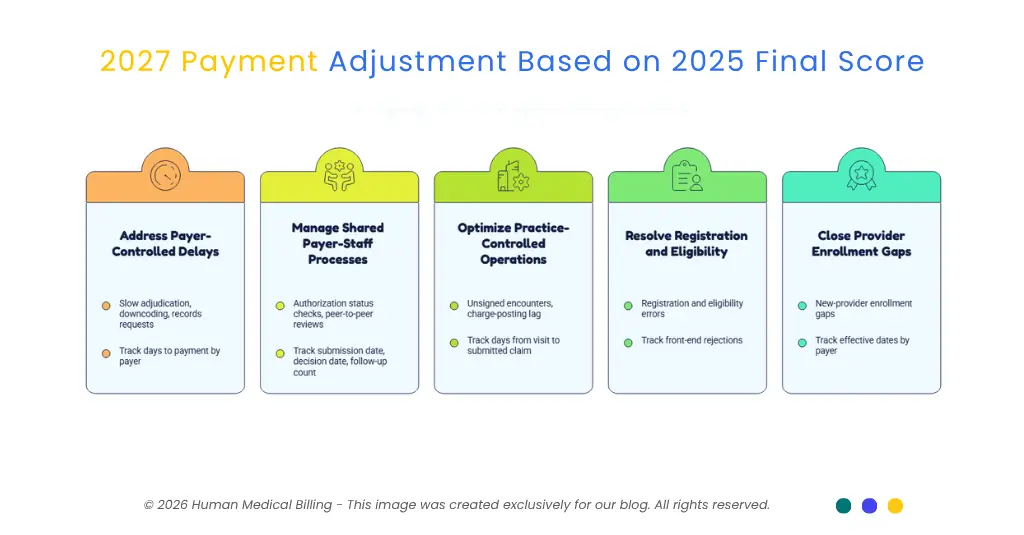
| Delay source | Who controls it | What to track |
|---|---|---|
| Slow adjudication, downcoding, records requests | Payer | Days to payment by payer |
| Authorization status checks, peer-to-peer reviews | Payer and staff | Submission date, decision date, follow-up count |
| Unsigned encounters, charge-posting lag | Practice | Days from visit to submitted claim |
| Registration and eligibility errors | Practice | Front-end rejections |
| New-provider enrollment gaps | Practice and payer | Effective dates by payer |
The staffing side of things also affects the picture. Billing vacancies, and difficulty finding people to replace experienced A/R personnel, as well as credentialing delays for new providers were some of the reasons respondents provided. This is one reason why medical credentialing services should be considered along with A/R. The delay of billing for one practice due to their system change reportedly took two months because of an issue on how the systems interfaced. Also, 61% of all practices reported to MGMA in March that they have at least 7 payers that employees need to access by logging into those payer’s websites every week.
What This Means for Patients
Two areas are where patients experience a “drag”. Delayed authorization for care may cause delay in treatment; delayed insurance payments will shift focus to how much money the patient owes. MGMA’s 2025 Financials & Operations report indicates that, in 2024, medical practices were able to collect approximately 72% of all copays at the point-of-service while collecting roughly 27% of all other amounts due from patients. Most of this will be transferred to statements, phone calls or placed into older accounts receivable (A/R) status.
Patient self-pay may also hide good performance by a physician. In one case an MGMA respondent was able to collect on their insured A/R within 28 days however, the collection on patient balance increased the practice’s average number to 32.
What Should Your Practice Do Now to Reduce Days in A/R?
Begin at home base, where the time delay is located. How are things going from week to week in terms of daily operations and activities? A simple series of checks done on an ongoing basis will get you there.
Five Steps to Take This Month
- Run A/R aging by payer. The big picture may be that there is money owed (a/r), but split reports by payer and plan, then bring these numbers into the discussion about contracts.
- Log every authorization. Keep track of who authorized what; when it was submitted and when it was decided; whether it was standard or expedited; any additional information requested; how many times the status check has been checked; peer to peer reviews; and appeals. If a Medicare advantage plan takes longer than 72 hours or 7 days to authorize a service, you now have documentation to move forward with the next step.
- Shorten the lag you control. Mgma states that clinicians should close out their patients’ encounters within 72 hours and office staff should submit their charges to insurance companies within 48 hours. Many practices experience this lag time of 3-7 business days.
- Work denials daily. Begin with high dollar claims and the nearest appeal deadline. Review your top 5 common denial codes to see if you can eliminate the reasons for them. In many cases, practices with limited personnel hire denial management services to ensure appeals do not go unprocessed.
- Collect at check-in. Provide front desk staff with a standardized method of explaining estimates and asking patients for payment responsibility amounts prior to leaving the practice. If follow up calls are still piling up after implementing a system of requesting payments at check-in, medical accounts receivable services can remove the follow up call queue from your team.
Frequently Asked Questions
Days in a/R is total accounts receivable (total ar) / average daily charges (adc). Days in a/R demonstrates how long it takes from when services are provided until payments are received.
Yes. According to the results of the july 28th mgma poll: 32% reported an increase; 43% reported no change; and 25% reported a decrease in Days in a/R.
As of january 1st, 2026, all impacted payers, as well as Medicare advantage organizations (mao), have been required to respond to expedited prior authorization requests within 72 hours and standard prior authorization requests within 7 calendar Days. Additionally, they were required to provide a clear explanation for each denied request.
Checking these reports will help determine if the delay is caused by you or the payer.
Don’t think that payers will begin moving faster in 2027 when the new API (Application Programming Interface) takes effect. While the 2027 API may help speed some things along – for now, at least – the real advantage comes from knowing specifically where every single one of those claims gets stuck. At Human Medical Billing, we work with medical billing offices to track the slow payments back to the specific payer, the authorization process or if there are posting habits creating issues. We’ll go over your aging by payer with you, so contact us today if your numbers are increasing but you cannot determine why.

Contact Human Medical Billing to schedule a compliance readiness review or learn more about our end-to-end billing and regulatory support services.