


Reports from the Office of Inspector General (HHS OIG) were published on June 11, 2026. These two reports provide data to support something that billing professionals have likely thought about. Prior authorizations denied by Medicare Advantage for skilled nursing, Long Term Acute Care (LTAC), and in-patient rehabilitation admissions are commonly overturned.
In reviewing 19 of the major Medicare Advantage organizations (MAO's), the reviewers determined that when patients appealed their denial of Skilled Nursing Facility (SNF) services, the MAO reversed approximately 95% of these appeals. This is NOT just an error. It indicates a large-scale failure within the Medicare Advantage system, which was only corrected after the patient or provider fought to appeal the decision.
Quick Answer
- May 2024; OIG examined information for prior authorization submitted by 19 Medicare Advantage Organizations (MAO) to review the number of post-acute care admission requests made in June 2024
- Denial rates for skilled nursing facility (SNF) admission requests were 12%, however the appeals overturned the denial 95% of the time
- The LTCH and IRF's also had similar patterns to SNFs as all three large Medicare Advantage Organizations (MAO) that denied access to these services did so at a much greater rate compared to other MAO's
- The total number of SNF denials was 18%, or less than one-fifth, of all denials; therefore, it appears that fewer than one fifth of denials are actually appealed.
What the OIG Actually Found
OIG published two reports that were each related to one type of health service (the first related to skilled nursing services; the second related to long term hospital and in-patient rehabilitation services). Each report used prior authorization data for June 2024 collected from the 19 biggest Medicare Advantage Organizations ("MAOs") operating in the U.S.
SNF-related issues received most of the attention with the 19 MAOs as a group denying approximately 12% of all SNF admission requests. However, denial rates among these plans were highly variable -- ranging from 23% down to 0.4%. In addition, when patients and/or their treating physicians appealed adverse decisions, the MAOs overturned approximately 95% of such appeals on behalf of the patient.
Approximately 50% of all SNF request activity was managed by an outside vendor named naviHealth. NaviHealth denied approximately 14% of the requests it reviewed which is higher than both the MAOs' own staffs and other vendors handling the same work.
What Changed for Billing Teams
In addition to the other ways that MAO practices and policies varied, the LTCH and IRF report also shows another way in which they vary. Three out of nineteen MAOs studied were among the top 5 MAOs in terms of enrollment size and all of them denied access to LTCHs and IRFs at higher percentages than almost every one else. Although it was difficult to identify patterns across MAOs based upon how they handled appeals, there were some overall trends. Collectively, MAOs overturned 36% of LTCH denials and 43% of IRF denials. One plan’s IRF overturn rate was 86%.
In practical terms, if your organization is experiencing large numbers of denials from certain MAOs, then you are not just "seeing things" or "making up a pattern." This pattern has been confirmed by the OIG. There are huge differences in the percentage of denials that occur from different MAOs and the success of an appeal can be much greater if the patient takes action to support their case.
Therefore, the decision on whether to take an appeal is no longer about simply whether a bill should have been approved. Rather, the question becomes whether it would be worth appealing because the chances of being successful may be significantly greater for certain types of cases depending upon the type of insurance coverage.
Impact on Patients and Facilities
In other words; the largest concern for everyone is that on average only 18% of appeals of SNF denials resulted in reimbursement to the hospital. Approximately one-third of IRF and LTCH denials result in an appeal. Thus, there exists a significant number of denial decisions which stand as final determinations regardless of medical necessity for the treatment rendered.
The individuals who do not have advocates (whether it be a discharge planner, a case manager, or a billing department that identifies potential denials and reviews them), will bear the loss of the gap. Many patients receive no post-acute care. Other patients pay for the post-acute care themselves, or they accept less post-acute care than prescribed by their doctor.
Denied admissions for Skilled Nursing Facilities and Rehab Hospitals also pose challenges. Denied admissions require alternative payer paths, discharges to other locations, or absorbing the costs of post-acute care already delivered until the appeal process has concluded.
What Should Your Practice Do Now?
Use the OIG data to give your billing team an argument in favor of aggressively pursuing appeals - especially those plans that have both a high rate of denial and also a high rate of overturned denials. Here’s how you can do that.
Steps to Take
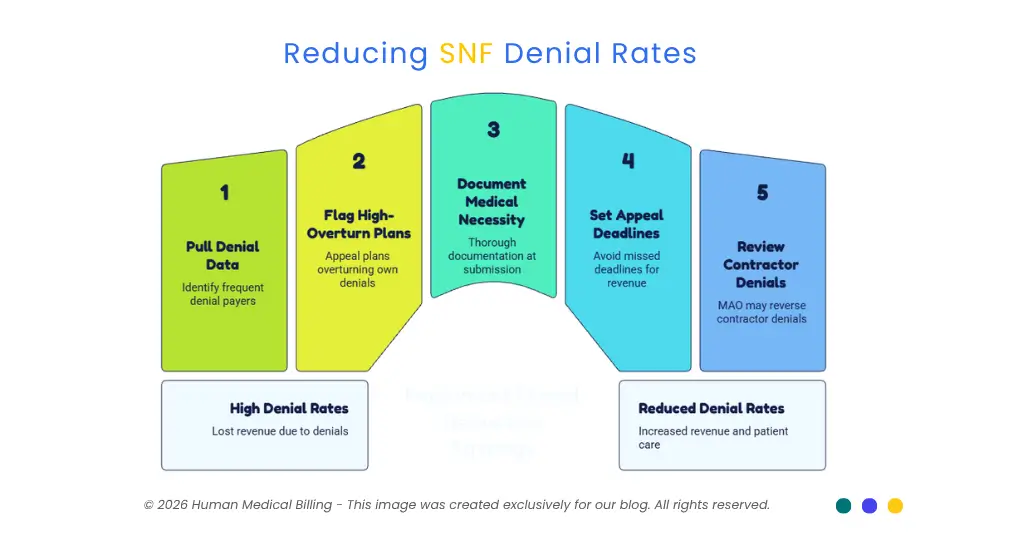
1. Pull denial data by payer.
Find out what medicare administrative organizations (mao) are denying SNF, ltch or IRF requests most frequently for your patient population.
2. Automatically Flag high-overturn plans for appeal.
Use the same logic when dealing with plans that overturn many of their own denied claims. If a particular plan is overturning a large number of its own denied claims then use this information as step #one. Do not accept their initial decision as final.
3. Document medical necessity thoroughly at submission.
In many cases, if all necessary clinical documentation was completed and submitted prior to the denial, the appeal process will be concluded sooner than later as a result.
4. Set a hard deadline for appeal decisions.
Since only such a small percentage of denials are actually appealed industry-wide; missed deadlines are one of the largest causes of lost revenue (not due to weak clinical cases).
5. Review contractor-driven denials separately.
Some denials issued by third-party contractors on behalf of an MAO were reversed by the MAO itself upon appeal; therefore they should be reviewed again prior to writing-off the claim.
A Denial Management Services Team can make this happen. They spend the time figuring out which plans deny more than others; how many of those denials get overturned on appeal; and which claims are worth taking the time to pursue.
Frequently Asked Questions
The Office of Inspector General reported that as a group, the 19 largest Medicare Advantage Organizations (MAOs), collectively, denied approximately 12% of all skilled nursing facility (SNF) admission requests in June 2024. The Office of Inspector General also reported that the individual Medicare Advantage Organization (MAO) denials rates ranged from 0.4% to 23%.
According to OIG, the 95% of appeals related to SNF admissions resulted in the denial being overturned. For Long-Term Care Hospital (LTCH) and Inpatient Rehabilitation Facility (IRF) admissions, the overturned rates were 36% and 43%, respectively; however, OIG reported some plans had overturned as much as 86% of IRF denials.
Although the June 2026 report does not provide a single explanation as to why only 18% of SNF denials were appealed, it appears many patients and smaller health care providers lack sufficient staff time and/or education/knowledge to contest a denial.
No. While the OIG data suggests a greater number of appeals should be pursued with those MAOs that have higher reversal rates, not every denial is worthy of appeal. Therefore, appeals will be prioritized based upon whether documentation deficiencies, rather than medical necessity issues, may have caused the original denial.
Every single medical billing practice and every single post acute care facility will benefit from examining their own denial trends as closely as OIG examined MAO trends in the industry. Human Medical Billing is working directly with SNF’s, IRF's, LTCH's, tracking denial patterns by payer and developing appeal strategies based on those plans that are most likely to have denials reversed. If you want an even better picture of what payers are denying and how many of them would be worth appealing, then we are offering a FREE DENIAL RECOVERY ASSESSMENT to help medical billing practices who can take action on the information. Get in touch with us today to get started.

Contact Human Medical Billing to schedule a compliance readiness review or learn more about our end-to-end billing and regulatory support services.