



Payer denials reached an all-time high in 2026 and medical billing denial prevention is working to prevent the denial from occurring in the first place as opposed to a provider having to pay a biller to pursue the denial. The issue at hand is that instead of focusing on being able to do appeals quicker, the focus needs to be placed on determining when, within the revenue cycle, does the claim break down. Eligibility checks, prior authorizations, documentation requirements, coding issues, claim edit failures and failed submissions each have its own failure point. Determine these failure points and identify who is responsible for each of them; denials become an operational issue which can then be solved rather than continuing to show up as a line item on your accounts receivable aging report.
Quick Answer
- The majority of denials are due to one of the following 8 check points; Eligibility, Demographics, Benefits, Prior Authorization, Documentation, Coding, Claim Edits or Payer Submission.
- As per AAPC’s Billing & Coding Research, Failure to Verify Insurance is still the number one reason claims are denied.
- Prior Authorization Denial Reasons Must be Provided by CMS; CMS was required to provide a specific reason for all prior authorizations denied as of 2026, through their final rules on Interoperability and Prior Authorization.
- By assigning One Accountable Department to each Check Point with a Tracked KPI, you can catch most of your mistakes before sending them to the payer.
Why Denials Keep Climbing
AAPC also has very clear coding and billing guidelines for insurance eligibility. Their primary reasons for denials from claims is the failure to verify an insured patients’ eligibility during each visit; therefore, front office personnel need to confirm eligibility for all patients at each visit. If front office staff do not check for eligibility or if they have checked too far in advance of the visit date and send claim(s) based upon coverage which does not exist at the time of service, this will result in a denial due to lack of current coverage.
The second major concern when sending claims through an insurance company for authorization is prior authorizations. The American Hospital Association (AHA) reported that almost 1/3 of the surveyed physicians stated that their prior authorization requests were either "often" or "always" denied. Additionally, over 90% of the physicians stated that prior authorization delayed their patients' ability to receive treatment. This delay in receiving treatment is then reflected in your denial log many weeks after the fact as a missing or incorrect authorization number.
Gaps in coding and documentation round out this picture. The denial management tools from AAPC show that certified coders who have claims bounced back see the two most frequent reasons for denials based on CARC codes CO-16 (missing/incomplete/incorrect information) and CO-50 (services do not meet medical necessity criteria of the payer), both of which could be prevented if the correct check-point were put into place prior to submitting a claim. This is exactly why health care revenue cycle services designed around upstream review can pay dividends.
What's Changed for 2026 and 2027
CMS’s Interoperability & Prior Authorization final rule mandates that health plan payers who are affected by this rule begin implementing certain operational rules as of 2026. The requirement for how quickly these health plans must respond to their members will be as follows; general “expedited” prior authorizations must receive a decision with-in seventy-two (72) hours, “standard” prior authorization requests must also receive a decision within seven (7) calendar days, and all denials of prior authorization requests must provide reasons why.
Health plans will have until generally the start date of January 1, 2027 to develop Application Programming Interface (“API”) systems to support the additional data exchange required under this rule.
Therefore, for your billing staff, this means that denial reasons provided by the payer will become much more detailed and much more consistent over the course of the next twelve months. That represents an opportunity. When a denial reason is provided in detail, it provides your billing staff with enough information to take action to possibly avoid receiving that same denial again in the future.
The 8 Revenue Cycle Checkpoints That Stop Denials Early
Here's how the failure points map to departments, controls, and the metric that tells you the control is working.
| Checkpoint | Likely Denial | Owner | Preventive Control | KPI to Track |
|---|---|---|---|---|
| Eligibility verification | Coverage terminated or inactive | Front desk | Real-time eligibility check at scheduling and again at check-in | Percent of claims verified within 24 hours of service |
| Patient demographics | CO-16, missing or mismatched data | Front desk | ID and insurance card scan at every visit, not just new patients | Demographic error rate on rejected claims |
| Benefits verification | Service not covered under the plan | Front desk or billing | Confirm plan-specific coverage, not just active status | Benefits-related denial rate |
| Prior authorization | No auth on file or auth mismatch | Prior auth team | Auth tracking tied to scheduled procedure codes, not just visit type | Percent of procedures with confirmed auth before date of service |
| Clinical documentation | CO-50, medical necessity not supported | Clinical and coding | Documentation template capturing medical necessity language for high-denial codes | Documentation-related denial rate |
| Medical coding | Incorrect code, missing modifier | Coding team | Second-look review on high-risk CPT and modifier combinations | Coding-related denial rate |
| Claim edits (scrubbing) | Payer-specific edit failure | Billing | Automated claim scrubbing before submission, including AI-assisted edit checks | First-pass clean claim rate |
| Payer submission and analytics | Timely filing or resubmission error | Billing management | Weekly denial trend review by CARC code and payer | Denial rate trend, month over month |
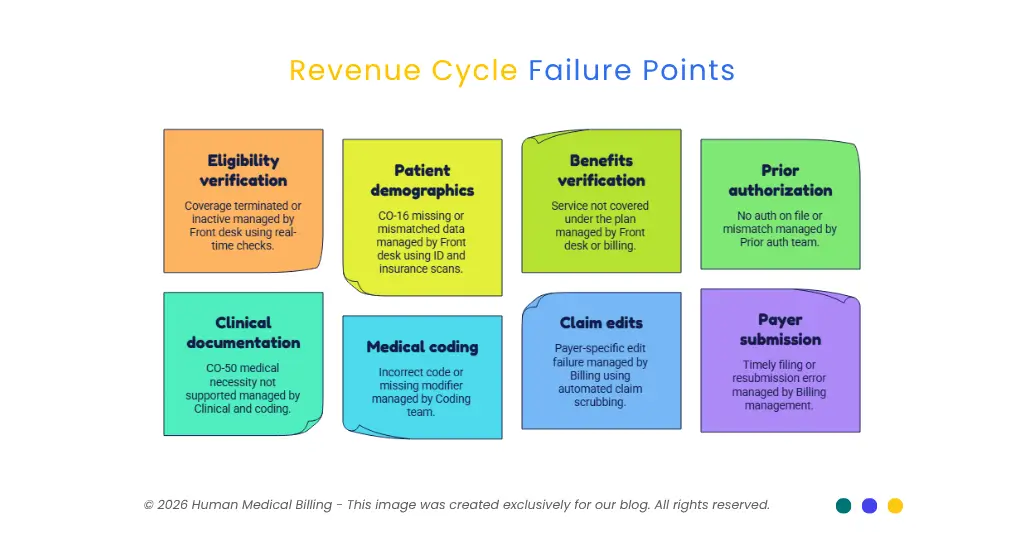
This table can be the backbone of your actual medical billing denial prevention strategy. Because this chart compels you to make decisions as to which party has control over every potential denial issue prior to the claim leaving your practice. The two that should receive additional focus would be coder reliability, because certified medical coding services provide value for money when there is a second pair of eyes reviewing modifier-heavy claims that your scheduler cannot detect. Claim scrubbing is also an area in which some medical billing offices are beginning to use artificial intelligence (AI) medical billing systems to help identify specific payer edits they may have missed by a person.
What This Means for Patients
Rejection doesn’t only hurt your business financially. According to a study conducted by The Commonwealth Fund, which was covered by AHA News, 1 in 5 privately insured adults have had a denied claim for medical care recommended by their doctor. Of those 41% stated that the denial caused a delay in receiving medical care and 28% stated that an underlying condition was exacerbated due to the denial. Additionally, less than 50% of those who were denied an appeal with the insurance company.
Prevention is better than an appeal. A rejection at the eligibility level will never be a delayed MRI or a patient giving up on treatment.
What Should Your Practice Do Now?
Begin with the most likely checkpoint for the fastest wins – typically it will be the first checkpoint at or near the main entrance.
- 1. Audit the previous ninety (90) days’ denials by CARC Code and organize them in order from Checkpoint One through Eight (8), not by Payer.
- 2. Designate an individual as the "owner" for each of the eight (8) checkpoints listed above; in a smaller office or practice, one person may cover two positions.
- 3. Incorporate a Same-Day Eligibility check into the patient’s scheduling process (not simply when they arrive on their scheduled date).
- 4. Create a standardized documentation template for your top five (5) denied CPT Codes.
- 5. Review your current denial trends on a weekly basis (versus monthly). It can take less money/time/cost to correct an issue that you identify during Week 1 rather than Month Three.
Frequently Asked Questions
Denial prevention is the process of eliminating errors in the claim processing cycle (eligibility, authorization, document, code and submit) prior to submitting claims to payers for reimbursement.
The number one reason for claim denials is failure to verify patient coverage with the payer prior to service delivery. The majority of this error occurs at the front desk rather than by coders.
In 2026, CMS (centers for medicare & medicaid services) will require payers to provide a specific reason for each prior authorization denial. This should allow for tracking and taking action based on denial trends across multiple locations within your practice.
No. While many small practices elect to complete all eight checkpoints internally, many small practices find it cost effective to contract third-party vendors for coding compliance, claim scrubbing and denial trend analysis.
Medical Billing Denial Prevention is not something you complete. Rather it is an ongoing series of checkpoints to monitor because changes occur within Payer Edits as well as Coding Rules on an annual basis. Human Medical Billing includes all eight of the Checkpoints in Client Workflows, along with Denial Management Services for those Claims that are denied despite all other steps. If you would like more details about how we can help you improve your work flow using any of the individual Checkpoint Steps, please visit the Human Medical Billing Xpert Billing Blog where we provide greater detail about each Step.

Contact Human Medical Billing to schedule a compliance readiness review or learn more about our end-to-end billing and regulatory support services.