


The FY 2027 ICD-10-CM coding system is now live. The FY 2027 ICD-10-CM coding system became effective as of October 1, 2026. Therefore, all Obstetrics & Gynecology (OB/GYN) services provided by physicians on or after October 1, 2026 will be subject to the new guidelines. The ICD-10-CM changes relevant to the OB/GYN community for FY 2027 are found within Chapter 15. Specifically, there were more detailed coding options available for ectopic pregnancies and an entirely new category was created for continuing pregnancy post-vanishing twin syndrome.
Each physician, coder, practice manager and revenue cycle leader has tasks they need to complete. In this article we will discuss the changes made, explain why documentation plays such a critical role in determining which code is used for each patient encounter, and review some common issues you may experience with your first month of claims related to these new codes. We will outline specific steps to assist you.
Quick Answer: What Changed on October 1, 2026?
- FY 2027 ICD-10-CM became effective October 1, 2026, and applies to encounters through September 30, 2027.
- The update adds 190 diagnosis codes, deletes 30 and revises four.
- Ectopic pregnancy coding now has new codes for interstitial, cesarean scar, cervical and cornual sites.
- The new O31.4 category covers continuing pregnancy after vanishing twin syndrome.
The FY 2027 ICD-10 OB/GYN Update at a Glance
The Centers For Disease Control (CDC) and their National Center for Health Statistics maintain ICD-10-CM, and CMS distributes the updates to the public. To view all of the ICD-10 code additions for 2027 from both organizations go to the official CDC website and download the most current "Annual Update Files" published by CMS.
| FY 2027 Update | Number |
|---|---|
| New diagnosis codes | 190 |
| Deleted codes | 30 |
| Revised codes | 4 |
As you can see Chapter 15 contains 44 of the 190 new codes added in this years update. As an organization dealing with Obstetrics/Gynecology issues within your practice or department, reviewing these changes is essential. Although some third party websites may list a greater number of new codes than listed above be sure to use only the total numbers reported on the official CDC and CMS files.
So what do these ICD-10 OB/GYN code updates 2027 mean for billing/coding staff? A ton of work for billing/coding staff in many forms. Table loads, Edit Reviews and Template Checks are just a few areas where your team will need to address the 190 new codes. While many Practices/Departments will only have to deal with a small portion of the 190 new codes, the impact will still be felt at Scheduling Templates, Superbills and Denial Queues. Therefore a brief review now will save time and effort later.
New Ectopic Pregnancy Coding Specificity
In 2017, ICD-10 added sixteen new billing code categories to Category "O" in order to cover the new sites as follows (per the Tabular Addendum)
- Interstitial ectopic pregnancy; without an intrauterine pregnancy (O00.12); with an intrauterine pregnancy (O00.13)
- Cesarean scar ectopic pregnancy (O00.31) without an intrauterine pregnancy; (O00.32) with an intrauterine pregnancy
- Cervical ectopic pregnancy (O00.41) without an intrauterine pregnancy; (O00.42) with an intrauterine pregnancy
The addendum removes "Cervical Pregnancy" and "Cornual Pregnancy", two inclusion terms previously used in combination with O00.8 (Other Ectopic Pregnancy). The coder is still asked to include a code from O08 if there are complications associated with the ectopic pregnancy.
This matter concerns coding because the coder will need the location of the ectopic pregnancy; the lateral direction, where possible; and whether or not there is an intrauterine pregnancy. If these items are omitted, then it cannot be coded at its highest specificity. This will impact code selection, document review, claim accuracy, and any edit related to the new tables, and could potentially lead to claims being denied due to disagreement between the documented diagnosis and the records. This highlights the importance of rapid communication between coders and providers, because asking questions quickly can prevent incorrect assumptions.
New Coding for Continuing Pregnancy After Vanishing Twin Syndrome
Vanishing twin syndrome coding category added in icd-10 (o31.4)
A new category was added in icd-10 that has it's own classification. The o31.4 category falls under the category of o31, complications specific to multiple gestations; and o31.4 has a title of continuing pregnancy after vanishing twin syndrome of one or more fetus(es).
There are now 28 billable codes available with the addition of the category. The fifth digit indicates which trimester: o31.40 = not specified, O31.41 = first, O31.42 = second, and o31.43 = third.
The seventh digit represents the fetus(s): from fetus 1 through fetus 5, plus "other fetus", and "not applicable or specified". For example, a first trimester code for fetus #1 would be represented as o31.41x1.
What does this mean for your practice?
Now, there will be two things coders can choose when selecting a code: whether the record supports both choices prior to entering them into their selection; and also if they have to enter either an "unspecified" option for each or choose another option.
Why Documentation Specificity Matters
All claims follow the same process: Clinical Documentation -> Code Selection -> Claim Submission -> Reimbursement. An early Gap in clinical documentation will travel all the way to the Payer.
Using a New Code does not automatically mean that you are going to use it. It is the Medical Record that determines if you will be able to use the new code. Coder's cannot make assumptions based on information that was never documented by the Provider. Your code must match exactly what is supported by your Medical Record.
For example, if there is a Visit for Ectopic Pregnancy, the Note identifies the location where the ectopic pregnancy occurred and states if there is an Intra Uterine Pregnancy (IUP) then the Coder will have confidence when selecting a matching O00 code. However, if the Note indicates "Ectopic Pregnancy" but does not provide location or state whether an IUP exists, the Coder may want to Ask.
If a Diagnosis could qualify as either a More Specific Code, both your Coder and Providers need a Simple Way to Discuss this. Building the Habit of having these discussions in their Daily Work is a Key to Developing a Strong Medical Coding Services Department. When your Notes are Clear, they allow your FY 2027 ICD-10 OB/GYN Codes to become Clean Claims rather than requiring Rework.
What Should OB/GYN Practices Update Now?
Here are your next steps, in the order most teams can tackle them.
Practice Update Steps
1. Popular diagnoses in EHR and Practice Management systems
Check what are commonly selected (so you do not accidentally select) an outdated or less specific choice for ectopic pregnancy and other multi-fetal gestations.
2. Superbill and Charge Entry Templates
Look at both your paper and digital superbill/templates to see if they have listed diagnosis that date prior to October 1.
3. Coding Reference Materials
Update all internal coding guides to FY 2027 Coding Resources.
4. Claim Edit Diagnosis Rules & System Tables
Check for any Claim Edits that reference older code lists (and thus would be using an outdated list).
5. Documentation Education to Providers
Educate your providers as to how site (e.g., pelvic), laterality (e.g., left), trimester and number of fetuses affect the new FY 2027 ICD-10 codes for Ob-Gyn.
6. Internal Coding Audits
Pull a sample set of claims that include one of these impacted categories.
7. Denial Monitoring
Monitor diagnosis related denials on claims dated from Oct 2026 forward.
Monitor the First 30 Days of Claims
The first thirty (30) days tell you about all of the things you did wrong with your edits, templates and habits. In early claims testing, all tables you uploaded and all favorites you modified are tested. Problems develop quickly, and fixing problems in October will be cheaper than trying to unravel a huge mess of denied claims in January.
Look at the following items as part of your review:
- Diagnosis related rejection(s)
- Medical necessity issues where applicable
- Payer edit(s)
- Wrong or old diagnosis selection(s)
- Document and/or coding correction(s)
- Trends of denial(s) - clearing house error(s), practice management systems errors
When reviewing the October and November 2026 date of service, try to identify repeating patterns. Each payer processes claims differently; therefore, follow each one separately. Pairing this review with denial management services allows teams to find a specific pattern's cause.
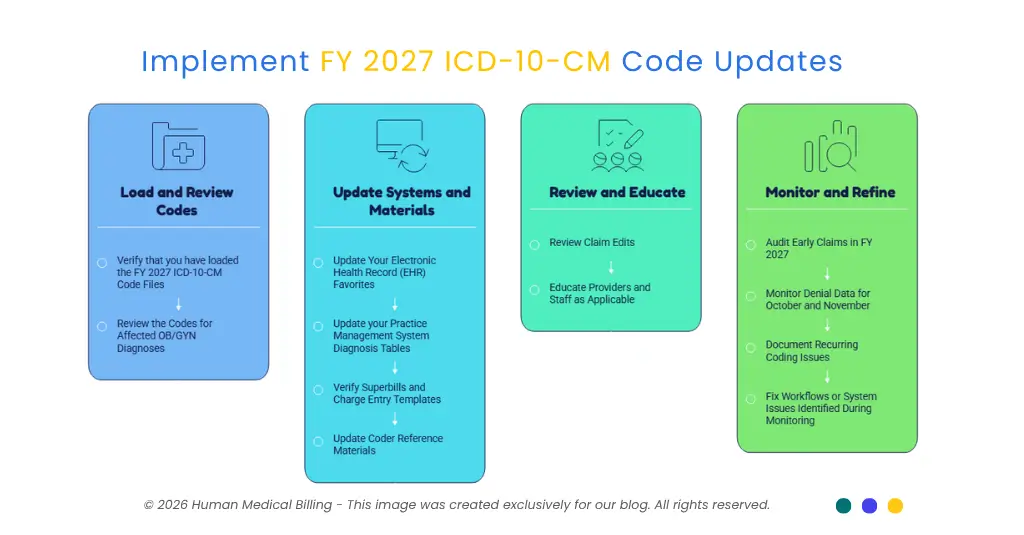
OB/GYN FY 2027 Go-Live Checklist
Ensure that the fiscal year (FY) 2027 ICD-10-CM coding files have been successfully loaded into your electronic health record (EHR)
- Verify that you have loaded the FY 2027 ICD-10-CM Code Files
- Review the Codes for Affected OB/GYN Diagnoses
- Update Your Electronic Health Record (EHR) Favorites
- Update your Practice Management System Diagnosis Tables
- Verify Superbills and Charge Entry Templates
- Update Coder Reference Materials
- Review Claim Edits
- Educate Providers and Staff as Applicable
- Audit Early Claims in FY 2027
- Monitor Denial Data for October and November
- Document Recurring Coding Issues
- Fix Workflows or System Issues Identified During Monitoring
Frequently Asked Questions
October 1, 2026. The ICD-10-CM coding system applies to clinical encounters occurring through September 30, 2027.
No. Coding follows the date of service, therefore, when services occur on or after October 1, 2026 the FY 2027 ICD-10-CM coding system should be used. All existing codes were retained as they were in FY 2026; however, refer to your payers' documentation for exceptions that may apply.
The FY 2027 release includes additional ectopic pregnancy diagnosis codes for interstitial, cesarean scar, cervical and cornual sites, and each of these codes include information regarding whether there is also an intrauterine pregnancy. For further details, review the official CDC Addenda.
O31.4 (Continuing Pregnancy Following Vanishing Twin Syndrome) represents a new family of codes for vanishing twin syndrome and it includes a code value representing which trimester the vanishing occurred and how many fetuses were involved.
Review them all, but change only what the update touches. Many favorites will stay as they are.
Beginning with the implementation of the FY 2027 ICD-10 OB/GYN codes, will require all parties to work in concert. If you would like an additional pair of eyes on your teams' diagnosis workflows and claims, Human Medical Billing can be utilized as an additional resource for your coder(s). The OB/GYN medical billing services provided by HMB include, but are not limited to; coding reviews, claim follow-ups, and denial tracking. Therefore, if your team has concerns about how to implement or maintain accurate coding practices prior to October, that may lead to denial reports in November, a brief phone call today will cost less than a lengthy denial report tomorrow.

Contact Human Medical Billing to schedule a compliance readiness review or learn more about our end-to-end billing and regulatory support services.