



Your OB-GYN office will have the option of using two maternity billing systems when it enters 2027. New CPT codes go into effect on January 1, 2027, which split maternity care into four separate levels or phases. At the same time, CMS is proposing Medicare-only G-code(s) that would allow for continued use of the bundling system used currently for commercial insurance claims.
This means that if these proposed G-codes are accepted as part of the final rule making process, you may be able to bill a commercially insured patient differently than you can a Medicare patient for the exact same services provided to them both during their pregnancy; essentially, you will be required to route each service and code in the correct manner to the correct payer.
Quick Answer:
- As of Jan. 1, 2027, New CPT Codes will replace all the previous Global Maternity Coding Codes, taking what was once a single "bundled" payment into 4 individual billing transactions.
- CMS is proposing 15 Medicare-only G-Codes to preserve current Medicare Global Maternity Billing as the new CPT Coding Structure takes effect for Commercial & Medicaid Plans.
- Potentially practices will have to operate Two Different Coding Workflows; Two Separate EHR Charge Capture Setups; and two separate coding training programs in parallel.
- ACOG believes that the use of G-Code should be eliminated, and are advocating for CMS to accept the new CPT Framework without a Medicare carve out.
The Current Global Maternity Model
For over 30 years, maternity services have been billed using global CPT codes including 59400, 59510, 59610 & 59618. The one code that was used to cover an entire pregnancy included all the individual prenatal visit charges in a single payment, regardless of the number of physician or nurse-midwife visits a patient required.
This billing model was acceptable for a long period of time when each pregnancy could be considered similar. However, this model is no longer acceptable today because medical care has become much more complex. Weekly testing of patients who are at risk for developing gestational diabetes will require significantly more physician or nurse-midwife time than a low risk pregnancy. As such, the previous coding system would pay the same amount of money whether it was a high risk pregnancy requiring extensive testing, or a low risk pregnancy.
The New 2027 CPT Framework
The American Medical Association’s CPT Editorial Panel has approved a complete overhaul to maternity care coding, and those new codes go into use on January 1st 2027. All seventeen of the previous global codes have been deleted in the CPT codebook. Practitioners instead will bill for each phase separately including standard E/M coding for encounters during the antepartum period, labor management, delivery, and postpartum care.
Beginning with the AMA’s RUC surveying over 650 obstetricians, family medicine doctors and certified nurse-midwife to determine how much time is involved to create the new codes, the AMA sent those suggested times to CMS for review in February 2026. On July 14, 2026, CMS issued a proposal for the work times and included them as part of the CY 2027 Proposed Rule for the Medicare Physician Fee Schedule (CMS-1848-P) along with a 60 day comment period that ended on September 14, 2026. CMS anticipates publishing these finalized times by early November to allow enough time for coding system updates prior to the January 1, 2027 start date.
The Proposed Medicare G-Codes
In addition to these 15 new HCPCS G-codes, the Centres for Medicare & Medicaid Services (CMS) included additional 15 new HCPCS G-code additions in its proposed rule with the purpose of preserving the previous bundled maternity payments for Medicare claims only. The intention behind the CMS’s proposal was to ease the transition for providers who are adapting to the new coding system. However if finalized, a pregnant woman covered by Medicare could still have her pregnancy treated as one single bundle on a claim submitted to CMS, while a pregnant woman covered by commercial insurance in the same provider location may have her pregnancy treated as four separate CPT codes.
ACOG has decided that it will go for a "clean" separation from the current CPT coding structure. According to a statement made by ACOG president Camille A. Clare about the proposed rules regarding G-codes (the codes to identify which insurance companies use the new, unbundled codes), the G-codes will create two different patient categories; one category will be patients who have their insurer using the new G-code and thus can use the new un-bundled CPT code. The second patient category will be those patients who have an insurer that is still using the old CPT code bundling system.
Payer-by-Payer Differences
Neither commercial insurance companies nor State Medicaid programs will be forced to follow the route that CMS picks. Many state Medicaid agencies have now unbundled their maternity payment systems this Fall prior to the Federal Government making a determination on how they will do so. Thus, as we move into 2027, global maternity billing may vary not only by payer type (Medicare vs. all other) but also by individual payer.
The true operational risk lies here. Practices with an enrollment mix of Medicare, commercial insurers, and Medicaid, may need written confirmation of each payer’s position by January because if all payers end up in the same category it could result in claims going out incorrectly coded from day one.
EHR and Practice Management Configuration
Both billing forms will have to be supported by your electronic health record (EHR) and/or your practice management system in order to maintain all G codes, so you are going to need two different charge templates; one for billing based upon a per encounter CPT code and one for billing based upon the bundle claim with Medicare, as well as an automatic routing of payers to their respective templates. If you wait until January to begin building this functionality, then your first month of claims for 2027 will be submitted on speculation.
Charge Capture and Coding Education
A single pregnancy will now create either 1 claim in the past, or 15-25 claims today (depending upon your payers) - so you need to have a system that captures each and every part of the patient's entire journey through their treatment immediately as it occurs (not reconstructed at discharge). Your coders must be trained to work with both systems simultaneously because a coder can't use the exact same rules for a Medicare chart and an insurance company chart being worked on the same day.
Denial Risk
Denial of service is at issue with mixed billing structures. Claims submitted to the payer using incorrect coding will be denied as well. Conversely, claims which are submitted as multiple lines instead of being submitted as a single line as expected by the payer have the opposite result. Thus your denial management services process should include business rules for managing both forms of denials; it also should contain the necessary process to identify and route incorrectly routed claims prior to submission.
What Should Your Practice Do Now?
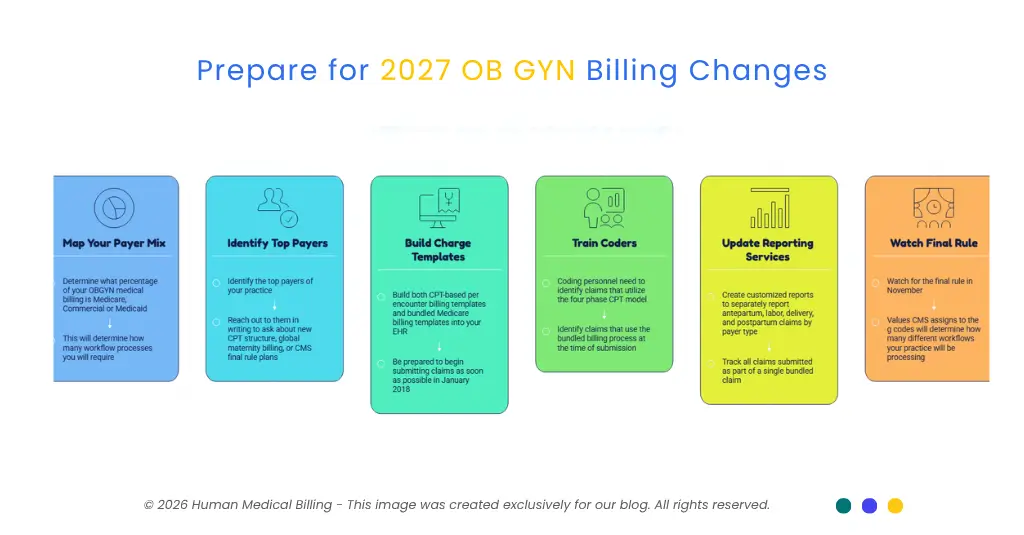
You can begin preparing for some 2027 OB GYN billing changes without waiting on a final rule. These are the areas to prioritize before January:
1. Map Your Payer Mix.
Determine what percentage of your OBGYN medical billing is Medicare, Commercial or Medicaid; as this will determine how many workflow processes you will require.
2. Identify your top payers & ask them questions
Identify the top payers of your practice and Reach out to them (in writing) to ask if they have any plans on using the new CPT structure for 2018, maintaining global maternity billing for 2017, or waiting for the CMS final rule in 2018.
3. Build charge templates for both models
Build both CPT-based (per encounter) billing templates and bundled Medicare billing templates into your electronic health record (EHR) so you are prepared to begin submitting claims as soon as possible in January 2018.
4. Train coders on both models in parallel
Coding personnel need to be able to identify, without hesitation, claims that utilize the four phase CPT model and those claims that use the bundled billing process at the time of submission.
5. Update your medical accounts receivable services reporting.
In order to effectively track both types of billing processes simultaneously, you should create customized reports that allow you to separately report antepartum, labor, delivery, and postpartum claims by a specific payer type, yet also track all claims submitted as part of a single bundled claim.
6. Watch for the final rule in November.
The values CMS assigns to the g codes will be critical in determining how many different workflows your practice will be processing in 2017.
Frequently Asked Questions
The reporting of Maternity Care has changed as of January 1st, 2027. Maternity care is now reported across 4 Phases: Ante-Partum (Per Encounter Using E/M Codes) Labor Management Delivery Post-Partum Care; Replacing the Current 17 Global Obstetric Maternity Codes.
CMS has not made a decision at this time. CMS has proposed 15 Obstetric G-Codes for 2027 to allow Medicare to maintain their current bundling method. However, the Final Rule, which is expected to be issued by Early November 2026, will determine whether Medicare chooses to go with the Bundled Method or the New CPT Code System.
CPT Codes and Finalized G-Codes will become effective on January 1, 2027. Therefore, Global Codes from prior years can no longer be billed for services rendered on or after this date.
The 2026 CPT Code Guidelines apply to all prenatal care service(s) provided in 2026; however, antepartum encounter(s) that occur in 2027 will be subject to the new "per-encounter" billing format. Practices should verify with their payers to determine how each payer intends to process claims for patients who deliver in 2027 as there is not an automatic split of the year.
Regardless of how CMS ultimately decides to implement the G-codes, the 2027 OB Gyn billing changes require that you develop a strategy for each possible outcome prior to January 1. Our company has tracked the 2027 OB-GYN CPT code rules since their initial release in mid-July, and our coding team is developing client-specific dual workflow templates for those practices with OB-GYN panels of both Medicare and Commercial payers. Contact us to schedule an HMB OB/GYN Billing Readiness Review.

Contact Human Medical Billing to schedule a compliance readiness review or learn more about our end-to-end billing and regulatory support services.