



Beginning on January 1, 2027, the universal maternal coding system your office will bill with is being eliminated. The AMA’s CPT editorial panel has decided to completely revise maternity coding in 2027, taking what was previously a single bundled charge and breaking it down into four separate stages: antepartum (pre-delivery), labor management (during delivery) delivery, and postpartum (after delivery).
A total of seventeen codes are slated for deletion, while twelve new codes are going to be created and six will be modified. This means if you are still treating pregnancy as one-nine month bundle in your billing process, your way of doing things is over at the start of January.
Quick Answer:
- For dates of service On or After January 1st, 2027 – The Global OB Code (59400, 59510, 59610, etc.) will be removed
- Antepartum and Postpartum Care – New Codes to Replace Bundled OB Visit Count Codes
- Split Billing Between Straightforward/Complex; Initial Day vs Subsequent Day with Four New Labor Management Codes (59080-59083)
- Two New Delivery Codes (Cesarean – 59502-59503 Vaginal – 59431-59432) Replacing Old Delivery Only Codes
Why Global Maternity Codes Are Going Away
For years, there was just "one code" for all of a woman's pregnancy care - from her antepartum clinic visits, through her delivery at the hospital and after, through her postpartum clinic visit. The simplicity of that billing process helped mask how much of an individual clinician's time is involved in each aspect of care. A patient may have received care from three different providers working in two separate hospitals; she would generate a single bill and there would be no record of which provider saw her and when.
The AMA and the American College of Obstetricians and Gynecologists (ACOG) took nearly two years to develop this new one. They believed maternity care is now far from what was originally defined by the Global Codes, as patients are being transferred among rural and specialty hospitals.
Also, telehealth has become an essential component of pre-natal care. In many cases, midwives, maternal fetal medicine specialists, and hospitalists will all be involved in the same patient's delivery. Therefore, the existing "bundled" CPT code could no longer provide for these needs.
What Actually Changes on Jan. 1, 2027
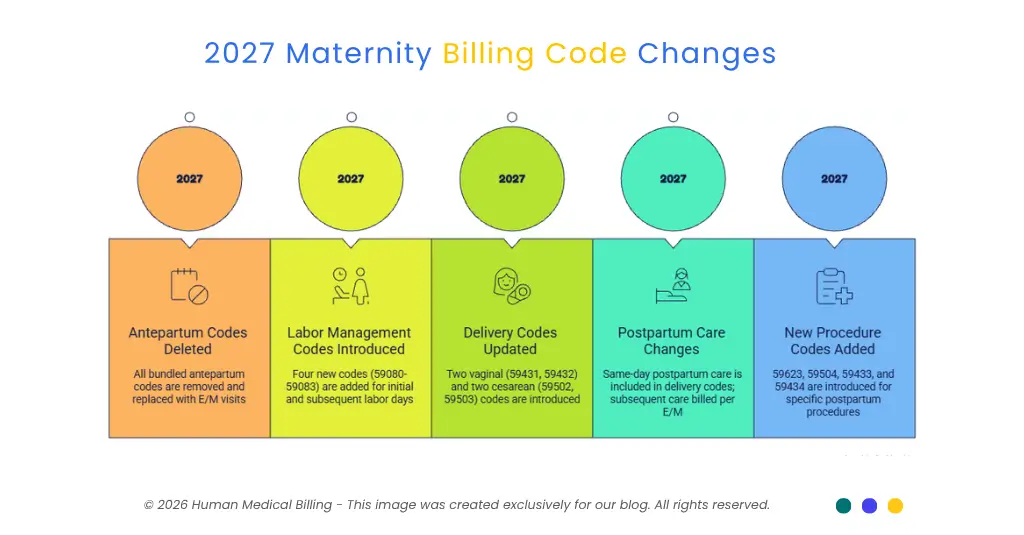
The 2027 Maternity Billing Codes affect 35 total codes. Here are the details:
| Category | What Happens |
|---|---|
| Antepartum care | All bundled antepartum codes deleted. Billed per visit using E/M codes. |
| Labor management | Four New Codes: 59080-59081 (First Day of Delivery, Simple / Complex) 59082-59083 (Subsequent Days of Delivery, Simple / Complex) |
| Delivery | Vaginal delivery has two codes (59431, 59432); Cesarean delivery has two codes as well (59502, 59503). Only includes same-day postpartum care. |
| Postpartum | Care on the same day as delivery is included in the delivery code. All subsequent care will be coded based on each E/M visit until discharge. |
| New procedure codes | 59623 (Uterine Tamponade to Treat Postpartum Hemorrhage) 59504 (Cesarean Hysterectomy) 59433/59434 (Third & Fourth Degree Lacerations Repair). |
In terms of basic labor management, it should include an initial presentation at one vertex, require routine monitoring, and have no prior c-section. If anything else occurs (ie; multiple births, the baby is not presenting at the vertex, etc.), then this will be considered complex. The first day that each hospital admits a patient will report the initial day. All days thereafter are reported as subsequent days; regardless of whether or not the patient is currently in active labor.
On July 14th, 2026 CMS published its Physician Fee Schedule Proposed Rule and included Relative Value Units (RVUs) for the aforementioned new codes. It is anticipated that CMS will publish its Final Rule by early November 2026 with RUC recommended coding changes to be budget-neutral overall.
What This Means for Payers and Claims Systems
Healthcare providers also encounter the same "crossover" issue when it comes to claims; prior to January 1st, contracts and fee schedules based on the former "global coding system" must be updated as they currently require a new (and different) code number in order for claims to be successfully processed. The American Medical Association (AMA) has taken a clear stance on this point: codes which were eliminated are invalid for use beginning January 1, 2027; thus, clearing houses should automatically reject such codes without pendency for manual review.
That creates a very limited time frame for payer side testing. The claims edit logic will need new rules based upon "pairs" of codes that would be logical in combination with each other; such as a Labor Management Code (LMC) paired with a Same Day Delivery Code, or LMC's combined from the same physician on the same date, and rules for combinations of codes that should flag an error. Practices that bill Medicaid should also be aware of State Specific Tracking Rules layered atop Federal Changes, since Postpartum Coverage Windows are different for each state and are not related to the CPT Code Set.
Billing Teams: This provides an advantage in terms of having plans/providers have more detail regarding what occurred during each pregnancy due to phase specific coding. Therefore, billing teams may be able to identify quickly those claims requiring additional documentation versus a full review of all maternity claims received.
What This Means for Billing Teams
Your largest area of risk is the transition from 2026 through 2027. With an Antepartum visit which crosses into both years you have the potential to be charged twice for the same pregnancy. If there are four or more visits completed prior to January 1, 2027 they were billed using the old bundle antepartum CPT codes (59425 or 59426) regardless of when those services were provided. On/after January 1, 2027 all Antepartum visits can be billed separately with E/M CPT Codes, No Exceptions!
The first rule where you will begin to see denial claims due to lack of preparation by your staff is this very rule alone. The claims processing systems used to process a single Global Code for each pregnancy, will now require tracking four individual claims for the same patient. Those claims may include multiple different providers and/or different calendar years.
Documentation becomes increasingly complex as well. As with all outpatient encounters, E/M Coding for Antepartum Visits is either based upon Medical Decision Making (MDD) or Time. Coders will have to now document at least a minimum level of documentation to support a code level for each individual prenatal visit rather than being able to count them towards a bundled threshold. This is a significant change in the amount of detail from each note that has to be present.
A regular pregnancy qualifies as one of the "problems addressed" when it comes to EM Coding. A regular pregnancy is classified by the AMA in the moderate category due to potential for worsening (exacerbating) or progression of the condition. Therefore, coders may be required to take an entirely new approach to coding antenatal visits which they have traditionally viewed as routine visits requiring very little documentation.
Each visit note needs to provide sufficient information to support a separate code for each visit rather than simply providing additional documentation that would lead to an additional check mark for the total number of visits.
What Should Your Billing Team Do Now About the 2027 Maternity Billing Codes?
1. Audit your current maternity billing workflow
Identify all maternity patients that are being billed using global codes and mark those who have appointments scheduled for either side of the date when the change occurs (January 2026).
2. Retrain coders on E/M-based antepartum billing
Maternity patients now require individual coding for each appointment that is determined by either medical decision making (MDM) or time spent with the patient; no longer may an appointment be counted towards a global fee.
3. Update claims edit logic before January
In 2027 deleted codes will reject all claims submitted for services provided after January 2027. Confirm your clearing house and payor contract has updated to support the use of only the new code set prior to submission of any claims.
4. Flag labor management documentation gaps
Whether a coder is coding a straightforward or a complicated determination will often depend upon the information available from the medical record. Clean documentation is necessary so that coders can document the appropriate level.
5. Watch for the CMS Final Rule in November
Relative Value Units will be locked once CMS releases their final rule in November. Until that time do not make any changes to your Fee Schedules.
Frequently Asked Questions
January 1, 2027. Services prior to this date may continue to use the current global and bundle maternity codes for antepartum services.
No. Codes deleted from the coding system will not be valid for processing for 2027, as Claims Processing Systems are expected to reject such codes for 2027 dates of service.
In 2026, all visits would follow current billing rules (individual E/M codes if there are three or less visits; bundled antepartum care code when there are at least four visits) . Each visit she has in 2027 will be billed separately using E/M codes for each visit; this does not matter how many previous visits were made by her.
Delivery will be considered straight forward if it was a single baby birthed from the top of her uterus (vertex), all deliveries have been monitored routinely, she had not previously delivered via cesarean section and her medical history is stable. The first deviation will cause the bill to be considered under complex.
Practices that do not contact and adjust for 2027 Maternity Billing Codes by December are going to miss the clean claims in January. The coders need training time; the clearing houses need edit changes; and the documentation patterns of the practice need to be changed months prior to the effective date, and not the week of. A review of your OB/GYN billing process with an Antepartum to E/M Transition Review, Labor Management Documentation Requirements, Claims Edit Updates prior to January 1 Deadline can be accomplished with a review with HMB.
For those teams who would like another set of eyes to evaluate their Medical Coding Services Setup, they may begin this evaluation process today when there is still time available to correct areas where service gaps exist. Denial Trends related to previous coding transitions have been documented as follows in the First Quarter after a Major Code Change at HMB's Denial Management Services Page

Contact Human Medical Billing to schedule a compliance readiness review or learn more about our end-to-end billing and regulatory support services.