



October 1, 2026 marks one of the largest changes in ICD-10 billing since last year. The 2027 ICD-10 diagnosis code revisions include approximately 190 new diagnosis codes; deletes approximately 30; and revises approximately 4, as reported by the Centers for Medicare & Medicaid Services (CMS) and Center for Disease Control (CDC), who released their files in June 2026. Many online coding sites have posted the entire list of new ICD-10 codes.
Your practice is concerned with what happens after October 1. Prior authorization requirements are built using previous ICD-10 codes; many automated claim scrubbing systems have not been updated; and most electronic health record (EHR) templates are referencing deleted codes. Here's a summary of the changes and what you need to do before your claims begin getting rejected.
Quick Answer:
- The FY 2027 ICD 10 CM Update includes the addition of 190 new codes, deletion of 30 codes, and revision of 4 codes, for encounters that occur during the period of October 1, 2026 through September 30, 2027.
- Pregnancy and childbirth coding has the greatest number of changes, which include a new sub category for Vanishing Twin Syndrome, and greater musculoskeletal specificity.
- Claims submitted using deleted codes after October 1 will be denied. Use the current CMS Conversion Table to map the deleted codes to the replacement codes.
- Denial of claims can result when prior authorization lists, claim scrubbers, or EHR superbills are out-of-date.
Why the ICD-10 Code Set Updates Every Year
CMS and the CDC’s National Center for Health Statistics update ICD-10-CM each fiscal year, so they can reflect developments in clinical practices. The FY 2027 files are available now as of June 2026. These will be used for discharge and encounter data between October 1, 2026 and September 30, 2027. While updates occur routinely, both the quantity of and placement of updates vary by year; therefore, you should familiarize yourself with what occurs in FY 2027 prior to implementation on your claims.
Relative to previous years, FY 2027 represents a moderate amount of change. In comparison to the number of chapters affected by an average yearly update, FY 2027 affects almost all chapters. Additionally, several of these updates generate sufficient new codes per category that specialty physicians will have to alter their documentation methods simultaneously.
What's New in the FY 2027 Update?
Changes to the 2027 ICD-10 codes do not occur in equal distribution. One specific area - Continuing Pregnancy after Vanishing Twin Syndrome – is responsible for almost all of the additional coding categories. Any obstetric practice and any billing teams which process Maternal-Fetal Medicine Claims should be well aware of this category as generic pregnancy codes will no longer document what payers are looking for.
Musculoskeletal Coding receives a similar specificity increase as there are new coding categories for musculoskeletal issues such as Plantar Fasciitis and Osteomyelitis which now have lateral requirements. Coders can default to Unspecified Code when a provider documents “Plantar Fasciitis” but does not specify left or right. Payers scrutinize unspecified codes.
Cardiology Coding has increased specificity as well. There are additional coding categories available for Cardiomyopathy and associated arrhythmias; however, the coder has increased opportunity for mis-coding if their superbill and/or EHR Favorites List includes only the older, broader codes.
New Z Codes will allow a greater number of ways that a practice can identify a patient's history and exposures. In addition to a code for an individual's own history of Clostridioides difficile infection, there are new codes for exposure to Blast Over Pressure (BOP), Burn Pits, Agent Orange and Gadolinium. Of all these groups, the one that has the greatest significance for those who care for veterans/military personnel is the group related to Gadolinium because it will be used by some to support their Risk Adjustment as well as Quality Reporting. The two new Body Mass Index (BMI) codes for Under Weight Adults complete this update.
Of the approximately 30 deleted codes, they did not go away. Instead, they have been divided into more specific codes that replaced them. This is precisely the reason the conversion chart has more importance in relation to the total "New Code" count.
Impact on Providers and Billing Teams
Here is the article's missing component that numerous other articles have omitted. The actual danger lies within the system constructed from an older code system.
First, let us start with prior authorization. Payers link authorization rules to specific diagnosis codes. As soon as CMS removes a code, splits a code, or changes its definition, the payer's authorization list doesn't automatically change on October 1. So if you submit a prior authorization request for a service coded with a code that existed at 12:00 AM on September 30 but did not exist at 12:01 AM on October 1, there may be a denial or a delay until the payer can process the authorization.
Likewise, clearinghouse and PM software (practice management) claim scrubbers also pose this risk. Any clearinghouse or PM software needs to run their edit tables against the FY 2027 file before submitting claims. If the claim scrubber is operating under an outdated version of logic; then it will allow submission of a claim which contains a removed code and after several days/weeks the claim will come back denied and those claims could have been fixed when they were inexpensive to correct.
Lastly, the hardest area for companies to keep current is EHR Templates. Although superbills, favourite’s lists, and clinical documentation templates can easily be created and updated infrequently, they are often written once. Therefore, if an electrocardiogram cardiologist has an EHR template which lists the previously used ICD-10-CM code for cardiomyopathy (as opposed to the new ICD-10-CM code), he/she uses the previous ICD-10-CM code on October 2 just like s/he would have done on September 30 and thus receives a denied claim.
What about Payers?
Health plans have to deal with their own "slow mover" issue. All health insurance programs including Medicare Advantage Plans, Commercial Insurance Providers and Medicaid Managed Care Organizations will have to modify Coverage Policies, Local Coverage Determination (LCD) edit rules and National Correct Coding Initiatives (NCCI) Logic to align with the FY 2027 correct coding initiative. The slow payer creates an opportunity for properly coded claims to be rejected merely because the payer's system has not yet been updated. Do not ignore this as a potential; it needs to be planned for by your team.
What Should Your Practice Do Now?
You don’t have to know each of the 190 new codes. All you really need is an idea of how many of those codes will affect you, and what percent of claims are affected by those codes.
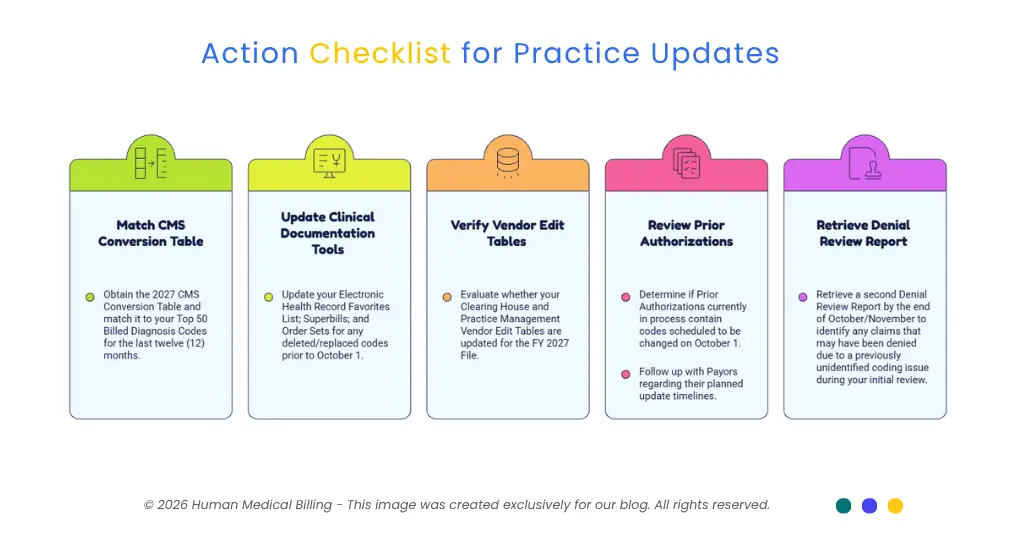
Action Checklist
- Obtain the 2027 CMS Conversion Table and match it to your Top 50 Billed Diagnosis Codes for the last twelve (12) months.
- Update your Electronic Health Record Favorites List; Superbills; and Order Sets for any deleted/replaced codes prior to October 1.
- Evaluate whether your Clearing House and Practice Management Vendor Edit Tables are updated for the FY 2027 File.
- Determine if Prior Authorizations currently in process contain codes scheduled to be changed on October 1. Follow up with Payors regarding their planned update timelines.
- Retrieve a second Denial Review Report by the end of October/November to identify any claims that may have been denied due to a previously unidentified coding issue during your initial review.
The practices that don't have this in their process will generally learn about this gap when they get a denial report several weeks after the fact. The practices that put it into their October workflow will identify the gap BEFORE ANY CLAIMS ARE SENT OUT!
Frequently Asked Questions
October 1, 2026 thru September 30, 2027 for discharges and patient encounters.
There were 190 new diagnosis codes, 30 deletions of diagnosis codes and four revisions (changes) as per the data from both CMS and CDC files that was made available through their website in June 2026.
Once a code has become deactivated or "inactive" then claims filed using those codes will be denied. This is the reason why it's important to cross reference all codes with the CMS conversion table prior to October 1 when these changes go into effect.
Maternal-fetal medicine and obstetricians are being affected most because of the new subcategories in Vanishing Twin Syndrome. Musculoskeletal and Cardiology providers also see the largest increase in the number of specific diagnoses they will need to report.
Being prepared for a new ICD-10 update is really more about getting ready for the systems involved as opposed to just the code list; workflow related to authorizations, those systems that perform claim scrubbing and templates used within Electronic Health Records (EHR) are areas where Human Medical Billing works primarily with our client practices during each October.
The majority of our work with clients at this point is finding out which parts of a practice's system still have outdated information from what has been published by CMS. When a denial rate goes through the roof immediately following an ICD-10 code update, there generally isn't a coding issue, but rather it can be said that the denial rate was simply caused by a systems issue; and, typically, this type of systems issue will first show itself in how quickly denials start showing up in your denial management services queue.
In addition to their normal day-to-day claim processing, many teams find themselves having to rely upon third-party medical billing or medical coding services to help facilitate their practice's smooth transition into a new fiscal year. Contact us today, if you would like an additional pair of eyes reviewing your preparation status for FY 2027 prior to October 1.

Contact Human Medical Billing to schedule a compliance readiness review or learn more about our end-to-end billing and regulatory support services.