



Medical Billing Metrics are used to determine if your medical practice receives timely payment for all services billed. The six most significant Medical Billing Metrics are Days in Accounts Receivable (A/R), Clean Claim Rate, First-Pass Resolution Rate, Denial Rate, Net Collection Rate, and Aged A/R greater than 90 Days.
In order for these metrics to be effective as tools for measuring performance within your practice, they require a specific mathematical formula, a defined measurement time frame, and an assigned name owner. If any of the above three criteria are missing from any given metric then the opportunity exists for two different individuals to generate the exact same report but have differing opinions regarding the results.
Quick Answer
- Days in accounts receivable: net accounts receivable / average daily net patient revenues. The scoring range for HFMA's map awards is 30-60 Days.
- denial rate: claims denied / claims remitted. The scoring range of denial rates by HFMA is 3-5%.
- collection rate: payments / (charges – contractual adjustments).
- medical appeals through Medicare: first level, 120 Days; other payers' time frames vary.
Medical Billing Metrics at a Glance
Here is the one-page reference. Assign the owners, and don’t change a formula without telling the team.
| Metric | Numerator | Denominator | Period | Owner |
|---|---|---|---|---|
| Net days in A/R | Net A/R | Average daily net patient revenue | Month-end snapshot, three-month average | Billing manager |
| Clean claim rate | Claims passing edits untouched | Submissions entering the scrubber | Calendar month | Billing lead |
| First-pass resolution rate | Paid on first adjudication | All adjudicated submissions | Monthly | Revenue cycle lead |
| Denial rate | Denied claims | Remitted claims | Calendar month | Denials lead |
| Net collection rate | Payments | Charges minus contractual adjustments | Month, plus rolling trend | Practice administrator |
| Aged A/R over 90 days | Billed A/R older than 90 days | Total billed A/R | Month-end snapshot | A/R specialist |
The medical billing metrics are all interconnected. If your clean claim rate is high, and your denial rate increases, then something is going on at either the edit level or the payer level.
Net vs. Gross A/R: Pick One Denominator and Keep It
Days in A/R (DIA) measures how long a bill will take to convert into money. In order to get DIA, we need to divide net A/R by our Average Daily Net Patient Service Revenue. We remove "credit balances" and "contractual allowances" from the receivable side of the equation. We use an average over the most recent three months on the daily side of the equation.
Here is the point at which we tend to deviate. For example, if two reports are reporting days in A/R using gross A/R as the numerator and gross charges as the denominator, but then report days in A/R again using last month's revenue as the denominator, they may appear reasonable yet different. Therefore, choose one method for both sides of the equation and document the time frame used. Do not change methods during the middle of the year.
What does a good days in A/R number look like? According to HFMA's MAP Award scoring guidelines, a good days in A/R number would be 30-60 days. Trend against your own base line before trying to determine what changes should be made to reduce your days in A/R. To read about reducing your days in A/R, click here: Reduce Days in A/R
Rejections vs. Denials: Where Clean Claims Fit
What is the difference between a denial and a rejection? Rejection will never be routed for an adjudication; denial will (and the remittance contains a denial code).
A clean claim rate will help you catch these early on. The health care financial management association defines clean claim rate as "the percent of all submitted claims that are processed without manual review/adjustment," compared to all items that were accepted in the claims processor. The first-pass resolution rate takes this one-step further by tracking whether payments have been made after the first adjudication.
The current hcfma list provides no example for a first-pass measure. Create your own and distribute to your team. In essence, if you see a very high clean-claim-rate along with a very low first-pass measure, then you know your problem lies in payer denials, not data entry.
Denial Rate Formula
HFMA's Remit Version splits the claim-denied from claim-remitted. Claims are counted, not lines. Only count those that your staff can fix to collect on.
Claims excluded in HFMA include those with a non-covered service denial (Group Code PR), patient responsibility denials, duplicate claims and RAC recoupment. The denominator includes both initial and appealed denials. This metric ranges from 3% to 5%.
Write-off amounts should be tracked independently from the Denial Rate, as a percentage of net patient revenue. Net patient revenue write-off will tell you how much money was written off after all appeals have run their course. For more information about Denial and 8 Revenue Cycle Checkpoints visit www.r1rcm.com and consider denial management services if volumes increase.
Net Collection Rate: The Corrected Formula
How to determine net collection rate (NCR) = total amount of payment made / total allowed amount - contractual adjustments. The Medical Group Management Association (MGMA) states NCR can be determined by dividing total amount of payment made by total allowed amount based on contractual allowances.
MGMA also states that only adjustments based on allowable amounts should be included when determining contractual adjustments. Denial write-offs are not considered contractual adjustments. Write-offs due to timely filing deadlines are also not considered contractual adjustments. If either of these types of write-offs are left out of the denominator, then the NCR will appear to be higher than what was actually achieved by the Revenue Cycle.
Using an example of a single month with $500,000 in charges, $200,000 in contractual adjustment and $285,000 in payments; this would result in an NCR of 95% ($285,000 ÷ $300,000). The MGMA's own opportunity estimate has used 98.5% as a benchmark for insurance NCR.
A/R Aging by Payer and Owner
Develop an aging report with a line for each payer type (Medicare, Medicaid, Commercial Insurance, Patient) that can be used to track physician accounts receivable aged by day of service (0-30, 31-60, 61-90, 91-120 and >120 days), which are cumulative percentages at 100% when adding all together. First pull the credit balances off the list.
Then include two new columns on your report: Owner, Next Action. If there is no name in the “owner” column beside a balance – you will never work that account. The largest commercial buckets should go to a specialist or to Medical Accounts Receivable Services, depending on how far back your commercial buckets go.
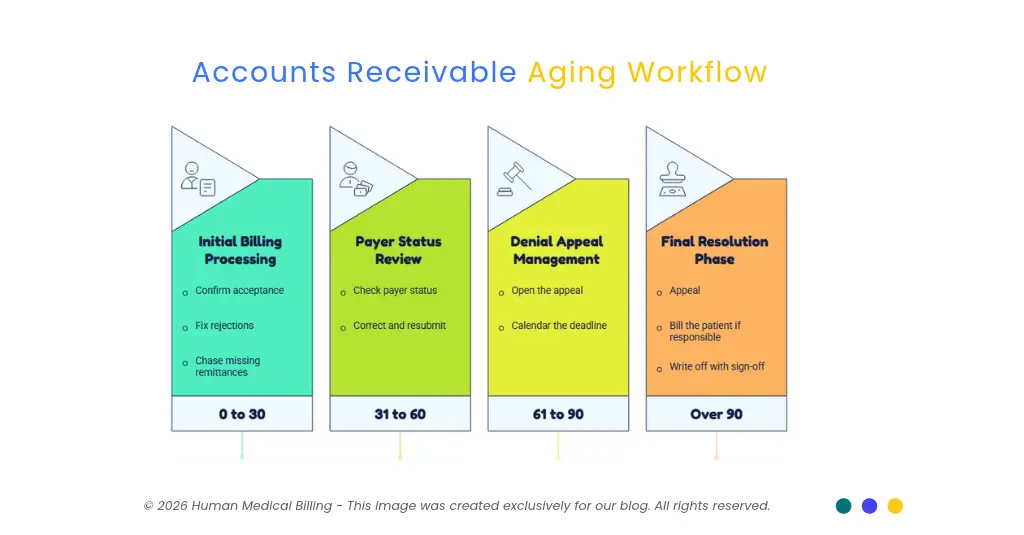
The 30/60/90 Decision Grid
Here is the grid to put on the wall.
| Bucket (days) | What happens | Owner |
|---|---|---|
| 0 to 30 | Confirm acceptance, fix rejections, chase missing remittances | Billing lead |
| 31 to 60 | Check payer status, correct and resubmit | A/R specialist |
| 61 to 90 | Open the appeal and calendar the deadline | Denials lead |
| Over 90 | Appeal, bill the patient if responsible, or write off with sign-off | Billing manager and administrator |
Appeal Deadlines by Payer
Deadlines vary by payer, so read each contract and remittance. For Original Medicare, CMS sets these:
| Level | Deadline |
|---|---|
| Redetermination by the MAC | 120 days from receipt of the initial determination |
| Reconsideration by the QIC | 180 days from receipt of the redetermination |
| Commercial, Medicaid, Medicare Advantage | Varies. Check each plan. |
Put the date on the worklist the day the denial posts. Don’t wait for the 61 to 90 bucket.
What Should Your Month-End Review Cover?
Review it once a month. Make sure it's brief. And use your medical billing metrics as the basis for discussion.
In Order of Agenda:
- 1. Compare all six (medical billing) metrics to last month.
- 2. Read through the aging report on a payer-by-payer basis, using the buckets to assist you.
- 3. Identify the top denial reasons based on both count and dollar amount.
- 4. Verify that there are no appeals coming up within the next 30 days.
- 5. Have a named person sign off on write-offs.
- 6. Assign an owner and a target completion date to each corrective action.
Quick Glossary
- Contractual Adjustment: The amount that is contracted with your payer to be excluded from collections.
- Remittance: An explanation provided by the payer detailing what they have paid for and what they have denied.
- Aged Accounts Receivable (A/R): Billed patient balances organized in chronological order based on number of days from when services were rendered.
- Actionable Denial: A denial which has been identified as one your team can correct and receive payment for.
Frequently Asked Questions
MGMA has an opportunity estimate that uses 98.5 percent as the reference point for the insurance net collections. Then you can compare your rate to this rate and trend it by payor.
No. Denied claims are never sent out to be adjudicated therefore denied claims will not show up on a remittance.
You have 120 days from the date you receive the determination of the first round of appeals, per CMS, to ask for a redetermination.
A single owner (with a back-up) for every metric. If there is shared ownership no One will contact the payor.
Medical billing metrics can be effective in helping teams meet their goals if the team has ownership of them and meets regularly to use them. Begin by creating a one-page document that contains six medical billing metrics; the six formulas for each metric; and the six names (and definitions) for each metric. Then apply the 30/60/90 grid to your most aged accounts today. Would you like a second pair of eyes? Ask about a sample monthly reporting review with Human Medical Billing. We will work with you to review your aging report and denial reasons. Send us your reports for the past three months, minus patient names. Contact Us to arrange it.

Contact Human Medical Billing to schedule a compliance readiness review or learn more about our end-to-end billing and regulatory support services.