


CMS’s interim final rule on Medicaid work requirements will take effect July 31, 2026. The deadline for state enrollees to receive notice about the new Medicaid work requirements is August 31, 2026. This new rule requires all adults aged 19-64 in the 41 Medicaid Expansion states (and Washington D.C.) to document at least 80 hours per month of paid employment, education, volunteerism, or any combination thereof, beginning January 1, 2027. State agencies have begun sending notifications to Medicaid-enrolled individuals. Billing teams working with Medicaid-enrolled patients should be aware of these changes as claims begin denying next year.
Quick Answer
- The states are required to issue an outreach notice for all those who have been affected by the work requirement by August 31st of this year.
- All non-pregnant adult Medicaid recipients who are between the age of 19 and 64, (and therefore do not qualify for Medicare), are subject to the Medicaid work requirements.
- CMS estimates that 2.3 million people will lose their Medicaid coverage as a result of these new requirements during Fiscal Year 2027.
- Although full implementation is scheduled for January 1, 2027, eligibility teams need to begin flagging those at risk of losing coverage immediately so they can be prepared for when the requirements go into effect.
Where This Rule Came From
The Work Requirement has been around since the Reconciliation Law passed in 2025. That's when Congress added a "Community Engagement" Condition for Medicaid Eligibility Under Section 1902(xx) of the Social Security Act within H.R. 1. For nearly one year, CMS built an operational model to provide states with a working plan for its implementation. On June 1, 2026, CMS issued the Interim Final Rule (CMS-2454-IFC) outlining the specifics of how states are expected to implement this program. The Federal Register formally posted the Rule on June 3, 2026. Comments were due by July 31, 2026, the same date these provisions went into effect.
The Work Requirement will be the first national condition of Medicaid eligibility. Several States implemented pilot programs using Section 1115 Waivers several years prior to attempting similar initiatives; Arkansas is probably the most studied example.
What the Rule Actually Requires
Affected enrollees are required to be working at least 80 hours per month by one or some combination of (the) following:
- Employment
- Educational enrollment with a half time status or greater
- A qualified work or job training program
- Community Service/ Volunteer Work
As there is an income option; being paid at least $580.00 in one calendar month based upon the 80 x federal minimum wage rate as of January, 2026 would meet this obligation without the need for hourly tracking.
While states may use attestation from participants similar to how they used it in previous waivers, states will now be required to review payroll data, Medicare/Medicaid claims and encounter records prior to requesting additional documentation.
Who's Exempt
| Exemption Category | Applies To |
|---|---|
| Pregnancy/postpartum | Pregnant enrollees and those in the postpartum period |
| Disability or medical frailty | Enrollees CMS or the state determines medically frail |
| Tribal status | American Indian and Alaska Native enrollees |
| Veteran status | Veterans with a total disability rating |
| Caregiving | Parents/caregivers of young children or dependents with disabilities |
| Existing work compliance | Enrollees already meeting SNAP or TANF work rules |
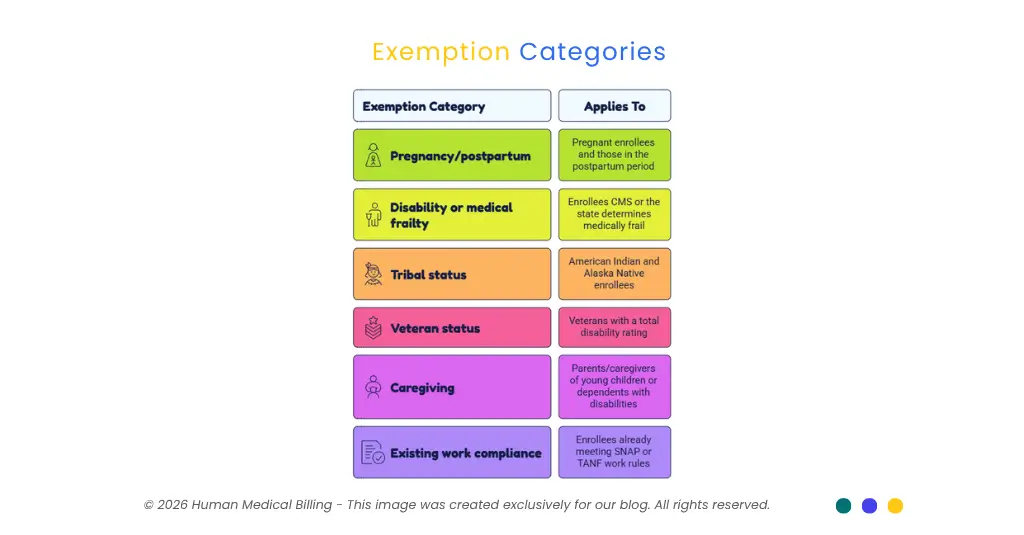
States can create their own temporary hardship exemptions as well. That creates an additional layer of variability from state to state.
What This Means for Providers and Billing Teams
Here is the part of the law that will affect your revenue cycle directly. States must send (via us postal service or via email to an enrolled individual who has opted for electronic delivery) a required outreach notice to all individuals by August 31, 2026. The required content of this outreach includes the requirement itself, the exemptions from the requirement, and the consequences of failure to comply with the requirement. Some states have begun sending outreach notices prior to the deadline, such as Nebraska and Montana which began sending notices in early 2025 and mailed them prior to the winter holidays.
Therefore, for billing and eligibility teams, it will be a tsunami of "coverage" issues before any type of enforcement occurs. Your patients will contact your front office to inquire about the "letter." Many will believe they are currently losing coverage in 2026; however, no one loses their coverage until January 1st, 2027.
CMS projects there will be 2.3 million individuals losing Medicaid eligibility by FY 2027, with those numbers increasing to over 3 million in subsequent years. Those are the types of shifts which can cause practices that have many patients eligible for Medicaid expansion to experience increased levels of retroactive denials, an increase in converting self pay, as well as additional time being devoted to verifying patient eligibility prior to each patient's appointment. That is why it is so important for all practices with a high percentage of Medicaid expansion patients to establish and implement solid healthcare revenue cycle systems in preparation for January (or when they expect the changes to occur) rather than waiting until after the changes occur.
What Should Your Practice Do Now?
Step 1. Create your list of patients eligible for Medicaid expansion
Identify those between the age of 19 and 64 that do not qualify for both Medicaid (due to being disabled) and Medicare (because of their age). These are the ones you need to be concerned about.
Step 2. Flag patients who might qualify for an exemption.
Exemptions related to medical futility, care-giver, disability status require supporting documentation that your organization likely has on file. The sooner you get on top of this; the less stress these patients will experience when they find out they qualify for an exemption from Medicaid expansion.
Step 3. Update your Eligibility Verification Process
Create a procedure for manually checking if the patient is exempt due to being medically frail, a caregiver, or having a disability at every Medicaid expansion visit. This way you won’t need to add this process in later by modifying your eligibility response system after it becomes mandatory.
Step 4. Train front-desk staff on the timeline
These patients need to know what to expect: the first notifications will begin sending out soon; however, based on current law; there is no change until January 1st, 2027. If your front desk staff confuse the two time frames, you will most likely see anxiety among your patients.
Step 5. Monitor your Denial Patterns Starting in Q1 2027
Terminations in coverage tied to non-compliance with the mandates of Medicaid expansion will very likely be shown through either new Denial Codes, or New Eligibility-Termination Reasons. A well-established denial management service will assist in identifying these issues prior to them becoming large problems in your Accounts Receivable.
Frequently Asked Questions
The Medicaid Work Requirement (MWR) is a new provision that requires all adult Medicaid Enrollees with no dependent children to report at least 80 hours of work, education, volunteer service or other qualifying activities each month as a condition of maintaining their Medicaid Eligibility. The MWR will begin on January 1, 2027.
All States must send an Outreach Notice to its enrolled adults with no dependents by August 31, 2026; they may begin sending notices as early as June 30, 2026.
Adults under the age of 21 years old; pregnant or postpartum women; individuals deemed disabled or medically frail; Tribal Members; Disabled Veterans; Caregivers; and Adults who qualify for the SNAP Program or TANF Programs.
Billing Teams should flag Medicaid Expansion Patients aged 19 through 64 immediately; ensure that all necessary documents related to exemptions are reviewed; and prepare/update your Eligibility Workflows prior to enforcement in January, 2027.
The Bottom Line
This month's notifications will be the first real indicator of just how much disruption Medicaid expansion practices may see in 2027. Being prepared as far back as possible in getting all your eligibility checks and documentation in order versus after the first denial is sending your billing team ahead of an issue that most have not even begun tracking yet. We work with offices dealing with this exact type of eligibility shift - identifying which patients are at risk and where there is potential to catch denials based on coverage issues before those denials turn into a write-off. Your team needs a second pair of eyes to assess their Medicaid expansion liability? Reach us via contact and we can go over it together.

Contact Human Medical Billing to schedule a compliance readiness review or learn more about our end-to-end billing and regulatory support services.