


CMS has proposed the largest adjustment to Medicaid financing since Medicaid was created. On July 21, 2026, the Agency for Healthcare Research and Quality (AHRQ) issued a proposal for the Medicaid Provider Tax Rule (CMS-2452-P). In this new proposal, CMS is replacing the current 6% limit that has been in place since January 1999 as a "hold harmless" or "cap," with state-by-state limits that are based on what each state had in place on July 4, 2025. The AHRQ estimates the rule would save the federal government $246 billion from 2026 through 2035. That savings will come out of state Medicaid budgets; state Medicaid budgets fund all of the claims paid under the program. Comments on the rule are due by September 21, 2026.
Here are some things that billing and leadership within practices need to be aware of prior to the number's movement.
Quick Answer
- As per CMS they will eliminate the 6% flat indirect hold harmless and peg each state to their tax structure at July 4, 2025.
- Beginning with October 1, 2027; these Medicaid expansion states are subject to a decrease of 0.5% each year for a total of two (2) years at which time the rate of decrease is capped at 3.5%.
- Additionally, as per the proposed rule, "Health Insurance Services" may now be used to classify taxes and has removed the 75/75 test for determination.
- Total Federal Spending is estimated to reduce by approximately $246 Billion in ten years due to lower reimbursement rates and fewer supplemental payments in States that have expanded their Medicaid programs.
How do provider taxes fund your Medicaid reimbursements?
Almost all states have them. CMS reports that there are currently 49 states plus D.C. that have enacted some form of a healthcare-related tax.
The process is quite basic. The state imposes a tax on hospitals, nursing facilities, or managed care organizations. The funds collected by the tax pay for the portion of the state's share of Medicaid costs, which are matched by the federal government. And many of those dollars ultimately go back to providers in the way of reimbursement rates and supplemental payment amounts.
Section 1903(w) of the Social Security Act provides for three requirements in order to establish a tax. First, it had to be broad based; second, it had to be uniform; and third, it could not protect taxpayers from paying what they owed. CMS (Centers for Medicare & Medicaid Services) took the position that taxes which were at or below 6 percent of net patient revenue would be considered "safe."
That 6 percent threshold was changed by section 71115 of Public Law 119-21.
What the Proposed Medicaid Provider Tax Rules Actually Change?
The proposed CMS rules were issued in July 21; they were officially published by the Federal Register on July 23, 2026. There are five elements that make this rule different from prior Medicaid provider tax proposals:
State-specific caps are used instead of a national cap. A state is "capped" at the same level as its own tax plan/structure that was in place as of July 4, 2025. Nothing above that gets approved.
"Imposed," and "enacted", are both narrowed down further. In this regard, CMS has stated that the term "enacted," is defined as a State having completed all of the requirements necessary to enact the particular tax structure prior to July 4, 2025. Similarly, CMS has defined "imposed," as being the effective date (and/or date when waivers were approved) of the tax imposed prior to July 4, 2025. The above definitions, are different than the Preliminary Guidance that CMS published in its Dear Colleague letter dated November 14, 2025.
The 75/75 Test is eliminated - Under current law, taxpayers will be considered successful if they have less than 75% of their total tax cost recovered by more than 75%. As part of this law change, CMS would eliminate that second prong of the test and instead use the July 2025 threshold amounts as the absolute limit.
Health insurer services join the permissible classes. State taxes on Medicaid managed care plans move under CMS oversight and section 71115 limits for the first time.
Beginning with the requirement for states to report once (one-time) and then again (on an ongoing basis), the tax information submitted to CMS will allow CMS to determine and enforce the threshold requirements.
Next is the phasedown process for states which have expanded Medicaid coverage to the adult population.
| Federal Fiscal Year | Hold Harmless Threshold |
|---|---|
| FFY 2027 | 6.0% |
| FFY 2028 (begins Oct 1, 2027) | 5.5% |
| FFY 2029 | 5.0% |
| FFY 2030 | 4.5% |
| FFY 2031 | 4.0% |
| FFY 2032 and after | 3.5% |
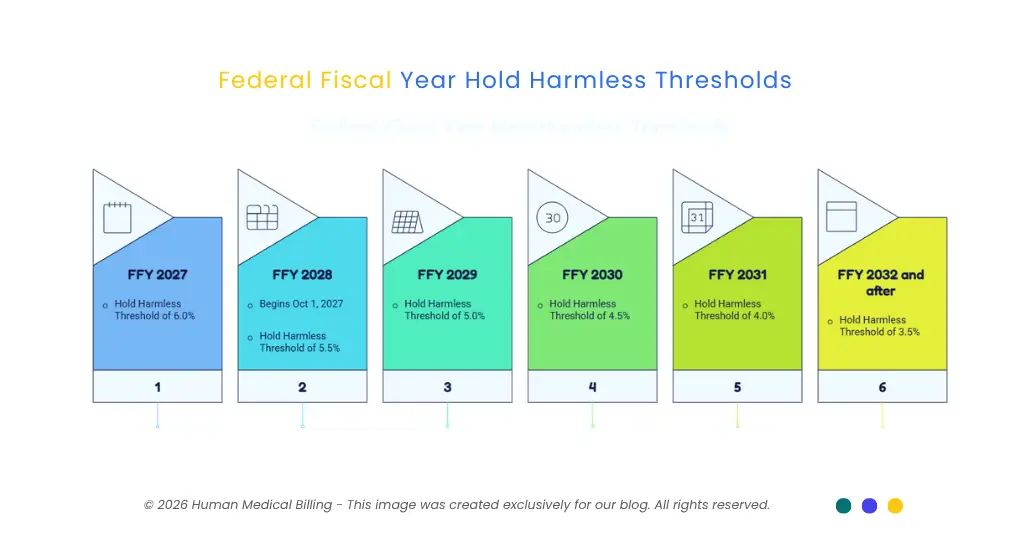
The Nursing Facility Taxes and ICF/IDD taxes, effective July 4, 2025 are exempt from the phasedown process. The non-expansion states will be "frozen" at the 2025 level; they will not experience a reduction in their threshold each year.
What This Means for Providers and Billing Teams
The effects of reduced government funding for Medicaid can be felt throughout many different areas of an organization.
Firstly, supplemental and/or State Directed Payments (SDPs) are typically cut as quickly as possible. They do not fall under a fee schedule that is printed or distributed publicly and therefore, tend to get significantly less attention. As such, if you receive a significant portion of your Medicaid revenue through Supplemental and/or SDP's, create a model illustrating how a 10% to 20% decrease in these types of revenue would affect your bottom line.
Secondly, Base Rates follow the SDP/Supplemental type reductions. These changes occur at a slower rate since states need to provide formal notification, pass a plan amendment(s), and endure public scrutiny. Therefore, expect to see a "lag" effect rather than a sudden "cliff." The impact on your patients' billing cycle will likely occur prior to your fee schedule being affected.
Eligibility churn is the third pressure point. When a state faces a funding gap it tightens redetermination processes which causes more patients to fall into coverage lapses.
Coverage lapse becomes eligibility denial (no insurance), and retro-termination as well as creates self-pay balances that you never accounted for on the front desk due to lack of effective leakage prevention by your medical accounts receivable service during every patient's visit through proper eligibility checking.
What Happens to Patients and Health Plans
Managed Care Organizations (MCO) are at risk here. Since managed care organizations would be brought under the Class Rules of what a Permissible Health Insurance Service is; State MCO Taxes which were previously outside of the CMS' Section 71115 scope will fall within it. California, Illinois and New York each have their own State Managed Care Taxes for their MCOs that could attract more attention from the CMS under this new floor.
The impact to Patients will be less choices and longer wait times due to reduced access in states with no way to replace lost tax revenues. Some States may increase other taxes. Other states may reduce non-essential benefits or limit the number of providers who can participate.
What Should Your Practice Do Now?
Waiting for the final regulation can cut into the time you have to plan. There is an opportunity to provide comments to the proposed rule through September 21, 2026; however, the statutory threshold will go into effect as of October 1, 2026.
The five things you should do during the remainder of the third quarter:
- Obtain your Medicaid payer mix based on dollars collected rather than volume. Identify how much of your collections come from Medicaid and/or Medicaid managed care.
- Determine if you have exposure to supplemental payments. Contact your state hospital association and ask about which directed payment programs your hospital's revenue is impacted. In addition, contact your Managed Care Organization (MCO) contacts and ask them the same question.
- Determine if your state has expanded Medicaid. States that have expanded their Medicaid program will be subject to a phasedown while those that did not expand Medicaid will be subject to a freeze. The timeframe each state has for planning differs.
- Tighten up eligibility verification when patients call to schedule and upon check-in. Coverage "churn" is the most fluid type of risk, and it is the least expensive form of risk management.
- Comment on the proposed rule by September 21, 2026. Referencing file code CMS-2452-P.
Many organizations typically are able to implement successful strategies regarding early exposure to changes in their exposures before they have to deal with them in their annual audit reports. Typically, teams working with HMB (Human Medical Billing), which is a healthcare revenue cycle management services partner will develop these types of strategies at least one year prior to when there will be any payments changed by the government.
Frequently Asked Questions
October 1, 2026 is the first fiscal year to be subject to the new Medicaid provider tax rules set forth in Section 71115. The Medicaid Expansion State Phase Down begins on October 1, 2027. It is still just a proposed rule. Comments need to be received no later than September 21, 2026.
No. It restricts how much a state can increase its portion of Medicaid payments. The rate cuts will be made by the state's budget process and as part of a state plan amendment if they occur at all.
The states with the largest expansion of Medicaid and running provider taxes at or below the former 6% limit are being targeted. This is primarily California, Illinois, New York, and Michigan (as well as many other states utilizing large managed care tax programs).
Look to see where supplemental & directed payment reductions are happening, followed by eligibility denial volume. Both happen prior to base fee schedules reducing. Managed services workflows that handle denials effectively can identify the eligibility wave early.
The Bottom Line
Provider tax reform is a financial model for funding an operation. By approximately 18 months, it becomes a story of how that operation generates enough cash to operate. Therefore, practices who have high volumes of patients receiving Medicaid should begin immediately to review their potential future cash flow models; ensure all eligibility work flows are clean; and confirm their coding for claims are accurate in order to protect against each payer reviewing each claim once the rules go into effect. As our team at Human Medical Billing follows each proposed change through the federal and state comment processes, we can help our clients avoid waiting until the last minute to react. If you would like us to determine what percentage of your total Medicaid exposure is, please contact us. We will take you through the process.

Contact Human Medical Billing to schedule a compliance readiness review or learn more about our end-to-end billing and regulatory support services.