
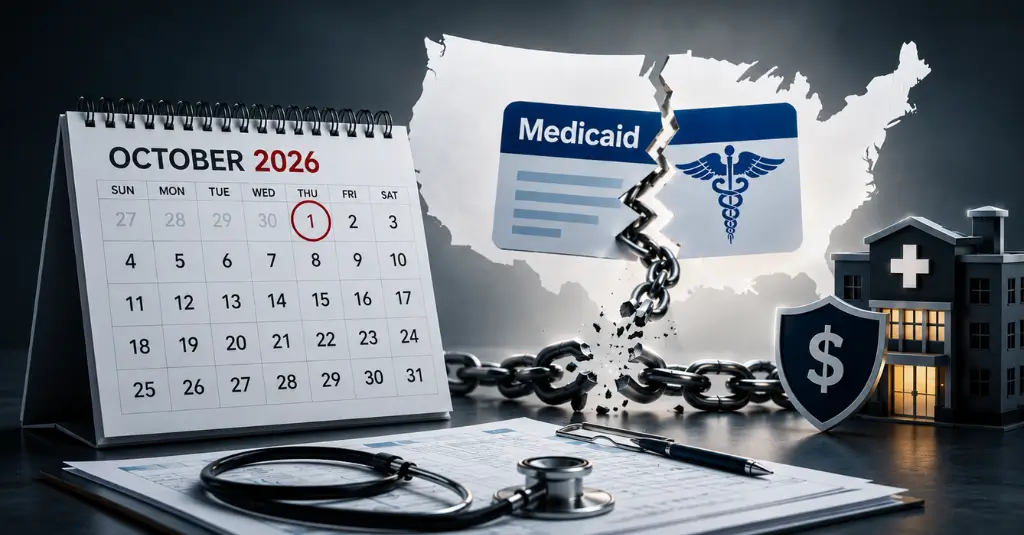


On April 8th, 2026, CMS issued State Health Official letter SHO #26-001 to instruct state agencies to discontinue claiming federal Medicaid & CHIP matching monies for all lawfully present noncitizens, effective October 1, 2026. This directive was enacted under Section 71109 of the Working Families Tax Cut legislation (Public Law 119-21). Refugees, asylees, parolees, trafficking victims, etc. (non-citizens) that are receiving full Medicaid coverage NOW will LOSE federal funding eligibility within six months. This is NOT just a change for you from a provider's standpoint. This has a direct impact on your reimbursement stream and your uncompensated care risk.
Quick Answer
- CMS issued an SHO on April 8, 2026 (SHO #26-001) that implements Section 71109 of Public Law 119-21.
- Federal matching funds for full Medicaid and CHIP benefits will cease on October 1, 2026, for most lawfully present non-citizens.
- Emergency Medicaid continues to be federally funded in qualifying acute care situations.
- Providers should immediately begin auditing their affected patient populations and preparing for emergency Medicaid documentation workflows.
What Changed and Why It Matters
Under Personal Responsibility and Work Opportunity Reconciliation Act (PRWORA) in 1996, there are specific qualified noncitizen populations (including refugees/asylum seekers, LPRs, and survivors of sex or labor trafficking) who can be fully covered under Medicaid and CHIP if they meet state-residency requirements and do not exceed state-income limits. Refugees and asylum seekers also did not have to wait the typical 5 years to receive all federal benefits.
Beginning October 1, 2026 the Framework will be revised under section 71109 of The Working Families Tax Cut legislation; federal financial participation (FFP) in the full Medicaid and CHIP benefits, will be limited to four groups: United States citizens and nationals, lawful permanent residents (green card holders); Cuban/Haitian Entrants, and compact of free association (COFA) migrants. All others, including those granted parolee status, asylee status, refugee status or victims of trafficking, who were receiving fully federally funded, prior to this date, will be ineligible for such funding beginning on this date.
According to CMS Administrator Dr. Mehmet Oz, this action is required "to fulfill a public mandate; to meet a statutory requirement; and to fulfill a moral obligation to protect the integrity of all federal health programs."
Who Is Affected: A Coverage Comparison
Here is a breakdown of how noncitizen coverage changes before and after October 1, 2026.
| Population | Before Oct. 1, 2026 | After Oct. 1, 2026 |
|---|---|---|
| Refugees & Asylees | Full Medicaid, federally matched | No federal match for full coverage |
| Afghan & Ukrainian Parolees | Full Medicaid, federally matched | No federal match for full coverage |
| Trafficking Victims (T-Visa) | Full Medicaid, federally matched | No federal match for full coverage |
| Lawful Permanent Residents | Full Medicaid (after 5-year bar) | Federal match continues |
| Cuban/Haitian Entrants | Full Medicaid, federally matched | Federal match continues |
| COFA Migrants | Full Medicaid, federally matched | Federal match continues |
| All Qualifying Noncitizens | Emergency Medicaid, federally matched | Emergency Medicaid match continues |
The CHIPRA 214 option of allowing states to cover lawfully residing children and pregnant women in Medicaid and CHIP without having to wait for five years (as provided in Section 71109) is unaffected. States can still use this coverage option; however, billing teams need to verify how their state will be treating continuing eligibility after October 1.
How This Affects Provider Reimbursement
Let's look at this from another angle. After federal funding of Medicaid is cut off to help those groups, states have two options: Fund the coverage entirely with their own money; or drop coverage for the impacted population. In all likelihood most states will opt to choose the second option. As a result of that decision, most of the patients that are currently carrying an active Medicaid card will likely be losing that coverage by October 1, 2026.
For providers, this creates three immediate reimbursement risks.
First, Medicaid-coverage by a patient is in effect at the time of service but it will likely have changed before that claim can be processed; therefore, eligibility verifications become important as you transition into the new system. Your billing team needs to develop clear procedures for verifying noncitizen Medicaid status prior to the October 1 deadline.
Second, the number of uncompensated care patients seen by primary and specialty care providers in high volume clinics and safety net hospitals caring for refugees/asylees/parolees will increase. In other words, when patients lose their insurance, they are going to continue to come into your clinic for care; however, the cost of providing them with that care will be on you.
Third, while emergency Medicaid is still a federal match program; however, the documentation requirements for emergency Medicaid are much higher than those required for standard Medicaid. Emergency Medicaid requires you to have specific clinical documentation showing the necessity for treatment of an emergency medical condition (as described by section 1903(v)(3), Social Security Act). Any weakness in your documentation will result in denied claims. Therefore, you should update your denial management services workflow prior to receiving the first claim.
What Does This Mean for Patient Populations?
Patients who are losing their Medicaid coverage will not be gone from your waiting room. A large portion of them will continue to live within the community and seek care without being covered. The heavy burden for absorbing these effects is expected to fall on safety-net hospitals, FQHCs and other rural providers because of the population that they tend to serve.
You should expect to see a larger number of patients coming in with no insurance coverage at all, an increase in the use of charity care programs, and an increase in denial of transitional claims when eligibility had been active at the time of service but had lapsed by the time adjudication occurred. Billing departments and those providing medical accounts receivable services need to consider this eligibility gap risk now - not in September.
What Should Your Practice Do Before October 1?
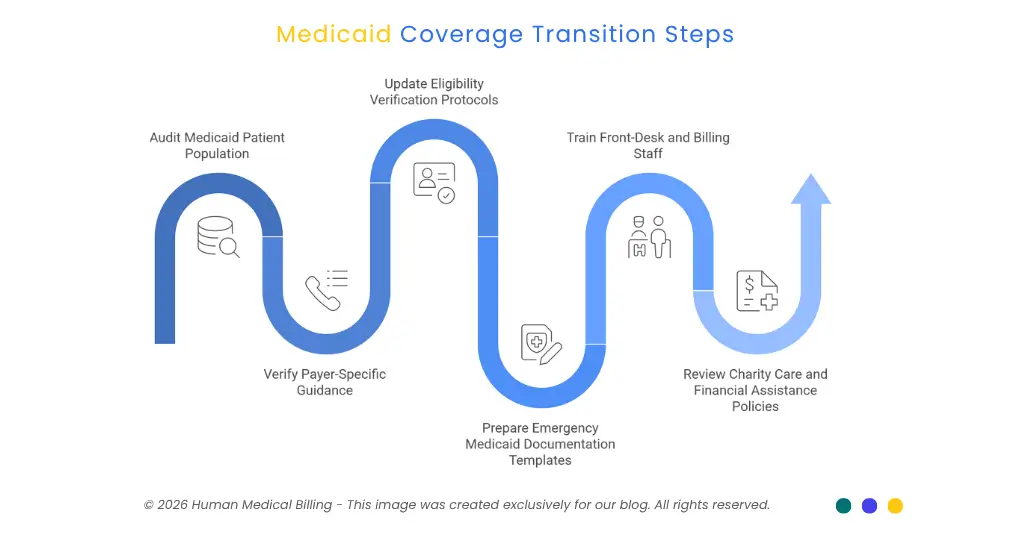
Here are the steps your billing and administrative teams should take immediately.
1. Audit your Medicaid patient population.
Create a listing of all current Medicaid patients. Identify those who may be outside of the new FFP- eligible categories based on their immigration status (refugees, asylees, parolees, trafficking victims, certain Afghan and Ukrainian parolees).
2. Verify payer-specific guidance.
Call your state Medicaid agency to verify how they are handling coverage for affected populations after Oct 1. States may fund such coverage using State-only dollars for a period.
3. Update your eligibility verification protocols.
Eligibility must be verified in real-time at each patient's visit. This is no longer optional; it will cost money if you do not have current information.
4. Prepare emergency Medicaid documentation templates.
Work with your clinical staff now, to develop a workflow in documentation that establishes the emergency nature of services for patients who lose full coverage. The medical coding services Team needs to know what clinical details are required supports this type of claim.
5. Train front-desk and billing staff.
Your staff must know which questions to ask; what documentation to collect; and where to send the claims beginning October 1.
6. Review your charity care and financial assistance policies.
Your patients losing their Medicaid coverage will need clear ways to receive financial assistance. Update your policy and train all staff on how to offer them.
Healthcare revenue cycle management Teams should mark this transition down as a high-priority planning initiative for Q3 2026.
Frequently Asked Questions
Yes. Emergency Medicaid will be eligible for a federal match for all qualifying people; regardless of their immigration status. In order to qualify as an emergency, services must meet the definition of an emergency medical condition as defined by Section 1903 (v)(3) of the Social Security Act; and there must be clear clinical documentation that supports the determination.
No. According to a recent State Health Officer (SHO) letter issued by CMS, as a result of the statutory changes made in Section 71109, states have the opportunity to continue to offer coverage for lawfully residing children and pregnant women through both Medicaid and CHIP under the CHIPRA 214 option.
Claims for the services that were provided to the patient while he/she had active coverage will likely still have to be paid; however, eligibility verification must occur at the time of the service. As long as coverage did not terminate retroactively or lapse prior to the claims process, you probably won't receive a denial. Denial management workflows need to be well established by Oct. 1.
All States must make the required changes to their systems and processes by October 1, 2026, as stated within the SHO letter. In addition, CMS is obligated to provide technical assistance. It can be assumed that providers will receive correspondence from their State Medicaid Agency regarding system updates along with a notice of transition for those beneficiaries impacted.
The October 1 deadline is approaching faster than many practices realize. That's why at Human Medical Billing, we work with the provider community that wants to be proactive about the upcoming changes (like this), rather than reactive when denials start piling up. This is an ideal time to review your patient population and make sure your emergency Medicaid processes are documented; and double-check that all of your eligibility protocols are in place to handle what is going on. If you would like to discuss how these changes may affect your specific billing practice, please go to our Contact Us page and reach out to our team. We'll help develop a strategy for your billing needs.
Contact Human Medical Billing to schedule a compliance readiness review or learn more about our end-to-end billing and regulatory support services.