



Your office recently received an "ACCESS Care Update." Can this be billed for?
Not by itself. The ACCESS co-management payment pays eligible Part B practitioners $30 per service. To qualify, your practice has to review the update, complete at least one care coordination activity, spend at least 5 minutes on that work, and document all of it. CMS opened practitioner billing on July 5, 2026, and FQHCs, RHCs and pharmacies became eligible on October 1, 2026. Three HCPCS codes, G0676, G0677 and G0678, cover the four original ACCESS tracks. Patients owe no cost-sharing.
Here is what your billing team needs to get right.
Quick Answer
- Who bills: Eligible part B practitioners can bill starting July 5th, 2026. And FQHCs, RHCs, and pharmacies can start billing October 1st, 2026.
- What qualifies: A documented review of the care update, at least one coordination activity, and at least 5 minutes of total practitioner time.
- How much does this pay: $30 per service (before geographic-adjustment) and sequestration. Adding modifier AC to your first claim in each track will add an additional $10 for the first qualified claim. But only if your practice provided onboarding support.
- How often: You are allowed to submit three claims for a single patient within a single track within 12 months. Earlier CMS materials described you could only do one every four months. Confirm spacing before billing services close together.
- What you need: Documentation of both the care update review and the coordination activities, along with a qualifying ICD-10 diagnosis for the patient’s track on the claim.
What Is the ACCESS Co-Management Payment?
ACCESS (Advancing Chronic Care with Effective, Scalable Solutions) is a voluntary 10 year CMS Innovation Center model for chronic care using technology. Organizations participating in this model will remotely monitor their patients and assist them through remote coaching and remote medication management for conditions like Hypertension, Diabetes, Chronic Musculoskeletal Pain, Depression and Anxiety. According to CMS approximately three-fourths of Medicare beneficiaries are eligible for at least one track.
You are on the referral side. As soon as the patient with Original Medicare enrolls into an ACCESS Organization, the organization will send your practice electronic structured care updates when they occur (e.g., start of care, clinical escalation, end of care). Your practice does not have to be part of this program. Once you receive them, you review what arrives, act on it, document it, and bill the ACCESS Co-Management Payment.
Eligible practitioners include physicians; nurse practitioners; physician assistants; certified clinical nurse specialists; clinical psychologists; licensed clinical social workers; registered dietitians and nutrition professionals; physical, occupational and speech therapists in private practice; marriage and family therapists; and mental health counselors
Codes, Dollars and Limits
CMS created one G-code for each track group and one modifier.
| Code | Track | Allowed amount |
|---|---|---|
| G0676 | Early cardio-kidney-metabolic (eCKM) and cardio-kidney-metabolic (CKM) | $30 |
| G0677 | Musculoskeletal (MSK) | $30 |
| G0678 | Behavioral health (BH) | $30 |
| Modifier AC | Onboarding support, reported on the first G-code per track | +$10 |
CMS will pay 100% of the allowed amount for a service minus the 2% sequestration reduction. Geographic adjustments made by the physician fee schedule apply a payment adjustment based on your location.
You may submit up to three services every 12 months, per patient, per track. A single patient can have multiple program tracks if you document that you performed distinct review and coordination activities for each. A patient can’t be enrolled in eCKM and CKM at the same time.
A note on frequency
CMS Billing Page indicates that no more than three services can be billed to one patient in a period of 12 months. However, earlier CMS material (technical FAQ) indicated a time frame of once per four months. Because CMS has yet to reconcile this difference, we suggest you contact CMS or your MAC to determine the exact number of months and also keep track of when services are submitted for patients who have been served less than four months prior.
How modifier AC works
The modifier AC is NOT automatically applied. Instead, it adds $10 to the first eligible co-management claim made for a track. This will only occur if you have actively participated in providing onboarding support to the patient. Examples of this type of support include; facilitating the selection/ enrollment into an ACCESS organization, educating the patient regarding their responsibilities as part of the organization, supporting the patient with their device/app setup and/or confirming that data is beginning to flow. Modifier AC can be reported only once per billing provider, per patient, per track, and the onboarding work should be documented in the chart.
Using the CMS payment tables, three $30 services and one $10 modifier equals $100 per patient per track over twelve months, before adjustments. We calculated this number ourselves using the CMS payment tables. CMS did not project these numbers.
What This Means for Providers and Billing Teams
A review alone doesn’t qualify. CMS requires a review of the care update, at least one coordination activity, and at least 5 minutes of total practitioner time across both.
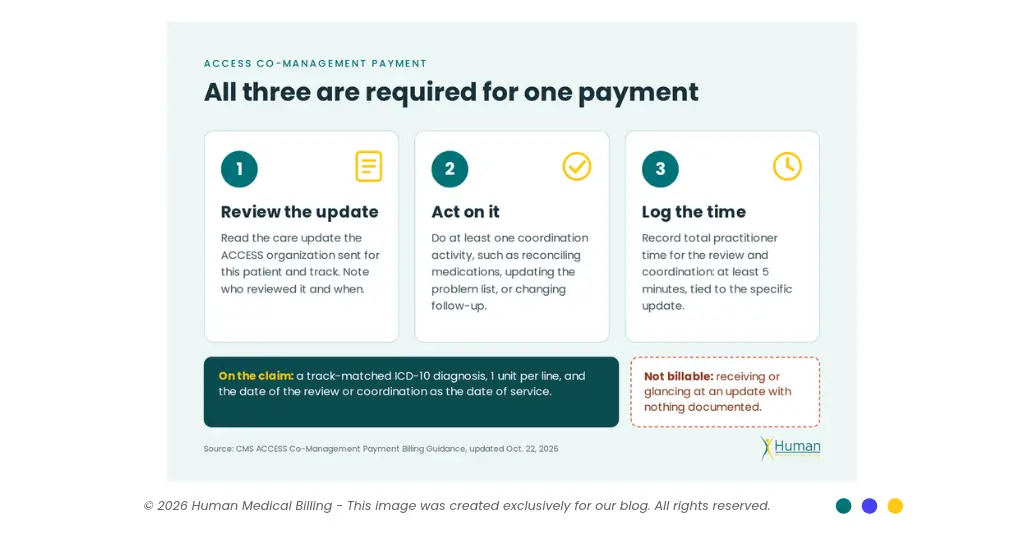
Examples of qualifying activities are as follows:
- Adjusting or Reconciling Medications
- Updating the Problem List
- Setting up or Changing Monitoring/Follow-up Instructions
- Coordinating with Other Clinicians Involved in Patient Care
- Communicating with ACCESS Organization
- Documenting Agreement or Disagreement with ACCESS Recommendations, and Your Reason
Consider a Nurse Practitioner reading a rising Pain Score, adjusting a Medication and documenting 8 minutes reviewing the Update and Change. This could be evidence for a Claim as long as the Patient is in this Track and the Note shows how the Medication was changed because of the specific Update received.
Getting the claim right
At least one diagnosis from the claim must meet a Qualifying Condition of the Patient's Track. CMS has published these ICD-10 Value Sets in the ACCESS Model API Implementation Guide. Claims that do not have at least one matching diagnosis will be denied. One unit should be reported per Claim Line; the MBI of the patient is to be included; the date of service is to be dated when the review/coordination was completed. The Place of Service is to represent the Practice Setting of the Rendering Practitioner. Timely Filing Requirements of Original Medicare also Apply.
Need help with your ACCESS Workflow to ensure you submit Clean Claims? Human Medical Billing will Review Your Documentation, Coding and Provider Enrollment Setup prior to your First Submission.
When auxiliary personnel do the work
CMS permits auxiliary personnel to furnish these services under general supervision when they are employees, leased employees or contractors of the billing provider. The supervising Medicare-enrolled practitioner’s NPI must be reported in both Item 24.J and Item 17. CMS describes the 5-minute minimum as total practitioner time and has not explained how that requirement applies when auxiliary personnel do the work. Get guidance from your MAC before relying on that model.
Enrollment and credentialing
When a reassigned rendering practitioner is reported in Item 24.J, CMS validates that practitioner’s Type 1 NPI in NPPES, Medicare enrollment in PECOS, and reassignment to the TIN on the claim. Item 24.J isn’t separately required when the same individual is both the rendering and billing provider. The billing provider’s Type 2 NPI must also be associated in PECOS with the TIN reported on the claim. Outdated enrollment or reassignment records will cause denials, so this is a good time to confirm your medical credentialing services are current.
FQHCs, RHCs and pharmacies
FQHCs/RHCs will submit Institutional Claims on the 837I, using Type of Bill (71X) for RHCs or (77X) for FQHCs. Use Revenue Code 0780 with Modifier 95 if Audio-Video Telehealth is used; Modifier 93 for Audio Only. Pharmacies billing under specialty code A5 leave Item 24.J blank.
What This Means for Patients and Payers
Patients owe nothing for this service. Because cost-sharing doesn’t apply, CMS says you don’t need advance patient consent to provide it.
ACCESS currently covers only Original Medicare. Patients enrolled in Medicare Advantage, PACE or the hospice benefit are not eligible.
In February 2026, CMS announced that major health payers representing about 165 million people across Medicare Advantage, Medicaid and private insurance had pledged to offer outcome-based payment arrangements aligned with ACCESS by January 1, 2028. These plan-run arrangements are separate from Medicare and do not make their members eligible for the ACCESS co-management payment. Until an individual payer publishes its own billing rules, treat G0676, G0677, G0678 and modifier AC as Original Medicare billing only.
CMS has also addressed the risk of misuse. The agency doesn’t limit how many clinicians can bill for the same patient, but it says it "will monitor billing patterns to identify potential duplication or abuse." Your documentation is your defense.
Be sure to keep this payment separated from all of your other billing. CMS says it doesn’t replace office visits or other distinct services. CMS has provided no guidelines specific to ACCESS regarding overlapping services with Care Management Codes including CCM, PCM or RPM. To protect yourself against possible compliance issues; record ACCESS time separately and never double-count the same minutes. Our G2211 guide explains that code’s own requirements.
What’s Changing in 2027
On September 15, 2026, CMS announced four new ACCESS tracks: heart failure, COPD, substance use disorder and tobacco cessation. The new tracks are scheduled to begin April 1, 2027. CMS is also adding a follow-on track for chronic musculoskeletal pain which will allow eligible patients to continue to receive support through their Access organization after they have completed their initial 12 month of care.
With the launch of the new tracks, look forward to hearing about additional care updates from your local Access Organization. Review all CMS Billing Guidance as it relates to any new coding guidelines or procedures related to the new tracks prior to billing for the new services.
What Should Your Practice Do Now?
Create a single repeatable workflow for all updates from Care Update to EHR Note. Verify with every Access Organization how their updates will get to you; as well as make sure your front office staff and clinical staff are aware of which way they should send all updates.
The Four-Step Documentation Flow
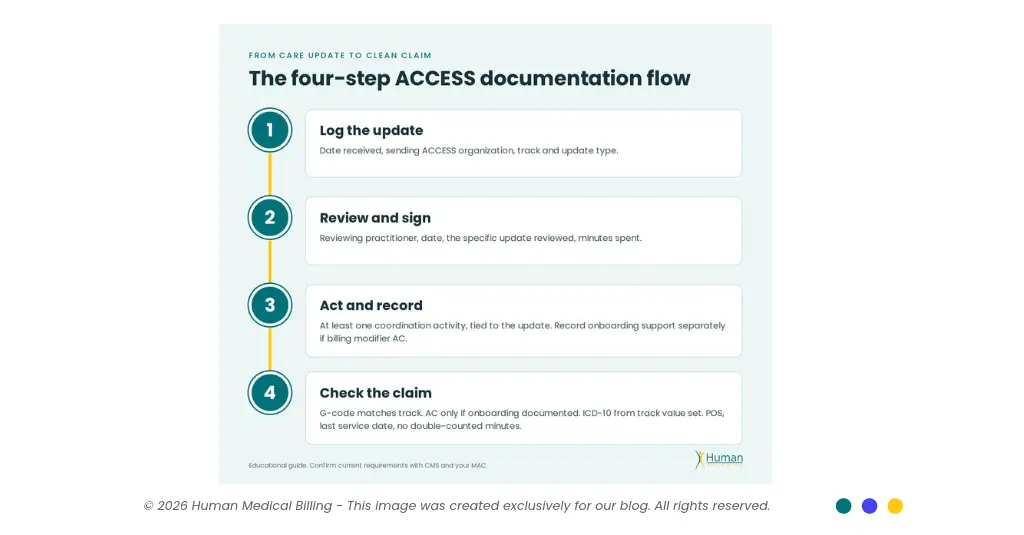
1. Log the update.
Record the date it arrived, the sending organization and the track.
2. Review & Sign.
The name of the provider reviewing, the date it was reviewed, what update was reviewed and how long he/she took to review is required.
3. Act & Record.
At least one action related to the update in plain language must be recorded along with how this relates to the update. Onboarding assistance can also be recorded separately to provide additional support for modifier AC.
4. Check Claim.
Match the G-code to the track. Modifier AC may only be applied if onboarding assistance was provided and documented. Make certain the ICD-10 code used for billing corresponds with the track. Make certain Place of Service is correct. Check the date of the patient's last service in that track. Minutes of care management should be kept separate. We have a CCM OIG Checklist that addresses that part of the process.
Prior to submitting your first claim, verify your understanding of the current version of the CMS Billing Guidance Page (updated thru Oct. 22, 2026). In addition, ensure your Coding Lead verifies your use of the proper Code, Modifier and billing interval.
Five ACCESS Claim Errors to Catch Before You Submit
Because this payment is new, most practices are building their workflows from scratch. Based on the CMS billing rules, these are the errors most likely to cause denials or audit exposure.
1. Billing upon receipt.
A care update arrived and someone glanced at it, but no coordination activity or time was documented. This doesn’t qualify, no matter how relevant the update was.
2. Treating Modifier AC as Automatic.
Appending AC to every first claim without documented onboarding support turns a $10 add-on into an overpayment risk.
3. A diagnosis that doesn’t match the track.
For example, when claiming a G0677; you need to have a Musculoskeletal Diagnosis Code (from the CMS Value Set). A Hypertension Diagnosis Code would result in Denial even though the Patient may have Both Conditions.
4. Incorrectly Billing Patients.
Medicare Advantage, PACE and Hospice patients are NOT Eligible. Coverage should be checked prior to creating a Claim, NOT AFTER the Claim Has Been Denied.
5. Counting the Same Minutes Twice.
If 10 minutes of Medication Reconciliation appear in both a CCM Log AND an ACCESS Note, both Claims will become difficult to Defend.
How the claim line comes together
| Claim element | Entry |
|---|---|
| HCPCS | G0677 (MSK track). Add modifier AC only if onboarding support was documented and this is your practice’s first claim for this patient and track |
| Diagnosis (Item 21) | A qualifying ICD-10 code from the CMS value set for the MSK track |
| Date of service | The date the review or coordination took place |
| Units | 1 |
| Place of service | The rendering practitioner’s practice setting |
| Rendering NPI (Item 24.J) | Required only if the rendering practitioner differs from the billing provider |
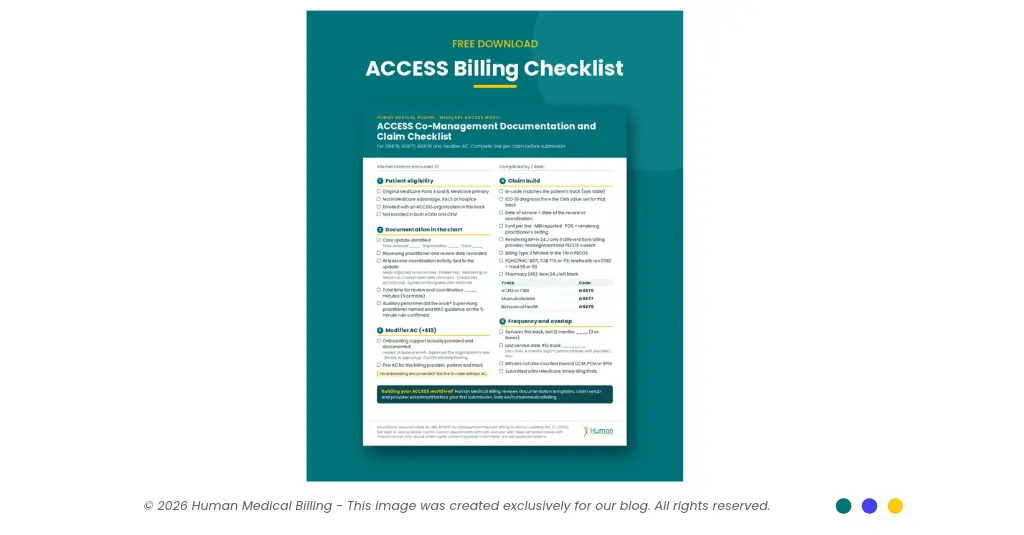
Free download: ACCESS Co-Management Documentation and Claim Checklist
One page your team can use on every ACCESS claim: documentation fields, the 5-minute time rule, track-to-code matching, modifier AC rules and a pre-submission claim review.
Frequently Asked Questions
No. The CMS states that there should be documentation of the care update having been reviewed by the practitioner; there has to be some form of coordination effort made as well as a minimum of five minutes (total) of practitioner time.
The CMS billing page allows up to three services every 12 months, per patient, per track. Earlier CMS materials described a once-every-four-months limit, so confirm spacing with your MAC. Modifier AC can be reported only once per billing provider, per patient, per track, and only for onboarding support you provided.
No. Any eligible practitioner may bill for the services as long as they are enrolled in Part B.
No. The patient will pay nothing for these services, so advance consent is not required.
No. ACCESS is limited to original Medicare only. Plans that pledged to align with ACCESS run their own separate arrangements.
CMS does allow auxiliary personnel to provide these services as long as they are provided under general supervision; however, CMS has not clarified if/how the 5 minute practitioner time requirement applies in an auxiliary setting. Verify with your MAC prior to using a all staff model of operation.
The Bottom Line
The Access Co-Management Payment is a relatively low dollar amount for each claim; however, when you have a large Medicare Panel (i.e., multiple claims), the amounts add up quickly. Each claim relies on notes written by individuals within your medical practice. When practices implement the correct workflow at this time, they will be prepared when the 2027 Tracks of Care Updates are implemented as well.
Please contact us at Human Medical Billing to evaluate your current care coordination billing workflow prior to submitting your initial claim(s). We can also provide an overview of how this payment relates to your overall Healthcare Revenue Cycle Management Services. If you would like to begin by asking a question, please do so and we will work through your documentation template and claim fields together.

Contact Human Medical Billing to schedule a compliance readiness review or learn more about our end-to-end billing and regulatory support services.