



The 2027 End Stage Renal Disease (ESRD) Final Rule establishes payment rates for dialysis services at Medicare-certified dialysis facilities. This rule does NOT establish payment rates for Nephrology physicians. On October 28, 2026, CMS published the 2027 ESRD Final Rule which will affect all dialysis services furnished on or after January 1, 2027. The Dialysis Base Rate increases to $297.52 and CMS estimates that total facility payments for dialysis will increase by approximately 2.7%.
Payment rates for physician professional services are governed under a completely separate system; as such, the proposed 2027 Physician Fee Schedule has been issued but is yet to be finalized. Prior to quoting an increase of salary, make certain your billing department confirms both changes separately.
Quick Answer
- Nephrology professional service fees are still based on Medicare's fee schedule and do not change under this new reimbursement program for dialysis services.
- The base payment rate in 2019 is $297.52, an increase of $15.81 from $281.71. The increase due to phosphate binder addition accounts for approximately $12.85 of the additional dollars.
- Note that the 2.7% increase represents total facility payment increases. Do NOT include this increase when projecting or estimating your nephrology professional revenue.
- The proposed Physician Fee Schedule (PFS) for 2027 is currently just a proposal and should be identified as such.
Who the 2027 ESRD Final Rule Covers
CMS-1846-F makes modifications to the prospective payment system (PPS) of End Stage Renal Disease (ESRD). With this PPS, Medicare will pay each dialysis unit a single bundled rate per treatment. This rate will include all the drugs, biologicals, lab tests, and materials used for dialysis. In 2027, Medicare anticipates paying approximately $7.0 Billion to around 7,600 dialysis units.
The below are the key events that led up to this point. On June 2, 2026, the proposal was published. The proposal had a base rate of $299.55. On October 28, 2026, the final version was released; it has a lower rate than the proposal of $297.52. Services paid under this new rule may begin as early as January 1, 2027. The Physician Fee Schedule is being updated through an independent process. Comments were accepted on September 14, 2026.
Facility Bundle vs. Professional Services
Chapter 8 in the Medicare Claims Processing Manual is where this issue is resolved. Any other ESRD related lab work, drugs, or medical equipment are paid by the provider for which you have submitted your claim, as a result of the ESRD PPS; therefore, other billers can also submit claims for these items, but they will be rejected or denied by the consolidated billing edit.
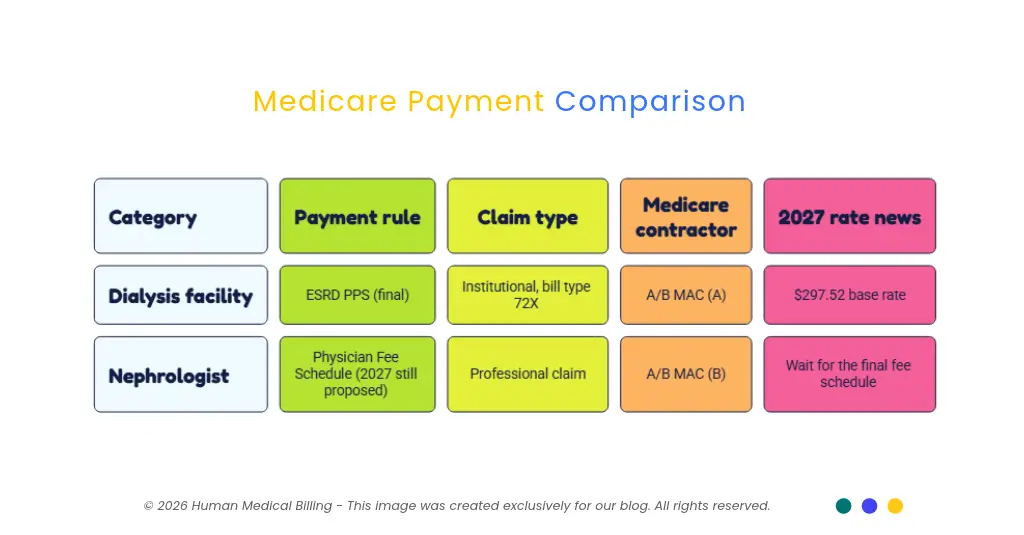
| Dialysis facility | Nephrologist | |
|---|---|---|
| Payment rule | ESRD PPS (final) | Physician Fee Schedule (2027 still proposed) |
| Claim type | Institutional, bill type 72X | Professional claim |
| Medicare contractor | A/B MAC (A) | A/B MAC (B) |
| 2027 rate news | $297.52 base rate | Wait for the final fee schedule |
What Changed in the Final Rule
Seven Changes to be Aware of for Dialysis Units and Anyone Working Near Them
1. Base Rate.
$297.52; A $15.81 increase over last year's $281.71. This amount is made up of $12.85 for adding phosphate binder folding into the bundle for good, as well as a 1.9% market basket update.
2. Wage Index and Outliers.
CMS continues to maintain the 0.6000 wage index floor and the 5% limit on annual reductions. In addition, adult outlier service thresholds are increasing (for the most part) due to new drugs being considered as outlier services.
3. Low-Volume Adjustment.
The number of treatments required before the low-volume adjustment kicks in has doubled from 4,000 to 8,000. The tier system also increased from two to six. Facilties have until December 31, 2026 to attest. CMS plans to offset this change by reducing the base rate approximately 1.1%.
4. Pediatric Payments.
The pediatric add-on that was established temporarily will run out after 2026. Instead, CMS will replace it with updated case-mix adjuster and apply the low-volume adjustment to pediatric treatments.
5. Training for Home and Self-Dialysis Patients.
The training add-on went from $95.60 to $138.00. In addition, facilities can now submit claims for training provided in the first four months of dialysis via an onset factor of 1.311.
6. AKI Treatment.
Payment for Acute Kidney Injury will match the base rate of $297.52. Facilities providing medical care to individuals suffering from AKI will need to provide all medically necessary phosphate binding agents to those under their care.
7. Add-On Drugs and Quality.
CMS is tightening TDAPA price limits. From PY 2029 forward, one ESRD QIP measure will give way to a hyperphosphatemia measure
What the Final Rule Means for Billing Teams
This budgetary piece was based upon the dialysis base rate being increased. The increase will only increase the amount earned by the facility; it will not increase the professional fees billed by your nephrologists.
CMS implemented the monthly capitated payments for physician services associated with dialysis via a Physician Fee Schedule Rule. Because the payment amounts for physician services are paid to a supplier, they are covered separately within Chapter 8.
So how will this affect your practice? The 2027 ESRD Final Rule changes what the dialysis facility earns. Your professional fee amounts remain unchanged.
There is also some pressure on the professional side. According to the American Hospital Association (AHA) the proposed 2027 Physician Fee Schedule would lower the qualifying APM conversion factor by 1.19 percent and the non-qualifying factor by 1.68 percent. We have put together a list of our 2027 PFS cuts post and you may treat these figures as proposals and indicate such in all reports issued.
Check your handoffs. Facilities submit a claim on behalf of their patients using institutional claims and include HCPCS 90999 on the Hemodialysis Revenue Code Line. Claims submitted on behalf of your practice will be submitted to a different contractor. Should a claim from a professional contain ESRD-related medications, laboratory tests or supplies, then consolidated billing edits could potentially reject the claim and the facility, not your practice, will receive the payment.
You should also know that CMS has instructed facilities that as of July 1, 2026, they cannot bill renal dialysis services that were performed on or after that date with the AX modifier. As we mentioned earlier, we have posted information regarding the AX Modifier in our NCCI Q3 2026 post.
Payer and MAC Cross-Checks
The patient is responsible for 20% (after the deductible) of the total bundled price, and Medicare will pay 80%. The 20% patient responsibility includes all aspects of the bundle including adjustments, additional training costs and outlier payments. Therefore, when you are billing under the new bundles, patients will receive their portion of the bill directly from the dialysis center, not through your professional claim submissions.
You can also ask your partners two questions. Have they filed their Low Volume Attestation as required by CMS and what changes have they made with regard to ordering Phosphate Binders since they were included in the Bundle?
Their responses will assist you and your staff in answering patient questions about the bundle in January.
Review all contracts. Identify which contracts reference the ESRD PPS versus the Physician Fee Schedule. If a contract references the ESRD PPS, follow the facility's rate structure. If the contract references the Physician Fee Schedule, follow the professional fee schedule.
What Should Your Nephrology Practice Do Now?
Most of what we're doing will take an afternoon, rather than a month.
Steps prior to January 1, 2027
- Identify all 2027 rates in your budget and label them either "facility" (ESRD PPS) or "professional" (Physician Fee Schedule).
- If your practice owns or has a partial interest in a dialysis unit verify that it submits the Low Volume Attestation for 2026 to the Medicare Administrative Contractor (MAC), prior to December 31st, 2026.
- Tag each contract with a payer as "bundle" or "fee schedule."
- Verify Professional Claims do not contain any ESRD related drug, lab or supply line components and monitor any January rejections on your Medical Accounts Receivable Services Workflow.
- Send any open questions regarding codes, settings, and fee schedules to your Coding Lead, or a Healthcare Revenue Cycle Management Services Partner, prior to loading your 2027 rates.
Frequently Asked Questions
The answer is no. However, the rule does establish how much dialysis centers will be paid under the esrd prospective payment system (PPS) in 2027. Payments for professional services are subject to the medicare physician fee schedule, and as of this date, the 2027 version has been proposed by CMS but it has not yet become final.
CMS has determined that the new base rate for all dialysis services covered under the esrd PPS in 2027 will be $297.52. This is an increase of $15.81 over the base rate established by CMS for the year 2026. A portion of that amount ($12.85) is attributed to changes in reimbursement rates for phosphate binding agents.
All renal dialysis services provided by dialysis providers on january 1, 2027 or thereafter will be governed by the provisions contained in the 2027 final rule.
As CMS reports, it estimates a total increase of 2.7 percent for payments made to dialysis providers in 2027; however, it also states that it anticipates both free-standing and hospital based units will experience a similar increase of 2.7 percent in their total payments received.
Your professional revenue needs its own forecast for 2027. The 2027 ESRD final rule is a facility story. Human Medical Billing provides support to medical billing practices in all specialties, with clean claim submissions and follow-ups on all of the practice's aging professional claims. Please provide our office with a copy of your payer contracts and draft of your 2027 budget. We can then note those lines in your budget that fall under the facility rule as well as those that are governed by the fee schedule. Complete this process prior to January 1st (when the new rates take effect). Are you looking for an additional pair of eyes? Schedule a consultation today.

Contact Human Medical Billing to schedule a compliance readiness review or learn more about our end-to-end billing and regulatory support services.