


CMS has published their performance score reports for August 2026, which include a facility's skilled nursing facility (SNF) value based purchasing (VBP) program incentive payments. Those reports can be found in iQIES currently. Your SNF VBP Incentive Payment Multiplier is within those reports and determines what percentage CMS will pay you on each part A claim for the entire fiscal year. CMS is scoring all participating SNFs using 8 Quality Measures as opposed to 4 previously. All corrections to those numbers are due by August 30th, 2026.
If your billing department has not produced the data report for this reporting period (the time to produce), then this will likely be the week you need to do so. You should not wait to discover why your claim payments are less than anticipated once they begin returning as such.
Quick Answer
- CMS issued the FY 2027 Skilled Nursing Facility Value-Based Payment (SNF VBP) Performance Score Reports via iQIES in August of 2026.
- SNFs will have a total of 8 Quality Measures scored within this program as opposed to four previously.
- Facility reports include the incentive payment multiplier which CMS will apply to your FY 2027 Part A claims' Adjusted Federal Per Diem Rate.
- A facility can correct its performance score by submitting corrections to the SNF VBP Help Desk no later than August 30, 2026.
What Is the SNF VBP Program, Exactly?
The Skilled Nursing Facility Value-Based Purchasing (VBP) is part of your Medicare reimbursement for providing care at an SNF. VBP will deduct a portion of your Medicare Part A payments to reward those SNFs that perform better on quality metrics. The amount deducted is 2%, which is called the withhold. Then CMS redistributes approximately 60% of this 2% deduction (the total withhold is $1.6 billion in FY 2027) as performance-based incentive funds to participating SNFs. The remaining 40% goes into the Medicare trust fund.
All these numbers add up to the one number that determines each SNF's Incentive Payment Multiplier. CMS multiplies each of its FY 2027 Part A claims by the SNF's Incentive Payment Multiplier (calculated from the previous fiscal year) multiplied by the SNF's Adjusted Federal Per Diem Rate. If your SNF receives a good rating, you may receive more money back than was originally taken out during the withhold. If your SNF receives poor ratings, you will lose more money on every single Part A claim made against your organization, for all of FY 2027.
It is important to note that this is not a minor program. This program affects Part A payments for every certified SNF throughout the United States regardless of whether the facility has 10 beds or 200 beds.
What Changed in FY 2027
Beginning in the FY 2027 program year, CMS will use eight quality measures to evaluate hospitals; in previous years, CMS used only four. These include, as per CMS's FY 2027 Fact Sheet:
| Measure | What It Tracks | Data Source |
|---|---|---|
| SNF 30-Day All-Cause Readmission | Unplanned hospital readmissions | Part A claims |
| SNF Healthcare-Associated Infections | Infections requiring hospitalization | Part A claims |
| Discharge to Community | Successful community discharges | Part A claims |
| Long Stay Hospitalization | Hospitalizations per 1,000 long-stay days | Part A claims |
| Total Nursing Staff Turnover | RN, LPN, and aide turnover | Payroll-Based Journal |
| Total Nurse Staffing | Nursing hours per resident day | Payroll-Based Journal |
| Discharge Function Score | Functional outcomes at discharge | MDS assessments |
| Falls with Major Injury | Long-stay falls resulting in major injury | MDS assessments |
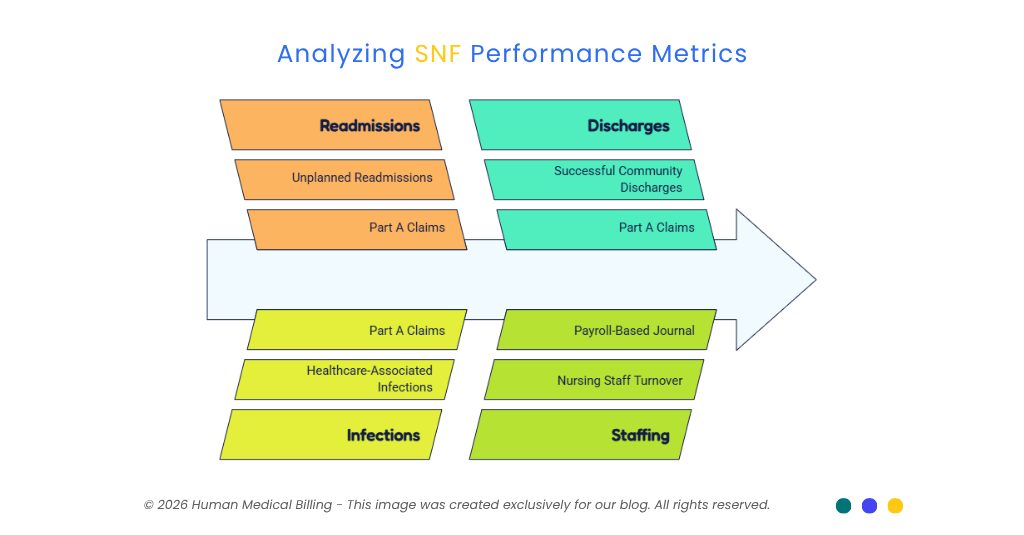
For every single measure, CMS has established both a base line and performance periods (FY 2023 and FY 2025 respectively); each has also been assigned a "case minimum" number of cases. In other words, if you do not meet the case minimum in an area during the performance period, then the measure is simply dropped from consideration when determining your total quality score.
However, CMS did establish a floor in terms of how many of the eight measures have to be met by facilities in order to be evaluated under the program.
Facilities that are unable to achieve the case minimum on at least four of the eight measures are disqualified from participation in the program and will receive their standard payment without being eligible for a positive or negative quality multiplier.
CMS calculates your payment based upon three steps: first it will use either the achievement score or the improvement score for each measure; second, CMS will take this higher of these two scores and calculate a normalized 100 point performance score using an algorithm that is specific to each measure; third, CMS will apply a transformed "multiplier" (a value greater than or less than 1) to your per diem rate. This multi-step process is completely invisible from a remittance advice. The only thing you can see is whether the amount of money paid to your hospital for this service was higher or lower than the amount of money you were able to bill for it last year.
What This Means for Your Billing Team
The quality office concern of reports has ended and become a revenue cycle concern in this section. Your incentive payment multiplier is applied to every part a claim you submit for FY 2027. It's not just a one-time adjustment on remittance advise. It will apply to the rate for all stays throughout the fiscal year.
Billing staff are to immediately flag a number of items.
- The "multiplier" is applied at the facility level. Therefore, all units/campuses that have their own CMS certification will need their own checks in iQIES.
- A decrease in your multiplier from last year could be seen as an unaccounted for underpayment on your remittance notice if no one has given finance warning prior to this being posted.
- Your Staffing Measures (Turnover & Total Nursing Hours) are now pulling data directly from your Payroll Based Journal Submissions. So, inaccuracies in your PBJ submissions will impact your Part A Rate similar to how they did NOT previously due to Readmission Measures.
- Facilities that operate several sites may receive different multipliers at each location. Thus, Budgeting the Same Rate Across a Portfolio No Longer Works.
Human Medical Billing has been working with SNF's because they are a prime example of how easily those payment mechanisms can be lost in the shuffle until the claim is returned at a lesser amount than anticipated. By catching the multiplier now (instead of having to chase down why there was one three months from now), you will have time to adjust cash flow planning accordingly by the time FY 2027 starts rolling into your systems.
What Should Your SNF Do Before August 30?
The correction window is closing quickly, and CMS will not extend it. Below are steps to follow throughout the week to correct issues that may have occurred during your QIES review:
Step 1. Log in to iQIES and download the Report.
Check your facility's CCN (CMS Certification Number) and confirm if your multiplier was changed compared to the previous year.
Step 2. Pull the underlying measure results.
Compare your baseline and performance period numbers for all eight measures to your internal data and MDS records.
Step 3. Check PBJ-sourced measures closely
Be cautious when reviewing PBJ sourced measures as these directly reflect payroll submissions. Small errors in payroll reporting can affect your total nursing hours and staff turnover measures which could negatively affect your overall score.
Step 4. File Corrections by August 30th.
Send a request to SNFVBPquestions@cms.hhs.gov with your CCN, what correction you are seeking, and why.
Step 5. Get your Revenue Cycle Team involved NOW.
If the Multiplier has decreased, prepare yourself for discussions regarding FY 2027 claim reimbursement prior to claims being submitted to your organization and someone asking "Why?
Frequently Asked Questions
This is how much CMS will multiply the amount of your Adjusted Federal Per Diem Rate when it processes FY 2027 Part A claims, based on the scores you receive across all of the eight VBP Quality Measures.
There are now eight measures to be used for the fy 2027 snf VBP Program as compared to four in previous program years. Those eight measures will include; readmission rates, infection rates, post hospital discharge outcomes, staffing levels, staff turnover and fall rates.
A single measure that you do not meet the case minimum on will get eliminated from your overall performance score. If there is no meeting of the case minimum for at least 4 (four) of the 8 (eight) total measures that make up the fy 2027 snf VBP Program, your facility will be eliminated from participation in this program for the current year and will receive the standard rate payment.
That would be August 30th, 2026. After that all submissions should be sent to snfvbpquestions@cms.hhs.gov.
The Bottom Line
If you don't see anything different when you pull the August report for FY 2027 your Part A Rate has already been established. Take some time to review those eight measures using your internal data as references. Send in any corrections you may find while there is still time to do so (by August 30). If you are looking at reviewing a "multiplier" based on claims data prior to starting FY 2027 billing or need another pair of eyes to double-check your rates, then Healthcare Revenue Cycle Management Services from Human Medical Billing will assist you with both.

Contact Human Medical Billing to schedule a compliance readiness review or learn more about our end-to-end billing and regulatory support services.