



The CMS has approved four post-acute care (PAC) rule finalizations that were released late July 2026 with each effective October 1, 2026. The finalizations are part of the FY 2027 PAC payment update and apply to Skilled Nursing Facilities (SNF), Inpatient Rehabilitation Facilities (IRF), Inpatient Psychiatric Facilities (IPF), and Hospice. The rate increase will be 2.3% to 2.4%, depending upon the type of facility. The real issue is found in the policy language, however. For example, Hospices will need to provide an election statement addendum to each beneficiary who elects this coverage as opposed to only providing it when asked by the beneficiary. Additionally, Inpatient Rehabilitations Facilities will have to meet a harder deadline to begin therapy for beneficiaries after discharge from hospitals; also, they will need to conduct their first interdisciplinary team meetings within 5 days of hospital discharge. Therefore, billing teams for all these providers will need approximately 7 weeks to correct or amend any claims edit, form corrections, and/or workflow issues prior to the end of the fiscal year.
Quick Answer
- The effective date for all four FY 2027 post-acute rulemaking documents is October 1, 2026; this is the beginning of fiscal year (FY) 2027 for the U.S. Government.
- FY 2027 SNF payment will increase approximately 2.4% or about $882.74 million. Payments for IRFs, IPFs, and Hospices are estimated to have a 2.3 percent payment increase.
- Hospices need to provide an election statement addendum with the election statement to all electing beneficiaries. It does not apply only to those requesting one.
- IRFs must begin all therapy within 36 hours of inpatient admission and conduct their initial interdisciplinary team conference by Day Four.
What CMS Finalized, and When
When CMS put out its SNF rule (CMS-1843-F), its IPF rule (CMS-1847-F), its IRF rule (CMS-1845-F) and its Hospice Rule (CMS-1851-F) on July 29, 2026 — they all went into effect as of October 1, 2026.
That will create one cutover window for four types of facilities, which should be helpful except when an outdated form starts causing claims denials in week 2 of October.
Post acute claim volumes, plus physicians billings can make it difficult for practices to manage their first two weeks of a new rate table. Rates update cleanly. Documentation does not. That's why Healthcare Revenue Cycle Management Services have a purpose.
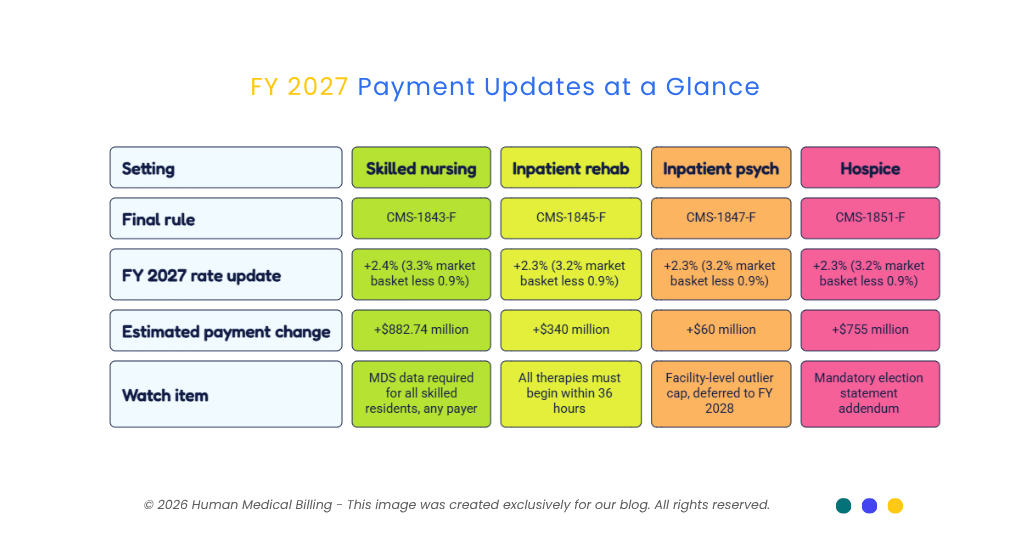
FY 2027 Payment Updates at a Glance
| Setting | Final rule | FY 2027 rate update | Estimated payment change | Watch item |
|---|---|---|---|---|
| Skilled nursing | CMS-1843-F | +2.4% (3.3% market basket less 0.9%) | +$882.74 million | MDS data required for all skilled residents, any payer |
| Inpatient rehab | CMS-1845-F | +2.3% (3.2% market basket less 0.9%) | +$340 million | All therapies must begin within 36 hours |
| Inpatient psych | CMS-1847-F | +2.3% (3.2% market basket less 0.9%) | +$60 million | Facility-level outlier cap, deferred to FY 2028 |
| Hospice | CMS-1851-F | +2.3% (3.2% market basket less 0.9%) | +$755 million | Mandatory election statement addendum |
Hospice Gets the Heaviest Lift
Beginning with FY 2027, the total amount of money available for all hospices (the "aggregate cap") is increasing by about $813 to approximately $36,175. That is an increase from $35,362. The 2.3 percent increase in FY 2026 would have resulted in an average annual per diem payment for each patient of about $820. However, if a hospice fails to report required Quality Data and instead gets a 4 percent decrease, their average annual per diem payment would drop to $774, a net loss of 5.8 percent over the prior year's payment.
Next we get into some background. The election statement addendum was first mandated in FY 2020; however, it was optional. Only those patients or their representatives who requested the addendum were permitted to obtain one. It appears that despite the requirement being optional, Medicare non-hospice spending continued to grow. Therefore, CMS determined that this optional provision did not provide the intended level of accountability. As such, CMS has now made the addendum mandatory for all patients electing to receive care through hospice.
One advantage was to be had. CMS allows for a physician's designate or the physician member of the interdisciplinary team to discharge a patient from hospice as well as the medical director.
Reporting quality is also increasing. The Centers for Medicare & Medicaid Services (CMS) reported hospice non-compliance rates at 22.06% in FY 2024, 23.53% in FY 2025, and 20.37% in FY 2026.
By FY 2028 at the earliest, Care Compare will post an icon on hospices who do not provide anything, or less than 90%, of their required reporting.
IRF Documentation Rules Just Got Stricter
CMS has changed 42 CFR 412.622 (a) (3) (ii) to include ALL Therapies in the 36 hour time frame following Admissions. One Word Changed; Years of Auditing Disputes Are Over!
Also, the CMS has made changes to the Interdisciplinary Team Meeting Rule. An Initial Team Meeting Must be completed ON OR BEFORE Day Four of Admission. In addition, CMS Defined "Weekly" as Seven Days Following the Initial Team Meeting Date. You will Need to Update your Documentation Templates to Include Date Logic to Match this New Definition.
In terms of Quality Data Reporting Requirements; Both IRF and SNF will have less time to report their Quality Data. CMS Has Reduced This Time Frame From 4.5 Months To Approximately 45 Days Beginning With the FY 2029 Reporting Cycles. As the Correction Window Shrinks to Such an Extent, the Only Workable Solution is Medical Coding Services Provided at the Source
SNF and IPF Changes worth Tracking
Beginning in FY 2028 SNFs will no longer have two COVID-19 vaccinations included in the Quality Reporting Program (QRP). However, it is expected that the impact of the MDS changes will be greater; as of FY 2028, each SNF will need to report Minimum Data Set (MDS) information on all residents receiving covered skilled services, regardless of whether or not they are paying for these services. Additionally, CMS expects there to be approximately $203.60 million in reduced revenue from SNF Value Based Purchasing adjustments due to the value based purchasing program in FY 2027.
The IPF’s received a 2.3% increase in payment amounting to roughly $60 million. CMS has capped facility level outlier payments at 20% of an IPF’s total Prospective Payment System (PPS) payments and made an exception for those IPFs that have less than 50 discharges per year and pushed back the effective date to FY 2028. Two additional quality metrics were removed from the IPF QRP effective with CY 2026 reporting – SUB-2 & SUB-2a, along with TOB-3 & TOB-3a.
Additionally, CMS plans to create a standardized patient assessment tool for IPF patients. An additional feature of the tool is the ability to allow providers to enter their information via a free CMS web-based application called PARIT or by using HL7 FHIR APIs. Therefore, IPF will be the first CMS quality reporting program to use FHIR APIs for entering patient assessment data.
What Should Your Billing Team Do Before October 1?
Seven weeks should be sufficient time for this transition as of today. Below are the necessary steps that need to occur prior to the cutover.
Prior to Cutover Steps:
Step One: Load FY 2027 rates and wage indexes into your billing system and test claims within all impacted facilities (sample) through testing.
Step Two: Reformat the Hospice Election Packet to print an automatic Addendum for every Hospice election with signature/receipt trail.
Step Three: Train Intake/Admissions Staff on the Addendum Discussion since the discussion now occurs with every Hospice election versus on-demand.
Step Four: Audit Admission Timing for the 36 hour rule and Day-4 Team Meeting Deadline over the last 30 IRF Admissions.
Step Five: Confirm Your SNF Workflow Captures All MDS Assessments for Non-Medicare Residents who receive Skilled Care.
Step Six: Pressure Test Denial Management Services against the New Documentation Triggers. October Denials will cluster around these triggers.
Frequently Asked Questions
October 1, 2026. This is when each of the SNF, IRF, IPF and Hospice Final Rules goes into effect.
Yes. The new rule makes it so that all beneficiaries who are electing to be on hospice will have the election statement addendum given to them, and replaces the previous optional (request) basis.
Yes. The hospice aggregate cap for FY 2027 is $36,174.75. It was based off the FY 2026 cap of $35,361.44 with a 2.3 percent increase.
No. According to CMS the revised requirements require all therapies to start during the time frame.
A new month begins on October 1 and brings with it the ability to automate some of the rate changes, but also the inability to document some of those same rate changes. The Hospice Addendum and IRF Timing Rules are within a provider's Clinical Workflow so their Billing Teams need to go "upstream" to protect the Claim from Denial. Human Medical Billing provides post-acute healthcare providers with the tools to connect their Intake Documentation with the Payment Rules prior to receiving Denial Stacks.

Contact Human Medical Billing to schedule a compliance readiness review or learn more about our end-to-end billing and regulatory support services.