


CMS released the CY 2027 Medicare Physician Fee Schedule final rule on November 4, 2026. This rule contains additional restrictions concerning Remote Physiologic Monitoring (RPM), as well as Remote Therapeutic Monitoring (RTM). Most of the changes take effect January 1, 2027. One that practices often miss has a later date: January 1, 2029.
The CMS CY 2027 Final Rule will go into effect on or after January 1, 2027. Below is an explanation of what was finally decided by CMS, what remains unclear at this time, and how you can modify your workflows accordingly.
Quick Answer
- CMS has decided that RTM will be limited to established patients. CMS approved this proposal for CY 2027.
- Both RPM and RTM require an initiating visit. This was finalized as the same way it was proposed.
- CMS has finalized changes in the way that RPM and RTM are priced. There were no dollar amounts included in the fact sheet. Industry reports state that there should be reduced device and set-up fees for these programs, which we address below.
- Payment for RPM and RTM will be made under the condition that clinical staff are employed by the medical group, not contracted. The employed-staff requirement is being delayed until January 1, 2029.
- CMS did not decide to bundle RPM/RTM into four new G-codes but instead asked for comments on them.
- The conversion factor also falls, to $32.63 (non-qualifying APM) and $32.95 (qualifying APM)
The Final Rule at a Glance
| Item | Final CY 2027 policy | Effective |
|---|---|---|
| RTM patient type | Established patients only | CY 2027 |
| Initiating visit | Separately reportable visit in association with onset of RPM or RTM | CY 2027 |
| Valuation | Updated, per CMS (amounts not in the fact sheet) | CY 2027 |
| Employed-staff requirement | Delayed two years | Jan. 1, 2029 |
| Code bundling and new G-codes | Comment solicitation only | Not finalized |
What CMS Finalized
CMS proposed four RPM and RTM policies in July 2026. After public comment, it finalized the first three as proposed:
- RTM is only available to established patients.
- RPM and RTM both need a separately reportable initiating visit.
- CMS changed the methodology used to value these services.
CMS also finalized the fourth policy, which requires the clinical staff furnishing RPM and RTM to be employees of the practice, not contractors. After public comment, it delayed the start date two years, to January 1, 2029, "to provide additional practices time to adapt.
The Initiating Visit
The CMS Fact Sheet explains that the "initiating visit" has to be separately reportable (as a distinct E/M service) as well as related to either the beginning of RPM or RTM services. The CMS Fact Sheet does not provide additional information on the visit.
The initiating visit must be furnished by the billing practitioner, in person or by telehealth, and must specifically address RPM or RTM. It is used to assess clinical appropriateness, evaluate the patient’s needs and obtain the patient’s consent.
The Payment Question: Device and Setup Codes
CMS states they have completed their final revisions on how both RPM and RTM will be measured/valued; there is no information provided regarding numbers within the Fact Sheet.
The Summary Report of HRS indicates that the Device Supply/Setup Codes (99454, 99445, & 99453) will generate lower payments in 2027. HRS also says practices could see declines of "up to about 21 percent," including the conversion factor. HRS identifies this percentage as their own estimation and not as a representation of any CMS number. Check the rule text and CMS's 2027 payment files for your specific codes.
Two things to remember:
- 99457 is a "treatment management" code. It is not a “device” or “setup” code. As such, do not model it in association with the device cuts. HRSA reported that CMS had not finalized a reduction in time management codes (99457, 99458, 99470)
- The conversion factor is reduced on all services. The 2027 conversion factor will be: $32.63 for non-qualifying APM clinicians (a reduction of 2.31% from the previous year); $32.95 for qualifying APM participants (a reduction of 1.83% from the previous year).
The 2029 Staffing Rule
CMS has established that payment can be made for both RPM and RTM only if they are conducted by clinical personnel working directly for your medical practice. Contractors will no longer qualify for reimbursement under this rule. The CMS Rule goes into effect January 1, 2029.
Practically speaking, there is ample time to prepare, however do not wait until the last minute. Use of an outside staffing company will allow you plenty of time; however if you decide on using a vendor-staffed model you will want to start planning your transition to employing those same individuals as part of your practice staff.
CMS has provided no guidance on how they define "employed." CMS has said it will publish additional guidance on clinical staff arrangements for remote monitoring.
CCM, PCM, and TCM
The CMS fact sheet does not reference chronic care management (CCM) or principal care management (PCM) codes. Neither is there a mention of transitional care management (TCM) codes. In HRS's summary of the final rule, they indicate that there were no code changes for their services and that the primary change was the reduction in payment due to the conversion factor. Please confirm this statement in the final rule prior to making it available to your clients.
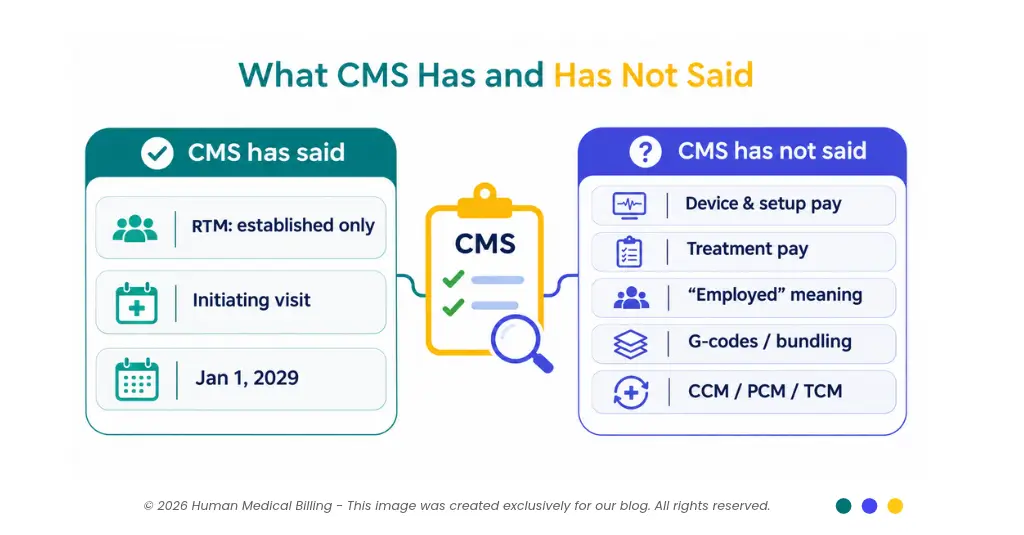
What CMS Has and Has Not Said
| Question | What the CMS fact sheet says |
|---|---|
| RTM limited to established patients | Yes, from CY 2027 |
| Initiating visit required | Yes, separately reportable |
| Device and setup payment amounts | Not stated |
| Treatment management code payment | Not stated |
| Employed-staff requirement date | January 1, 2029 |
| What counts as “employed” | Not stated |
| Code bundling and new G-codes | Comment solicitation only |
| CCM, PCM, TCM changes | Not addressed |
Who This Affects
Providers. If you have practices that run RPM or RTM programs then they will have to make changes to their enrollment processes. The deadline for practices who use contracted monitoring staff is in 2029.
Patients. All of your new RTM patients will require establishing them at your practice. Additionally, all new RPM and/or RTM patients will also need an initial visit prior to beginning monitoring.
Payers. As these are Medicare rules, check on each payer's (Medicare Advantage and Commercial) policies separately.
What Your Practice Should Do
Before January 1, 2027:
- Map how patients enroll in your RPM and RTM programs. Add the initiating visit as a step before monitoring starts.
- Identify which RTM patients are established with your practice.
- List all of the patients currently in either your RPM or RTM program as well as the date that they began receiving these services.
- Update your revenue model based on both the 2.31% and 1.83% reductions in reimbursement rates using your actual volume of devices, set up, and management costs.
- Confirm the 2027 payment amounts for 99453, 99454, 99445, and 99457 in CMS's 2027 payment files before you set prices.
Before January 1, 2029:
- Review each contracted monitoring arrangement to ensure all staff are employees of the practice/clinic.
- Await for guidance from CMS on what constitutes an "employee" of a practice before you change your current staff structure.
After go-live:
- Review January and February remittances for RPM and RTM claims by code.
- Track new-patient initiating visits and denials separately.
Frequently Asked Questions
RTM is only payable for established patients in CY 2027. The secondary summaries indicate that a patient becomes an "established" patient after their initial visit. Find this information in the rule text.
Yes. CMS has made the initiating visit (and the associated reporting) separately billable when either RPM or RTM begins.
HRS says no through a valuation adjustment; however, as far as all of the codes are concerned (including this one), it will be subject to the conversion factor. Confirm that information using CMS's Payment Files.
January 1, 2029. CMS changed this provision from what was included in their initial proposal.
No. The CMS is requesting comment regarding bundling, and they have identified 4 additional G-codes that they are considering for use in future rules; however, there is no indication of whether or not these codes would be used as part of the proposed bundles.
The CMS fact sheet doesn’t say. HRS reports no code changes. Verify before relying on it.
A Final Check Before the Deadlines
The Remote Monitoring program has two deadlines: January 1, 2027 - The initial (first) patient visit and established patient rules; January 1, 2029 - Staff (employed). First identify areas in which your enrollment model and Staffing Model are inadequate.
Human Medical Billing works with practices on billing, coding, and revenue cycle operations. Need help restructuring your remote monitoring workflows before the deadline? We can help.
Sources:
- CMS, Calendar Year (CY) 2027 Medicare Physician Fee Schedule Final Rule (fact sheet), November 4, 2026: https://www.cms.gov/newsroom/fact-sheets/calendar-year-cy-2027-medicare-physician-fee-schedule-final-rule
- CMS press release, November 4, 2026: https://www.cms.gov/newsroom/press-releases/cms-finalizes-cy-2027-physician-fee-schedule-shift-sick-care-healthcare-curb-waste
- Federal Register final rule: https://www.federalregister.gov/d/2026-22743
- Health Recovery Solutions summary, referenced as a secondary summary only: https://www.healthrecoverysolutions.com/blog/2027-medicare-physician-fee-schedule-final-rule-rpm-ccm

Contact Human Medical Billing to schedule a compliance readiness review or learn more about our end-to-end billing and regulatory support services.