



The Medicare NCD update for Cardiology Coverage Policies in October of 2026 will be updating two cardiology coverage policy areas; NCD 20.4 Implantable Cardioverter Defibrillator (ICD), as well as NCD 220.6.1 Positron Emission Tomography (PET) for perfusion imaging of the heart. The CMS describes this as an “update to ICD-10 Coding Information” which becomes effective on October 1, 2026.
Contractors are required to apply these updates starting on or after October 5, 2026. Since you do not have to reprocess all claims at once they should perform a specific review of their claim data to verify compliance with the updated NCD Tables. Below we outline what has been added/modified and what has remained the same, along with tips and resources for reviewing claims without having to guess.
Quick Answer
- As of 10/01/26 CMS has updated the ICD-10 coding to reflect changes in six National Coverage Determinations (NCD), which include NCD #20.4(ICD's) and NCD#220.6.1(Cardiac PET).
- CMS is calling this an 'update', they are referring to it as a maintenance update.
- You will be responsible for bringing the MACs to claims that have been affected by this new ICD-10 coding.
- Compare your claims with the NCD Spreadsheets provided in CR #14464, do not compare them to previous Diagnosis Lists.
What Did the Medicare Cardiology NCD Update Change?
The purpose behind CMS’s issuance of Change Request 14464 was to update ICD-10 conversion tables and related coding information for NCDs. These NCD coding updates are based on new code releases, previously released NCD coding updates and/or coding feedback provided by CMS. The primary action CMS wants providers to take is simply to inform their billing personnel of those NCDs that have new or deleted ICD-10 diagnosis codes.
CMS has listed physicians, suppliers and other types of providers billed to a MAC (Medicare Administrative Contractor) as impacted. Therefore, this notice will affect all cardiology groups or imaging providers who are billing Medicare for these services. Two of the NCDs mentioned in the notification will be most relevant to Cardiologists.
| NCD | Topic | Area |
|---|---|---|
| 20.4 | Implantable cardioverter defibrillators (ICDs) | Cardiology |
| 220.6.1 | PET for perfusion of the heart | Cardiology |
Change Request 14464 also addresses NCDs 90.2, 110.18, 110.24 and 150.3, which are located outside of cardiology. Make sure you have a member of your team read the most recent version of CMS's article that explains their reasoning behind the requested changes since earlier versions did list additional NCDs.
What Did CMS Not Change?
There's quite a bit. This is a coding table update. That was not presented by CMS as anything other than an update.
- Coverage changes (both expansions and reductions) were neither announced for ICDs nor for Cardiac PET.
- There is no instruction to rebill. There is nothing in the announcement instructing providers to revise their October claims or any prior claims.
- Denial rates or dollars were never reported by CMS. Don't believe numbers being cited otherwise.
This is also separate from the Ambulatory Speciality model. Here is your bottom line: Treat this as a targeted review, NOT a scrub of every single thing you have submitted this year.
NCD 20.4 and ICD Claims
NCD 20.4 is about the billing of implantable cardioverter-defibrillators (ICDs). Billing for an ICD is based upon whether the diagnosis codes reported by your ICD claim are located on the NCD 20.4 ICD-10 list. Diagnosis codes will be removed from the NCD 20.4 list when a new version is created. A diagnosis that was valid in September could be invalid in October due to these changes.
How do these changes affect your ICD claims? In order for your claims to qualify as ICDs, your submitted diagnosis codes have to fall under the NCD 20.4 criteria.
Do not assume which codes changed. To see the specific changes made for each code for NCD 20.4, review the CR 14464 spreadsheet. Have a coder conduct a side-by-side comparison between this spreadsheet and your cardiologists' and device clinics’ most common diagnosis codes. Ask your local cardiology clinic which diagnoses are used most frequently in their ICD referrals. That will give you a smaller group of codes to begin reviewing and avoid having to review every single line of data.
NCD 220.6.1 and Cardiac PET Claims
The NCD 220.6.1 covers PET for perfusing the heart. Therefore, the rationale for reporting a diagnosis by a cardiac PET is identical; namely, you have to document a diagnosis reported in the current version of the NCD's listed diagnoses.
Cardiovascular imaging groups or cardiology practices billing for PET should access the NCD 220.6.1 spreadsheet from the CR #14464 download and compare this information to the top five or six diagnostic codes their ordering physicians utilize on a regular basis. The Medicare cardiology NCD update reviews you will be conducting can begin with any cardiac PET claims denied since October 1, 2009, because those were the claims most likely to be rejected due to a diagnosis issue.
How Outdated Diagnosis Tables Affect Claims
Coding for Cardiology ICD-10 claims is only accurate if the data used to create the edits (the edit tables) are also updated to October standards. The tables themselves exist in many different systems; Your Billing System, Your Electronic Health Record (EHR), Your Scrubber Rules, and a Coder's own Spreadsheet. If any of those systems have old ICD-10 code lists they may send a claim that has a diagnosis that the National Coverage Determinations (NCD) no longer list.
CMS puts forth a word of caution. When converting from ICD-9 to ICD-10 there are no direct one-to-one translation options, and General Equivalence Mappings do not directly translate to each individual NCD. Therefore, you should NOT be updating your tables using a Mapping Guide. You should use the NCD Spreadsheets, and designate ONE PERSON to keep all systems up-to-date simultaneously.
RCM Leaders - Take Note: CMS refers to these NCD Coding Updates as Quarterly. Put the next cycle on your calendar NOW. Our 2027 ICD-10 Code Changes post will detail the upcoming major update.
What Should Your Practice Do Now?
7-Step October Claim Review
Next steps. Work through these in order.
- Download the NCD spreadsheets (CR 14464) for 20.4 and 220.6.1 from CMS.gov.
- Compare both files to the diagnosis codes within your billing system and EHR.
- Update the diagnosis tables that your team has developed, document changes made by whom, and when they were made.
- Extract ICD-10 and Cardiac PET claims that have dates of service as or after October 1.
- Tag all denials/rejections related to the use of a diagnosis code(s).
- Have coding staff verify each tagged claim against the updated table prior to making corrections.
- Document what was reviewed, by whom, the date, and results.
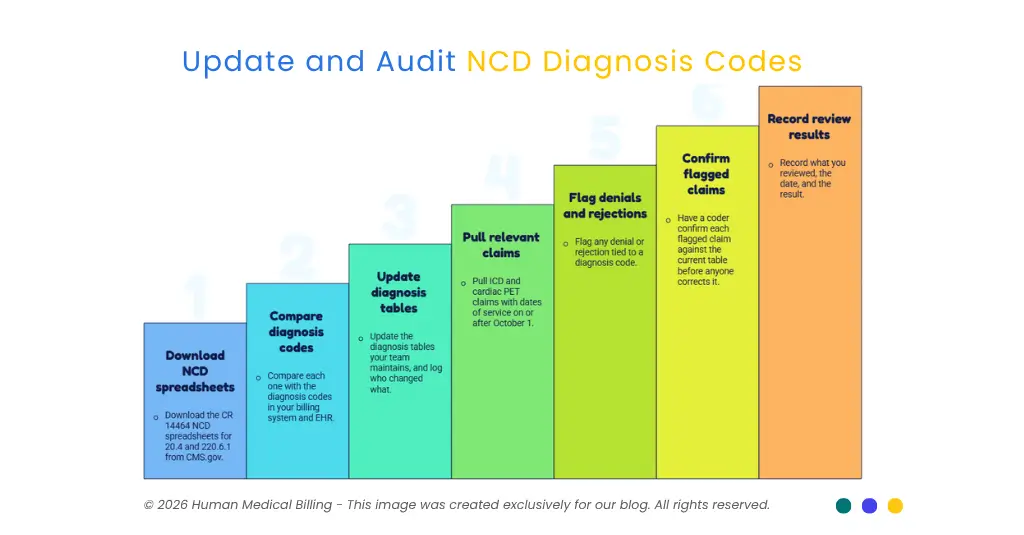
First run steps 1-3 to correct where your data originated. Then run steps 4-7 to remove the errors that have gone out.
Identify who will be responsible for each of these tasks prior to beginning. Ideally, someone should review the spreadsheet (coder), report claims (billing lead) and sign-off on the log (practice manager). However, when one individual performs all three functions, then there is an impasse in reviewing.
When Should You Contact Your MAC?
CMS explains it clearly: "The Medicare Administrative Contractors (MACs) will not proactively search for or identify potential claims issues; however they will take action if you bring an issue regarding a claim to their attention." What this means for you is that, if you notice a claim was incorrectly processed due to one of these updates, you need to begin the discussion.
CMS also directs providers to look at their MAC's website for specific information. The official instructions were sent to the MACs by way of Transmittals R13752OTN, R13910OTN and R13968OTN. Look at your MAC's webpage for their adjustment process. Before contacting them, have all of the following ready for your reference: the claim number, the date(s) of service, the ICD-9-CM/ICD-10-CM code(s) you used as the basis for the diagnosis code, and the specific spreadsheet line you based your decision on. Also track each claim that has been denied using a denial management system, including all correspondence with your MAC regarding those claims to ensure compliance with timely filing deadlines.
Claim-Check Checklist
- CR 14464 Spreadsheets Downloaded
- Diagnosis Tables Compared/Updated
- ICD & Cardiac PET Claims Since Oct. 1 Pulled
- Denials Identified by Diagnoses
- Coders Must Approve All Corrections
- MAC Contacted for Adjustment of Appropriate Claims
Frequently Asked Questions
The October 2026 Maintenance Update by CMS to ICD-10 Coding for NCDs (NCD 20.4; NCD 220.6.1) and became effective on October 1, 2026.
20.4; 90.2; 110.18; 110.24; 150.3 and 220.6.1.
The Notice has simply described it as a Maintenance Update on Coding. There is no announcement in the Notice about expanding or reducing coverage.
No, you do not. Just review those claims which may be subject to the new coding rules for ICD’s and Cardiac PET, and contact your MAC regarding any issues you find.
No. According to CMS, MAC's will make adjustments to those claims that you report to them as impacted.
The NCD spreadsheet files found in the CR 14464 download section on CMS.gov. As such, the article does not provide the specific codes.
Coding changes in Cardiology may be missed between quarterly CPT updates; an article cannot replace a coder's review of the CMS spreadsheets or guidance from your MAC. Our Human Medical Billing will assist with review of Medicare practice related NCD coding, claim checks, and follow up denials as it relates to cardiology billing. If you would like a second opinion on your October 2026 Cardiology Billing Update Review, we can provide assistance through our Healthcare Revenue Cycle Management Services.

Contact Human Medical Billing to schedule a compliance readiness review or learn more about our end-to-end billing and regulatory support services.