



Medical providers who submit claims for services they provided out-of-network will need to understand a new process by the time winter arrives. On May 28, 2026, CMS finalized a rule outlining how the federal IDR gateway would handle payments for disputed services resulting from the No Surprises Act. As of August 3, 2026, these changes are in place. Those changes that most impact billing personnel relate to disputes where an open negotiation period began on or after November 1, 2026.
Your practice may be impacted if you provide anesthesia, emergency medicine, radiology, or surgery out-of-network. Below is information regarding what has changed and what you should consider prior to the deadline.
Quick Answer
- CMS completed the Federal IDR Gateway rule on May 28, 2026; it goes into effect on August 3, 2026.
- The number of line items in a batch increases from 25 to 50. This applies to all open negotiations which are available after an open negotiation period begins on November 1, 2026 or later.
- A party can now negotiate via a portal. A new response notice will be issued by the 15th business day within the 30-business days required for open negotiations.
- The minimum amount charged as an administrative fee is being decreased to a flat $15 per party. Previously, this was $115 per party.
What Is the Federal IDR Gateway?
Since its launch in April 2022, the Federal IDR (Independent Dispute Resolution) Process, has accepted over 5 Million disputes. Although the Federal IDR Process was created by CMS with expectations of only a few hundred thousand dispute submissions annually; the subsequent backlogs have prompted this regulation.
The New Federal IDR Gateway is a new centralized platform that replaces prior individual use webforms. The new gateway allows parties to initiate disputes, monitor deadlines, and access dashboards all within one platform versus numerous paper notices and e-mail threads. CMS indicates that the new gateway will roll-out in the second half of 2026, in conjunction with the remainder of the regulations' amendments.
The above regulation pairs well with CMS' issuance of remittance code guidelines that were released in July and cover the CARC and RARC Codes required to be included in remittance advice. In our previous article regarding the new remittance codes we provided an overview of those new codes. As they both are part of the same federal regulation however they address separate issues therefore do not treat them as repetitive.
What Actually Changed
There are five key factors that will affect how you do your billing.
1. Batching Cap.
Up until this point, a single dispute could contain no more than 25 line items. As long as there is at least one commonality among the line items (i.e., a common test date; a common service code; anatomic/pathologic/radiology/laboratory services using a Category I CPT code), line items may be included together in a dispute. The maximum number of line items in a dispute has increased to 50.
2. Open negotiation through the portal.
The 30-business day clock for open negotiations begins the business day after an open negotiation notice is submitted by any party to the Federal IDR portal, not when an open negotiation letter is sent out
3. Eligibility timeline.
A certified IDR entity has five business days after selection of the dispute in which to determine if the dispute is eligible for mediation and notify all parties
4. Administrative Fee
The administrative fee was reduced to $15.00 per party per dispute; this represents a significant reduction from the previous amount of $115.00. This fee applies to disputes filed immediately upon implementation of the Rule
5. IDR Registry
Now payers are required to register with CMS and receive a unique identification number. Providers may then use this ID to verify what plan they should be contacting during the open negotiation process.
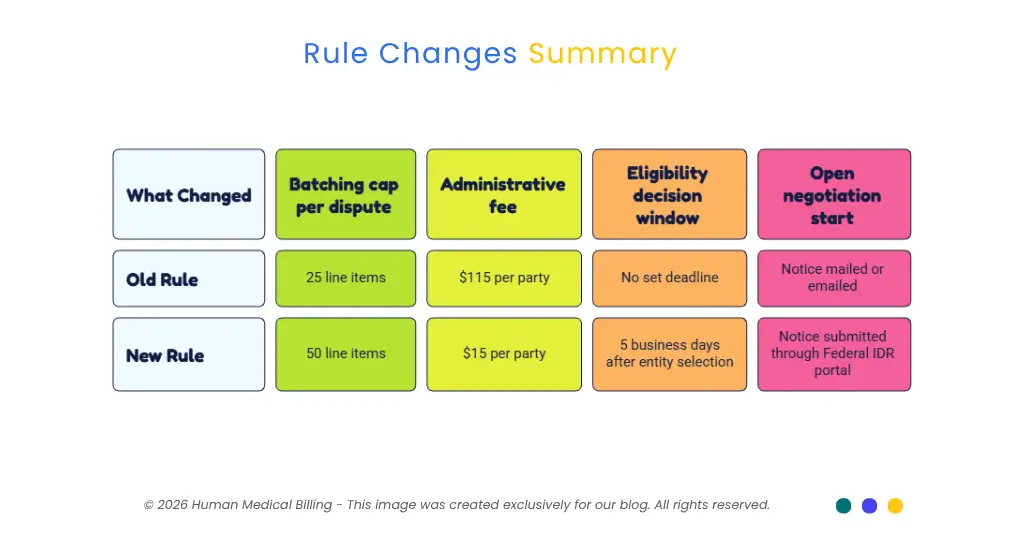
| What Changed | Old Rule | New Rule |
|---|---|---|
| Batching cap per dispute | 25 line items | 50 line items |
| Administrative fee | $115 per party | $15 per party |
| Eligibility decision window | No set deadline | 5 business days after entity selection |
| Open negotiation start | Notice mailed or emailed | Notice submitted through Federal IDR portal |
How This Hits Anesthesia, ED, Radiology, and Surgery Billing
Those practices with the highest out-of-network disputes will be impacted most from the batching process and these are the ones that will see it first. A group that would formerly have divided a big batch of the same code anesthetics claims into 2-3 submissions may now submit all of them at once in a single dispute (cutting submission costs & reducing paperwork).
However, this also impacts the workflow. To prove that negotiations remain open payment posting staff and AR teams can no longer use the fax confirmation as evidence that open negotiations began. It is the date stamp within the Gateway that determines when open negotiations begin. Therefore, groups that contract with vendors who track deadlines for them via denial management service providers or medical accounts receivable service providers need to verify whether those vendors are tracking deadlines in the same manner.
What does this mean for a practice with a small billing team? It means there will be fewer individuals working on monitoring portals and there will be less margin for error if when a deadline passes by un-noticed.
What Should Your Practice Do Before November 1?
1. Map your current open negotiation deadlines.
Determine whether you are negotiating prior to or subsequent to Nov. 1 as the rules governing each type of dispute will be based upon this date.
2. Watch for IDR Registry openings.
Once registration is opened for your payer relationships (i.e., provider relationships), register promptly so that providers do not experience delays in locating your plan information.
3. Rebuild your batching logic.
Update your rules regarding when to file disputes by creating batches using the new three-batch categories, rather than the previous 25-claim limitation.
4. Train payment posting and AR staff on the new timelines.
Personnel will need to identify the 15-business day time frame within which responses to the notice must be made and the 5-business day period during which eligibility may be verified.
5. Loop in your billing partner now.
If a third-party filing service represents you in disputing claims filed on your behalf, verify that your third-party filing service has included access to Gateway in their process flow before the capability is available.
Frequently Asked Questions
The Federal IDR Gateway is expected to be launched by the end of 2026 and replace the current one-time use Web Forms that are used for filing each individual dispute
No. Only disputes with an open negotiation period beginning on or after Nov. 1, 2026, (90 days from when the final rule takes effect) will have the 50 item limit applied
The Administrative Fee is $15.00 per party per dispute, no matter what is being disputed, or if the dispute has been resolved
No. These two updates address different issues. The Remit Codes indicate which claims qualify for IDR; the filing, tracking, and payment for the Dispute will be updated under this Rule
The Portal Change, New Batching Math for claims & the Fee Cut which will cause you to question whether disputing is reasonable, means Billing Teams will need to recreate a process most have followed since 2022. With practices utilizing Human Medical Billing, we help track Regulatory Changes and build them into your workflow prior to the deadline of the Federal IDR Gateway so that you are prepared, not just reacting. We invite you to reach out to us at Human Medical Billing in order to evaluate how the changes made by the Federal IDR Gateway will affect the number of your Out-of-Network claims.

Contact Human Medical Billing to schedule a compliance readiness review or learn more about our end-to-end billing and regulatory support services.