



The billing teams have another date to include in their planning. CMS has given its guidance on the use of No Surprises Act remittance codes by group health plans and insurers as of July 17, 2026, which will require the use of these remittance codes on the remittance advices for out-of-network claims effective January 1, 2027. The new guidance is based on the requirements stated within the final rule for Independent Dispute Resolution Operations that was issued by CMS on July 17, 2026. As an office who submits or posts out-of-network claims, it may affect how you process those payments in 2027.
- The Centres for Medicare & Medicaid Services (CMS) finalized the New Surprise Remittance Codes (No Surprises Act) codes for July 17, 2026, as part of a broader IDR Rule that was finalized on May 28, 2026.
- Starting with plan years beginning on or after January 1, 2027, plans and issuers will be required to include the specific RARC codes for all out-of-network claims processed on or after this date. The RARC codes are effective as of November 1, 2026.
- These new codes will allow billing teams to identify if a claim is eligible for the federal independent dispute resolution (IDR) process for out-of-network charges.
- Billing teams will need to update their remittance-parsing logic by November 1, 2026.
Why does the No Surprises Act IDR Overhaul matter?
On May 28, 2026, the Department of Health & Human Services, Labor and the Treasury released their Final Rule designed to improve how the federal independent dispute resolution (IDR) process operates. The rule focuses on a significant problem many billing professionals are all too familiar with - payers frequently issue remittance advice with no indication as to whether or not a specific claim will qualify for IDR.
As a result, providers were left to make educated guesses regarding the eligibility of a claim in IDR. This new rule requires that payers provide Claim Adjustment Reason Codes and Remittance Advice Remark Codes on any remittance notice provided to an out-of-network provider. These codes give the provider immediate feedback regarding the status of their claims.
The IDR process also changed how disputes are resolved by creating new rules. Under the IDR process up to 50 items/services could now be included in one dispute; as such, when there is a large number of claims that need to be disputed for a physician or other health care provider, it would likely be easier for them to do so in one dispute. Additionally, the administrative fee associated with filing a dispute through the IDR process was reduced from $115 per party to $15 per party. To a small group of physicians determining if they should pursue a dispute over a claim, the fee reduction changes the way they view the value of a dispute.
What changed with the July 17 Guidance?
May was a policy. July is how it will work. CMS stated the RARCS take effect as of November 1, 2026, and all new claims which have been provided by services on or after January 1, 2027 shall utilize them. The regulations that require utilization went into effect August 3, 2026
Two codes are currently being used that provide insight into how this works in practice. RARC N883 has a code description of “Alert: Processed according to State law” and RARC N830 has a code description of “Alert: The charges for this service were processed in accordance with Federal/State Balance Billing/No Surprise billing laws.” These types of codes provide your team immediate visibility on why a claim ended up in the location that it did; as well as if IDR would be applicable
CMS stated that in terms of claim adjustment reason codes (CARE) all plans and issuers will continue to use certain CARE codes they are accustomed to using when processing standard claims. However, the new CARE code requirements will apply only to those CARE codes associated with the NSA-related RARCs.
How Does This Affect Providers and Billing Teams?
Providers and billing teams will have to make changes in their workflow as this is going to be a change of process with how they code, not just a change in what they are coding. Payment poster staff will now have to look for these new codes when processing claims. Denial management teams will also have to adjust the criteria that determines whether or not a claim should be denied due to standard adjustments vs. a denial of a Non-Specific Adjustment (NSA) dispute.
Here's what that means day to day:
- Rules for your remittance parsing application (or clearinghouse) will have to be updated by November 1, 2026.
- Payment staff will have to understand how new RARCs are signified so they can flag them properly when posting payments.
- Claims in dispute status that should go to open negotiations or IDR will need to be flagged as such so you don't miss the dispute deadline.
Outsourcing practices will need to inquire with their billing partners about whether these changes were integrated into their denial management services. An example of a missed RARC could lead to leaving money on the table for an out-of-network claim.
What about Patients and Payers?
Patient are not responsible for reading through remittances; however, as an indirect beneficiary, they will see improvements from their providers. CMS said that it hopes to enhance communications among parties prior to filing IDR’s, thereby reducing the number of disputes filed under IDR at inception. With fewer "stuck" disputes, there will be quicker resolution of claims, thereby keeping patients out of billing limbo.
For Payers, the requirements are non-negotiable. In addition to requiring that all claims include one of two specific codes indicating whether or not the claim is subject to the NSA's surprise billing provision(s) and/or the federal IDR process, payers also have a specific deadline to comply with the coding requirement.
What Should Your Billing Team Do Now?
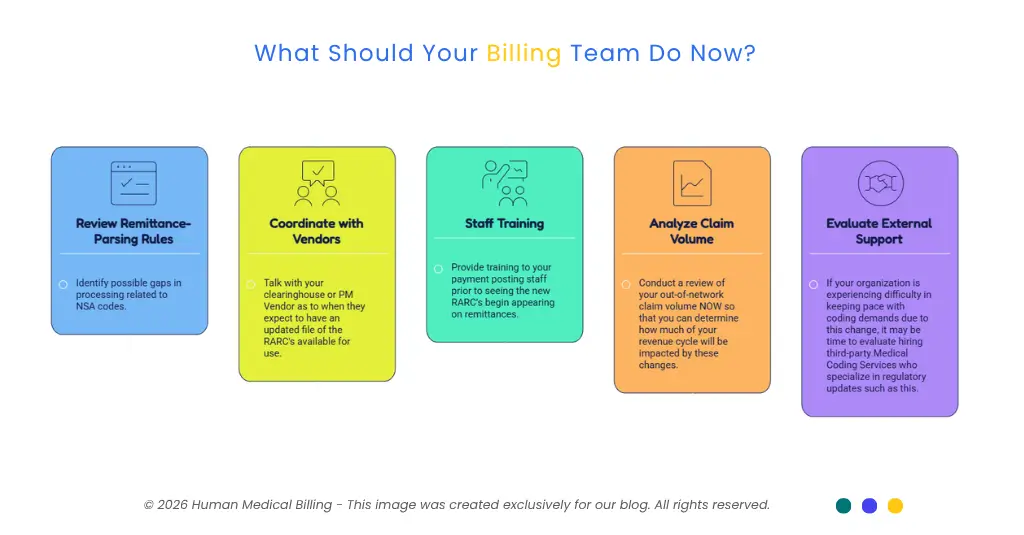
You have a few months before the November 2026 effective date of these codes; and approximately six to seven months prior to the January 2027 filing deadlines. Don’t wait until Q4.
- Review your current remittance-parsing rule-set to identify possible gaps in processing related to NSA codes.
- Talk with your clearinghouse or PM Vendor as to when they expect to have an updated file of the RARC's available for use.
- Provide training to your payment posting staff prior to seeing the new RARC’s begin appearing on remittances.
- Conduct a review of your out-of-network claim volume NOW so that you can determine how much of your revenue cycle will be impacted by these changes.
- If your organization is experiencing difficulty in keeping pace with coding demands due to this change, it may be time to evaluate hiring third-party Medical Coding Services who specialize in regulatory updates such as this.
Frequently Asked Questions
The Remittance Advice Requirements Codes (RARCs) will go into effect on November 1, 2026; however, RARCs will be required on claims submitted for services provided on or after January 1, 2027.
HHS, Labor, and the Treasury released a new federal regulation (a "final rule") on May 28, 2026, which completely revised how IDR can be done federally and the July 17th guidance is implementing just one part of that (the remittance code).
No. This will only be applied when a claim is being made for an item(s) or service(s) from a provider who has no contract with the payer; therefore, could qualify under either the surprise billing provision of the National Health Service Act or potentially could qualify for Federal IDR.
Yes. CMS stated that plans and issuers are allowed to continue using whichever claim adjustment reasons they deem acceptable as long as the claim being adjusted is a standard claim. The above mentioned (new) requirements are only related to the specific NSA related reason for adjustments (RARCs).
If you have an in-house team for handling out-of-network claims, this date needs to be noted on your calendars. Human medical billing will track these types of changes from CMS, so if there were a need for additional information on what was added as part of the "remits" received by your office due to the new codes, your practice would know about them before they arrive. If you currently do the billing within your office or utilize a third party vendor for billing, the resolution is the same; update your logic, provide training for all applicable personnel and do not wait until January to learn your software does not recognize the new codes.

Contact Human Medical Billing to schedule a compliance readiness review or learn more about our end-to-end billing and regulatory support services.