


Federal District Court in Maryland has temporarily blocked eight components of a new CMS Marketplace Rule (the "Rule") that was scheduled to go into place on July 20, 2027. This temporary injunction was issued by the U.S. District Court in Maryland on July 16, 2027; which is 4 days prior to when the components of the Rule were to take effect. The injunction will alter the way marketplaces process eligibility determinations, enrollments and product design for the 2027 year. If you are a provider with an active billing office supporting patients purchasing plans through the Exchange, this ruling impacts many aspects of the pre-enrollment verification processes, patient subsidy eligibility and networks, some or all of which you may have previously incorporated into existing workflow(s) within your practice.
Quick Answer
- A U.S. District Court for the District of Maryland preliminarily enjoined eight provisions of CMS’s 2027 Notice of Benefit and Payment Parameters (“Notice”) final rule on July 16, 2026;
- Two of these prohibited or modified are as follows:
o Subsidy Reconciliation (prohibited);
o State Network Adequacy Reviews (modified). - CMS also directed that in addition to continuing to issue premiums based upon estimates, it would be reasonable for Exchanges to continue issuing premium tax credit ("PTC") s even if an individual had not filed their prior year tax returns or completed a reconciliation of prior year PTCs. The CMS guidance was issued on July 22.
What Led to This Ruling
In May 2026, CMS issued its final version of the 2027 Affordable Care Act (ACA) Marketplace Rule. The 2027 ACA Marketplace Rule sets the minimum requirements for qualified health plans that are sold via the Federal or State Exchange. Many of these changes were intended to decrease improper enrollments. Doctors For America joined as one of many Plaintiffs to challenge the pending 2027 ACA Marketplace Rule from taking effect. They stated there was no valid reason to remove individuals from insurance coverage. Judge Brendan Hurson agreed with some portion of their claim and granted them a preliminary injunction regarding the enforcement of 8 provisions of the proposed 2027 ACA Marketplace Rule, just prior to when those provisions were scheduled to take effect.
The battle over how to implement the ACA has been ongoing since at least 2025. The judge had stayed a very similar proposed rule for Plan Year 2026 in 2025; he vacated the entire proposed rule in June 2026. CMS issued another proposed rule for Plan Year 2027, which resulted in the Court pausing most of it for a second time.
What Changed: The Eight Blocked Provisions
Here's what the injunction actually stopped:
- A "failure-to-reconcile" provision that would make those who had previously received advanced premium credits through the exchange ineligible for them in future years unless they provided proof that they had completed reconciliation with their tax authority.
- Enrollees reporting less than 100% of the FPL on their application would be required to provide additional documentation in order to establish their income levels.
- All individuals seeking special enrollment periods would be subject to wider eligibility verification.
- Catastrophic plans offered by carriers could have a greater cost sharing limit, up to 130% of the maximum allowed under law.
- The AHCA removed the requirement that each carrier offering an exchange product must also offer at least one plan that is a standardized cost-sharing plan for each "metal tier".
- States would assume responsibility from CMS for conducting network adequacy reviews.
- Hardship exemptions for catastrophic coverage would expand to include broader hardships.
- Plans that are not part of a carrier’s network could qualify as “marketplace” plans
Although changes were made to some of the provisions included in the original rule, the Court permitted CMS to move forward on its methodological revisions to the premium adjustment percentage. This is a percentage that will be utilized by CMS to determine how much of an increase there will be in the annual cost-sharing limits for each plan under the Affordable Care Act (ACA) for each year.
Impact on Providers and Billing Teams
CMS acted quickly after the decision. On July 22, CMS instructed the health insurance exchange platforms to cease all removals or denials of Advance Premium Tax Credits for individuals whose subsidies have not been reconciled for any prior year. These instructions are applicable to both Plan Year 2026 and Plan Year 2027.
CMS is also once again automatically extending to 60 days when determining a mismatch in household income data. This extension is important as it will be used in conjunction with your front end verifications. Therefore, your teams that have been using a short window of time (that was tied to the paused rule) for resolving issues should revert their workflow.
This case is being watched by Human Medical Billing because it impacts actual operational procedures such as; eligibility check, subsidy verification and network status. As these rules are updated so too could be your claims denial rate if your intake does not keep pace.
A few practical points for your team right now:
- Verify that you are no longer having your intake team apply the suspended failure to reconcile screen for those patients that did not file a prior year tax return
- Determine if your eligibility verification process has been updated with the reinstated 60 day time frame for resolving income discrepancy issues
- Monitor State specific network adequacy information as states will begin handling reviews that CMS was going to be reviewing
- Avoid Marketplace Patients whose plans could potentially have a change in their Metal Tier Cost Sharing Structure, if Standardized Plan Requirements go back into effect
What Should Your Practice Do Now?
The honest answer: stay flexible" This case is still active, and appeals already exist.
More rulings could come before open enrollment. Steps to take today:
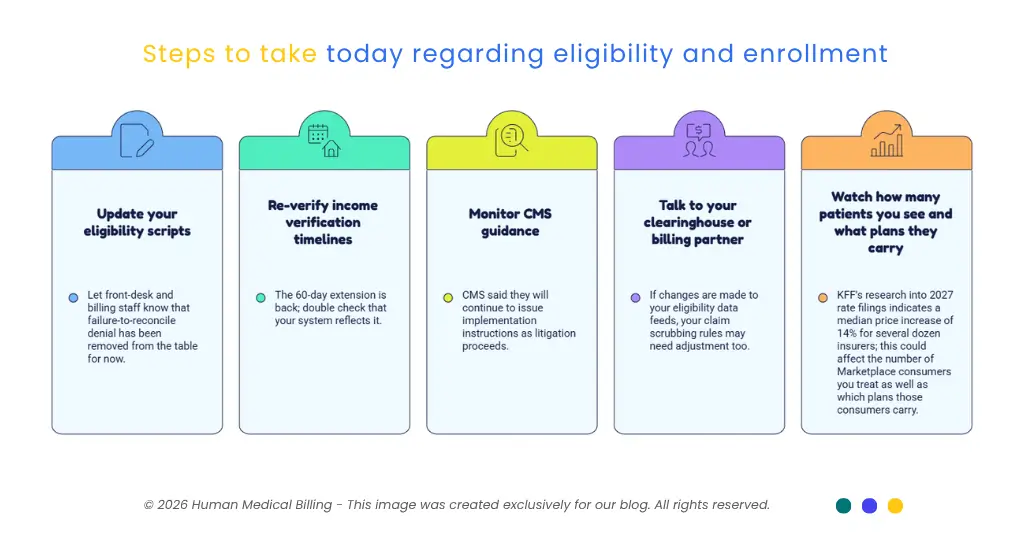
1. Update your eligibility scripts.
Let front-desk and billing staff know that failure-to-reconcile denial has been removed from the table for now.
2. Re-verify income verification timelines.
The 60-day extension is back; double check that your system reflects it.
3. Monitor CMS guidance.
CMS said they will continue to issue implementation instructions as litigation proceeds.
4. Talk to your clearinghouse or billing partner.
If changes are made to your eligibility data feeds, your claim scrubbing rules may need adjustment too.
5. Watch how many patients you see and what plans they carry.
KFF’s research into 2027 rate filings indicates a median price increase of 14% for several dozen insurers; this could affect the number of Marketplace consumers you treat as well as which plans those consumers carry.
With a partner to monitor this information each day, you won’t have to be concerned about tracking it. The health care revenue cycle management services we provide create eligibility and verification workflow systems in accordance with present federal regulations; they are not based upon those of the previous three months (last quarter).
Frequently Asked Questions
The CMS final rule sets the guidelines for Qualified Health Plans (QHPs) offered through an Affordable Care Act (ACA) marketplace as well as, enrollment, cost sharing and network provider obligations for Plan Year 2027.
The Maryland federal court said it felt the Plaintiffs were probably successful on the procedural side, and therefore the delayed parts of the law will have serious consequences to enrolled individuals if they are allowed to go into effect as planned.
Yes. The July 22nd Guidance from CMS states that exchanges should retroactively correct (going back) current subsidy denial(s) based upon the pause of the reconciliation requirements that caused the error. Contact your clearing house to find out how to handle retroactive claim processing.
Possibly. CMS has previously attempted provisions such as these in the 2026 rule which were stayed and ultimately vacated, so they attempted provisions such as these again in the 2027 rule. These are all included in the One Big Beautiful Bill Act and can begin being enforced statutorily in 2028.
Bottom Line
The decision made by this court does not resolve the issue of how ACA Marketplace Rules will be determined. The decision suspended eight specific provisions until the litigation is resolved; CMS has also informed Exchanges that they need to make adjustments to their systems as a result of this suspension. Therefore, billing teams which support patients in the marketplace should update their eligibility screening immediately. Your team may want to continue to monitor updates from the government regarding the next phase of guidance on implementing the suspension. In addition, if you have difficulty identifying the impact of the eligibility changes against your claim data, we can identify new denial patterns created by eligibility changes with our Denial Management Services.

Contact Human Medical Billing to schedule a compliance readiness review or learn more about our end-to-end billing and regulatory support services.