



Preliminary 2027 Medicare clinical laboratory fees have been released by CMS; this is bigger than the percentages or dollar amounts. On Sept 21, 2026, CMS published preliminary Medicare clinical lab fee rates for 2027 based on private payer payment data. According to CMS, if you were to calculate the overall percent decrease (average) in the Medicare clinical lab fee schedule for 2027 compared with 2026 Medicare lab fees, it would be approximately 16%. Lab facilities can begin reviewing preliminary rates now vs. their current codes to identify areas where a problem may occur prior to submission of claims. Here's a breakdown of what has occurred, which deadlines remain open, and the best way to review each test code.
Quick Answer
- CMS announced preliminary CY 2027 rates on Sept. 21, 2026. CMS is planning to announce final CY 2027 rates for Medicare physician services in late Nov. of this year.
- The rule limits how much any one service fee will drop by no more than 15% per year from 2027 until at least 2029.
- "C.Y." stands for Calendar Year (January thru December) NOT Fiscal Year (July thru June).
- A Medicare Physician Fee Schedule (MPFS) fee does NOT equal what you bill, nor does it equate to the amount that you collect. MPFS fees have NO bearing on Commercial Payers.
How the CY 2027 Clinical Laboratory Fee Schedule Gets Set
Most clinical laboratory testing is covered by Medicare at the weighted average of private payor reimbursement. This is how PAMA works. Labs submit their costs based on payment received from private payors during an established time frame. Those submissions are then used by CMS to create a single nationwide price for each test.
CMS has stated that they update these prices approximately every three years, based on private payer submissions. The submission period for CY 2027 was from January 1 through June 30, 2025. Lab submissions were accepted between May 1 and July 31, 2026.
The CY 2027 CLFS will be the fee schedule used to determine payment for clinical laboratory services covered by Medicare for calendar year 2027. The proposed rates are based on data regarding payments made by non-governmental payors (private insurers) for laboratory testing during 2026.
Beginning with 2027, reductions to test payments will begin as soon as they reach the 15 percent maximum decrease allowed annually per test. This maximum percentage was established by Congress within Section 1838 of Title XVIII of the Social Security Act in the Consolidated Appropriations Act of 2026.
What Changed in the Preliminary Rates
CMS preliminarily computed a weighted median for 1528 laboratory codes as reported in Becker’s Hospital Review. The preliminary calculations show that over 1100 of these laboratory codes will be subject to reductions; however, many will not. Categories have varying average reductions with genomic sequencing having an estimated 23% reduction compared to Medicare's proposed 2026 reimbursement rates and molecular pathology having an estimated 22% reduction. These figures represent category averages rather than individual test charges. Additionally, CMS stated that it believes Medicare currently reimburses lab services at approximately 16 percent higher levels than what private insurers reimburse.
American Hospital Association (AHA) criticized the underlying data supporting the CMS preliminary rate computations. AHA stated that based upon incomplete commercial pricing data, the preliminary rates could result in potential reductions of up to 15 percent on nearly 1200 tests.
Preliminary vs. final
CMS Preliminary Rates, are CMS's Draft for Public Comment, the Final Rates will be posted by CMS on their Website in November 2026. All figures should be treated preliminarily until posting occurs; therefore, do not place any of these figures in your Fee Schedule as final.
Three Separate Tracks with Different Dates
CMS is conducting three (3) separate tracks with varying dates:
- Preliminary Rates and Supporting Data: Comments were due by October 21, 2026.
- Negotiations Regarding New-Test Preliminary Determinations and Requests for Reconsideration Regarding Final MAC Gap-Fill Recommendations: Also Due October 21, 2026.
- Codes that Have No Applicable Private Payer Information: Comments are Due November 19, 2026 to CLFS_Annual_Public_Meeting@cms.hhs.gov
What It Means for Lab Billing Teams
What this all means in practical terms: A rate table does no good until you tie it to your individual volume. For each code, you need to have four pieces of information:
- HCPCS Code: Verify the HCPCS Code and description for what you actually are billing; include proprietary Laboratory Analysis Codes (PLA). We have a post on our site about PLA Codes.
- Contract: Find all Commercial contracts and Medicare Advantage agreements that reference the CLFS.
- Test Mix: Rank codes by claim volume as opposed to ranking them based on the amount of the rate increase.
The laboratory's implications are that while some of the Medicare rates for tests will decline by 2027; however, no test will decrease more than 15% from its prior year payment amount. Additionally, the certification of laboratories is also important to consider when reviewing the changes in reimbursement as CMS reviews claims based on the CLIA certificate level of all HCPCS codes that qualify for a laboratory under CLIA. Therefore, be sure to evaluate your CLIA certificate requirements along with your current rate review.
Use this five-column checklist for every code you review:
| Code | Current rate | Preliminary rate | Verified payer or setting | Reviewer action |
|---|---|---|---|---|
| HCPCS code | 2026 CLFS amount | CMS preliminary amount | Payer contract or lab setting | Confirm, flag or escalate |
A laboratory coder/reimbursement professional would need to compare their current lab testing data against both the CLFS file from CMS and the specific guidance provided by your Medicare Administrative Contractor (MAC) as well.
New codes, crosswalk and gapfill
When there is limited data available for tests that have no related data for private payers, you cannot use a weighted median. CMS instead uses cross-walking; it identifies a test for comparison with an existing test. Gap-filling occurs when a MAC recommends how to report the test. CMS has released preliminary findings about what they will consider to be new tests in 2026 and codes for which there is insufficient data available. You should identify all of the new 2026 tests and low volume codes you are submitting and look at them within these files. The most recent version of the Q2 2026 HCPCS updates may also include additional codes that were submitted during 2026.
Do Medicare Rates Set Your Commercial Payments?
Medicare reimbursement rates are not automatically applied to private payers. The Medicare reimbursement rates may not be applicable to all private payers. Review the contractual language (not just summaries) that defines the terms of payment; review the contractual language for specific references to "a percentage of the Medicare CLFS" or "the lesser of billed charges and [set rate].
What Should Your Lab Do Before Final Rates Post?
Begin with dates then move down the List. Use the preliminary cy 2027 clinical laboratory fee schedule as a draft until final rates are posted by CMS.
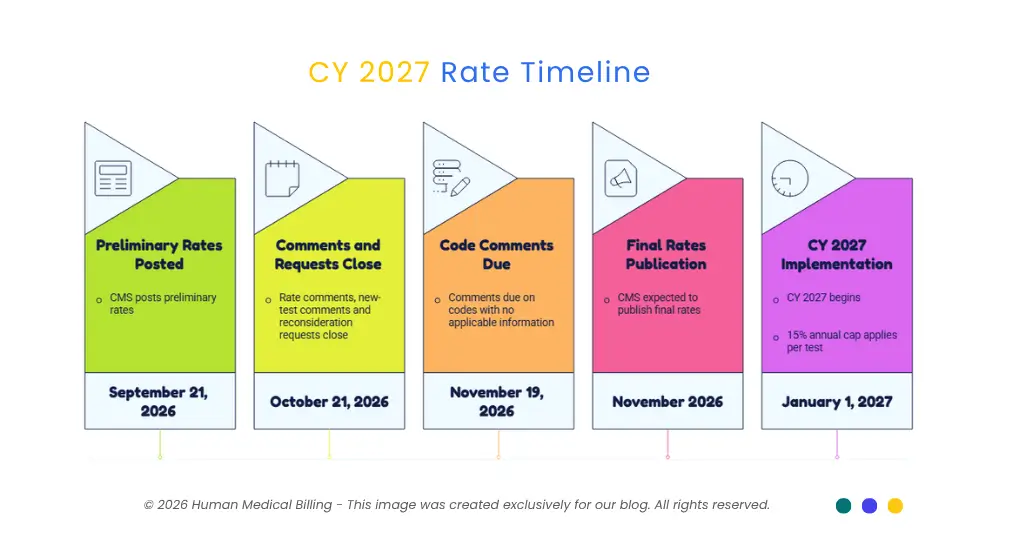
| Date | What happens |
|---|---|
| September 21, 2026 | CMS posts preliminary rates |
| October 21, 2026 | Rate comments, new-test comments and reconsideration requests close |
| November 19, 2026 | Comments due on codes with no applicable information |
| November 2026 | CMS expected to publish final rates |
| January 1, 2027 | CY 2027 begins; 15% annual cap applies per test |
Next steps
1. Compare your current 2026 file to the preliminary cy 2027 rates downloaded from the CMS CLFS page.
2. Bullet points for top codes in volume on checklist above.
3. Fetch every contract that references the CLFS and document each payment formula.
4. List new tests in 2026, low-volume codes and check against CMS crosswalk & gapfill files.
5. Submit comments regarding no applicable information codes by November 19.
6. Rerun all rows when final rates post.
Here’s the bottom line - A rate decrease on paper does NOT equal an increase in revenue. So keep your billed charges, collection amounts and Medicare reimbursement rates in separate categories; Do not confuse a payment rate with actual monies collected.
Frequently Asked Questions
No. CMS will finalize these CY 2027 rates November of 2026.
No. This is the maximum annual percentage reduction per test from 2027-2029. Any test that decreases is decreased by the lesser amount; Some tests may experience no decrease.
Calendar Year. CY 2027 represents January 1 thru December 31 of 2027.
No. Your collections are based upon your Payer Contract (PPO, EPO etc.) Patient Responsibility and Claim Accuracy. The Medicare Rate is simply the Payment Schedule Amount
Final billing rates will be posted in weeks, but that's after you've already completed the useful part of the process. Contact Human Medical Billing for an evaluation of your laboratory claim submissions as it relates to Payer Rules and 2027 compliance. Our medical coding service team can evaluate how accurately your selected HCPCS is aligned with your provider contract(s) on a one-family-at-a-time basis. We would like to help you start by contacting us and providing us with your top testing codes.

Contact Human Medical Billing to schedule a compliance readiness review or learn more about our end-to-end billing and regulatory support services.