


If you are billing professional claims for services rendered to patients, then place of service (POS) codes are probably a common part of your daily routine; however, there is one code which is used more often than all others - POS 11 in medical billing. The two-digit POS 11 code is simply a way for the payer to know that the patient received their healthcare in a physician’s office versus a hospital/facility type setting.
Let’s take a closer look at how this works.
What does POS 11 mean in medical billing?
A POS (Place of Service) Code 11 in medical billing refers to "Office" by CMS and represents a location at which a health care professional conducts routine examinations, diagnoses and treatments on an ambulatory basis.
In everyday terms, you use POS 11 when:
- Patients are seen in a physician office or clinic operated by you.
- The visit is outpatient and the patient leaves the same day.
- The location is not part of a hospital provider-based department.
Why does this matter? The difference in this one code can affect how much you get reimbursed for, determine if an auditor comes knocking, or if a claim is paid correctly on the first try.
| Feature | POS 11 in medical billing | POS 22 | POS 21 |
|---|---|---|---|
| CMS description | Office, nonfacility, ambulatory care setting | Hospital outpatient department, facility setting | Inpatient hospital, patient admitted |
| Who owns the space | Physician or group practice | Hospital or health system | Hospital |
| Typical services | Routine exams, followups, minor procedures, diagnostics | Outpatient surgery, complex imaging, hospitalbased clinics | Inpatient rounds, acute care |
| Professional reimbursement | Often higher than POS 22 for the same CPT because there is no separate facility fee | Often lower than POS 11 for the same CPT due to facility fee paid to hospital | Different inpatient payment rules |
Why POS 11 in medical billing matters for reimbursement
POS codes are a lot more than just labels; they inform Medicare and commercial payers whether to pay at "facility" rates (which are typically lower) for a physician, versus "non-facility" rates (typically higher). POS 11 is one of the many non-facility POS codes, which will generate a larger professional fee to the physician as opposed to what would be paid if the patient were seen as an outpatient of the hospital.
POS 11 vs POS 22 and POS 21 at a glance
When used properly, use of the POS 11 code in medical billing results in the following:
- Match your overhead and risk; the practice covers office costs, so the fee schedule pays more on the professional side.
- Avoid overpayments tied to facility codes that do not reflect the actual setting.
- Reduce underpayments where an office visit was mistakenly billed as hospital outpatient.
Human Medical Billing sees this every day. As we identify and correct POS 11 misuse within our overall healthcare revenue cycle management services, physicians and hospitals have reported fewer denied claims, more predictable and consistent cash flow and less take backs during audits.
Official CMS definition of POS 11
When using a trusted clinical resource for billing, we can use the CMS's description of code 11 from the Place of Service Code Set as follows:
"Any place other than a hospital or skilled nursing facility (SNF) that is a military treatment facility, community health center, state or local public health clinic or intermediate care facility, where a licensed health professional routinely performs health exams, diagnoses and treats patients with illnesses or injuries on an outpatient basis."
The key parts of this definition help keep billers safe:
- Any place "other than a hospital or SNF" indicates that the 11 should be used when the hospital does not own and operate the clinic as a provider-based department.
- Routinely provide helps identify a stable office (not a one-time borrowed room or temporary space).
- Ambulatory basis identifies that the 11 will always indicate outpatient.
This is exactly what Human Medical Billing teaches staff during training sessions and uses as a base for our medical coding service.
When to use POS 11 in medical billing
Let’s examine the common ways POS 11 in medical billing is used to provide services.
Common types of services performed by POS 11 in a physician's private office, group practice, etc.
1. Typical officebased services under POS 11
- The visit took place in a physician's office or in a physician's practice setting.
- The patient checked into the physician's office, was treated, and discharged from the physician's office.
- The physician's office is responsible for staffing and managing the space.
Examples of common services reported as POS 11 would include:
- Primary care, routine follow-up for chronic conditions.
- Wellness/preventive exams.
- Minor dermatological, gynecological, or orthopedic procedures that don’t need the support of a hospital.
- EKGs, spirometry, or basic imaging, if they occur during a visit to a physician's office.
- Blood draws occurring in a physician's office for labs, such as CPT code 36415.
2. POS 11 and outpatient vs inpatient
It is easy to confuse POS 11 in medical billing as being able to denote an inpatient service. It is not. POS 11 denotes an outpatient service occurring in a physician's office.
When a patient is admitted to the hospital overnight:
- Report the inpatient services using POS 21.
- Report the emergency department (ED) services using POS 23 when the services were provided in the ED of the hospital.
Reporting inpatient services using POS 11 will likely result in denials, recoupment, and/or other adverse actions on your claim(s).
When POS 11 in medical billing is the wrong choice
Here is how many claims become problematic. The best way to understand "Never POS 11" is to consider all of the situations that would never be reported using POS 11.
In medical billing you should never use POS 11 for the following:
- Even though it may appear as an office, you should never report POS 11 for clinics that are owned and operated by hospitals as outpatient departments.
- When receiving treatment at a skilled nursing facility (POS 31) or a nursing home (POS 32), do not report POS 11; report POS 31 or 32.
- During delivery of care in an emergency room (POS 23) - use POS 23.
- For encounters that are strictly telemedicine from the patient's home and the payer has specific requirements for POS 02 or POS 10 - use POS 02 or POS 10.
Telemedicine needs to be treated differently than other types of encounters. As a result of the public health emergency, some payers had temporarily allowed the use of POS 11 with modifier 95 for video visits when the provider was physically present in their office. While Medicare still permits the use of POS 11 with proper modifiers until the end of 2025, most commercial plans have transitioned to requiring POS 02 or POS 10 for telemedicine.
This is why we provide Human Medical Billing with both AI-powered medical billing and human auditors within our denial management process. Our human auditors will review your payer policies and ensure that POS 11 lines up with the current telemedicine policies to reduce unexpected denials.
POS 11 in medical billing and telehealth: current rules to watch
Many voice assistants and AI systems have raised a number of concerns regarding Telehealth (POS 11) and telehealth medical billing. Below is an overview of the current CMS and payer guidelines for telehealth.
1. Medicare
- Medicare will assign POS 11 for in-person visits for patients in a traditional office setting.
- Medicare's telehealth billing guidelines will allow for the location of the billing provider to determine the POS, and will require Modifier 95 to be added to the claim to identify that service as being provided via telehealth.
- Some flexibility for telehealth billing may remain through December 31, 2025; however, office-based telehealth visits can continue to be assigned POS 11, as long as the billing provider is physically located in the office and meets all of the applicable Medicare requirements.
2. Commercial Payers
Most commercial plans returned to assigning POS 02 for telehealth after the emergency waivers were lifted. A few commercial payers have adopted POS 10 for "home" telehealth encounters and want to differentiate them from in-office encounters.
3. The Safe Approach:
- Each payer should check their most recent telehealth billing guide.
- Set your Practice Management System (PMS) to automatically assign POS 02 or 10 for all virtual care encounters and override only when you are assured by the payer that they permit POS 11 for those encounters.
Human Medical Billing often packages this work inside medical accounts receivable services, since telehealth POS errors tend to surface in aging reports months later.
Common POS 11 coding mistakes that trigger denials
Let's examine those common errors auditors are finding again and again when auditing POS 11 in medical billing.
1. Mistake 1: Treating hospital owned clinics as POS 11
The HOC may be a very similar clinical setting to a physician owned clinic; however, since the HOC will qualify as a provider-based department under Medicare rules, payers anticipate and expect a Facility POS designation (such as 22) rather than a Professional POS designation (such as 11). Therefore, incorrectly designating a HOC as POS 11 can result in:
- Overpayments on the professional side.
- Retrospective audits and recoupment demands.
- Compliance concerns if patterns appear systematic.
2. Mistake 2: Using POS 11 for inpatient or ER care
There is no way around it, Coding an ER service or inpatient round with a POS designation of 11 in medical billing will always guarantee denial's and can produce unreliable data for reporting purposes. Payors utilize POS designation to determine acuity, expected costs, fee schedule etc. Therefore, errors will always trigger red flags.
3. Mistake 3: Mixing POS 11 and telehealth rules
POS 11 and the telemedicine service rules are two of the most common reasons why a telemedicine claim has been denied following the Public Health Emergency (PHE) period. The mistake creates reporting issues that make it difficult for offices to identify what percentage of their volume is actually generated from office-based care.
4. Mistake 4: Inconsistent internal rules
When different staff members or coders use different methods to code services as POS 11, the same type of patient encounter may be coded as both POS 11 and POS 22 depending upon the specific coder who used the CPT code for the visit. This type of variation will create difficulties for an office to have consistent reimbursement practices for patients and create potential audit risk as auditors will review the POS patterns for all patients seen by the office.
Best practices to get POS 11 in medical billing right every time
The following provides a framework of actionable steps to implement today.
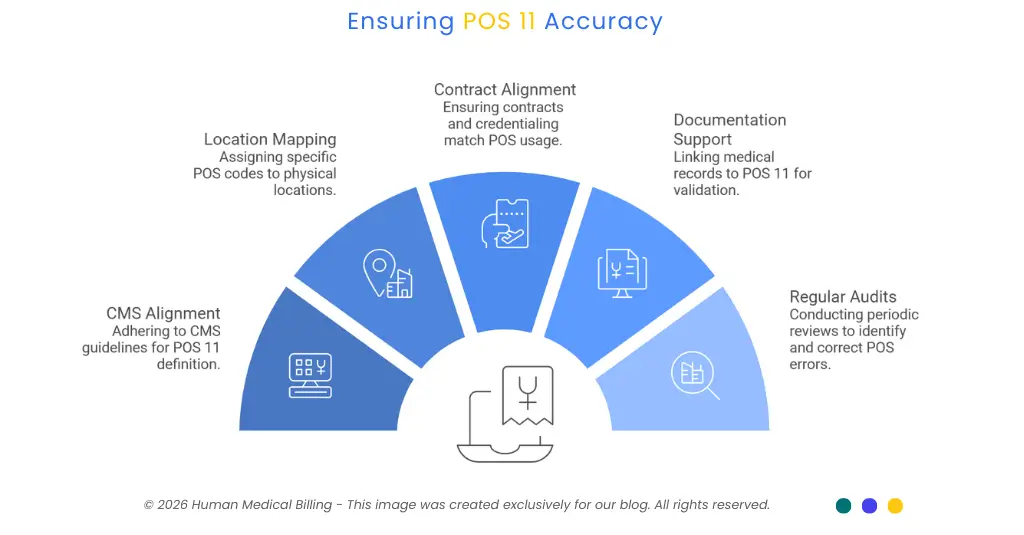
1. Anchor your definition to CMS
First begin with CMS’s Place of Service (POS) Code Set and ensure all internal policy references include CMS’s official POS 11 definition. Each coder/biller must understand that in the case of medical billing, POS 11 strictly adheres to CMS’s description of the office-based setting.
2. Map each physical location to a single POS
Create a “Location Matrix” in your practice management system:
- Map POS 11 to independent offices and group practices you directly own/operate.
- Map POS 22 to hospital outpatient departments per hospital/payer documentation.
- Fix these mappings so the front desk cannot change POS on the fly without a valid reason.
3. Align contracts, credentialing, and POS
Correct POS 11 in medical billing usage also relies on how providers are set up with payers:
- All contract agreements, medical credentialing documents, and NPI/Tax ID records accurately reflect the locations and POS code used in your claims.
- Notify your payers when there is a change in ownership or a change in physical address.
4. Link documentation, CPT selection, and POS 11
Documentation should consistently support the use of POS 11 in medical billing:
- Document the office location in either the chart header or encounter details.
- E/M codes and procedure codes must be representative of what is typically done in an office-based environment.
- Avoid documenting Inpatient-level H&P's as Office Visits unless they were indeed completed in the office.
The auditor will verify the documentation in the chart, the CPTs selected for service, and the POS code assigned to the claim.
5. Run regular POS focused audits
Conducting short and focused audits can be beneficial:
- Each month sample claims submitted with POS 11.
- Verify the patient actually visited the office location.
- Ensure Telehealth visits comply with current payer requirements.
If you currently utilize Human Medical Billing Services for medical accounts receivable services, we will incorporate POS auditing into your monthly medical billing review, which will allow us to identify potential issues early on.
How Human Medical Billing supports accurate POS 11 usage
Human Medical Billing provides support for medical billing offices that desire clean, compliant and predictable use of POS 11 in medical billing as an element of their overall revenue cycle process.
Below are the steps we are taking to provide that support:
- We assist the practice by aligning POS 11 policy with CMS and/or payer contract requirements and training the staff so that all rules are applied consistently each day.
- We utilize both rule-based medical billing checks (i.e., automated) and Artificial Intelligence (AI) medical billing tools combined with human review to identify discrepancies between POS 11, CPT codes and documented settings prior to claims going out.
- If claims are denied due to issues related to POS, we will assist in appealing those claims when necessary and modify the configuration so that the same issue does not occur again.
If you want to see real world results, visit the success stories section on the Human Medical Billing site or learn more about us, how our services work, and Xpert billing blog pages. You can also reach our team directly through the contact us page to discuss POS 11 audits.
We help practices eliminate costly POS errors so they get paid correctly the first time—clean claims, faster reimbursements, fewer audits.
Kara Wily, Head of Business Development at Human Medical Billing.
FAQs about POS 11 in medical billing
POS 11 always represents outpatient office services. Patients are not admitted and usually go home after the visit.
Typical services under POS 11 in medical billing include routine exams, follow ups, preventive care, minor office procedures, basic diagnostics, and lab work performed in the office setting.
POS 11 marks an independent physician office with no separate facility fee, while POS 22 marks a hospital outpatient department where the hospital bills a facility component. This difference often changes the professional reimbursement rate.
Sometimes, but it depends on the payer and current rules. Medicare still allows certain telehealth services to use POS 11 with modifier 95 while temporary flexibilities remain, but many commercial plans now require POS 02 or POS 10 for virtual visits. Always confirm with each payer.
Incorrect use of POS 11 in medical billing can lead to claim denials, overpayments that must be returned, audit findings, and inaccurate internal reports. Regular audits and clear policies help avoid these problems.

Contact Human Medical Billing to schedule a compliance readiness review or learn more about our end-to-end billing and regulatory support services.