
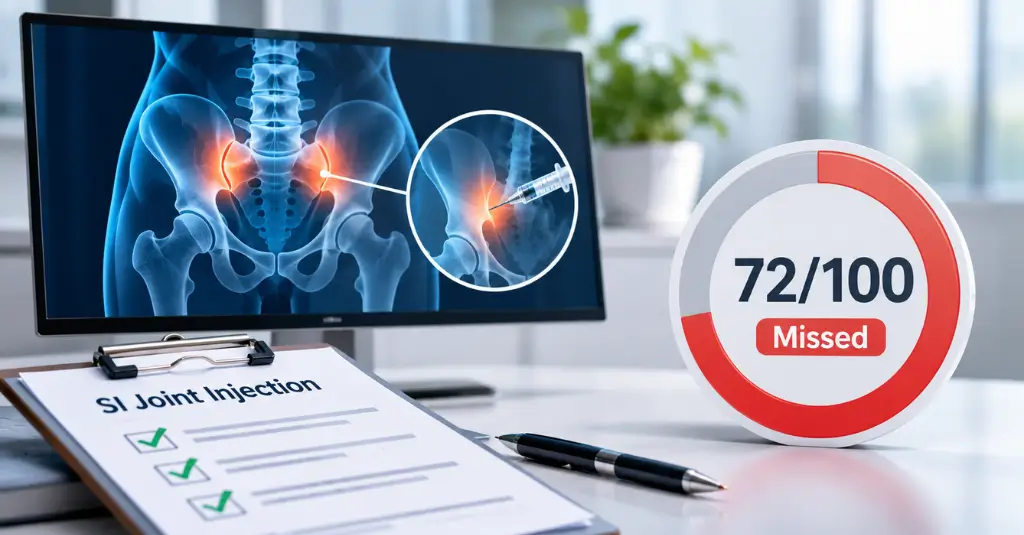


The SACROILIAC JOINT INJECTION BILLS are being reviewed by Federal agencies. On Aug. 2026 HHS OIG reported that 72 of 100 samples did not meet at least ONE of the required elements for coverage and made an estimate of approximately $15.2 Million dollars in improper payments. This was not a NEW policy. The OIG reviewed sample claims using dates of service from Oct. 1. 2023 thru Sept. 30. 2024, and compared them to Local Coverage Determination (LCD) policies already on file. What does this mean? Your Claim, Your Chart, AND Your MAC's Policy MUST all be telling the SAME STORY. Below are the specifics regarding what OIG found; where the KX Modifier comes into play; and How to Audit a Claim against the Record.
Quick Answer
- OIG reviewed 100 medical sessions; they determined 72 were inappropriate for Medicare coverage as well as identified an estimated $15.2 million worth of improper payments by five different MACs.
- There was no change in the services covered. The OIG examined the LCDs and the billing articles already being used at that time.
- The diagnostic lines of injections are billed using a KX modifier under the billing articles. The therapeutic lines do not have this designation.
- Take a random sampling of SI joint claims, determine what the patient's chart says, then find out your MAC's current position on SI joint injections before you begin.
Why Sacroiliac Joint Injection Billing Draws Audits
Medicare Part B will pay for SI joint injections if deemed reasonable and medically necessary. The types of practitioners who can provide SI Joint Injections include Interventional Pain Physicians, Radiologists and Anesthesiologists.
There are two CPT Codes to know here. CPT code 27096 is used for intra-articular (within the joint) injections. CPT code 64451 is used for interventional procedures directed toward the nerves supplying the SI joint. As of March 19, 2023 five out of Seven MAC’s have published LCD’s for SI joint injections; Each LCD has a Billing/Coding section. Anesthesia Groups follow the same guidelines as all other providers and our Anesthesia billing service Page explains how to bill in this area of practice.
What Did OIG Find, and What Does “72 of 100” Mean?
OIG began with 186,842 sessions (that five MACs paid for) for a total of $22 million and randomly selected 100. Of those 100 sampled sessions, seventy-two did not meet one or more Local Coverage Determination (LCD) criteria. Using the results of that sample, OIG determined that an estimated $15,156,922 was made as improper payment(s), due to 134,526 session(s). The range of this estimate is between approximately $13.2 million and $17.1 million using a 90 percent confidence level.
Read the caveats before you quote any of it:
- There was an example of 72 and it does not represent 72% of all SI joint claimants in the United States at some point or time made improper claims.
- OIG evaluated documentation for compliance with LCD policy rather than to determine if the services provided would be medically necessary.
- Estimate applies to five MACS. The first coast and novitas do not have an SI joint LCD from this time frame; therefore they paid (with $12.3 million) approximately 36% of total national payments for services rendered beyond the estimated timeframe.
- Apart from the 72 there are 25 additional sessions billed as therapy which should have been billed as diagnostic using KX. Of the 25 sessions above 19 were covered by deficiencies.
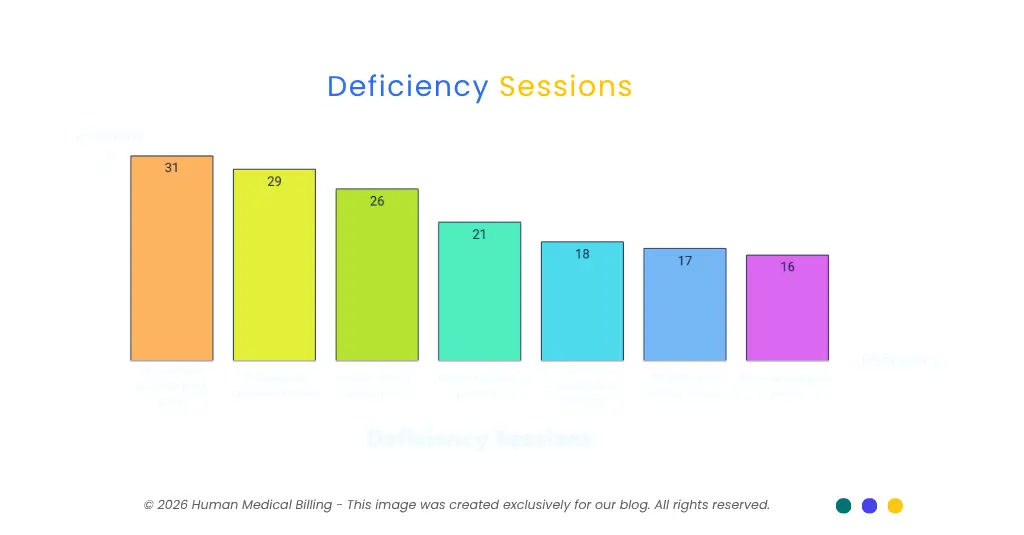
| Deficiency | Sessions |
|---|---|
| No end-of-session pain score | 31 |
| Therapeutic injection with no diagnostic injection, or under 75% relief | 29 |
| Fewer than 3 positive provocative maneuvers | 26 |
| Radiculopathy present or not ruled out | 21 |
| Fewer than 4 weeks of conservative therapy | 18 |
| Wrong imaging guidance, or no contrast allergy documented | 17 |
| No starting pain score | 16 |
Diagnostic vs Therapeutic SI Joint Injection: Where KX Fits
To qualify for diagnostic injection testing to determine if the sacro-iliac (SI) joint is causing your pain; a therapeutic (pain relieving) injection can be performed. However, before a therapeutic injection can be done the diagnostic test results must show that the SI joint is causing the majority of your pain.
The Least Costly Diagnoses (LCD) require at least a 75% reduction in pain with the initial diagnostic test. Additionally, when performing an additional Therapeutic Sacro-iliac Joint Injection, the patient must demonstrate at least a 50% consistent pain relief or functional improvement that lasts for a minimum of three months.
Billing for sacro-iliac joint injections are determined by using KX. In accordance with the Office of Inspector General's interpretation of the CCI/CCI edits, include KX on all diagnostic claims and do not include KX on the therapeutic claims.
KX will NOT correct a missing note nor will it create a valid Diagnostic Block. KX identifies to the MAC which category the services belong. If KX is omitted, Medicare will still reimburse the same amount, according to OIG. However, there are caps placed on coverage through the LCDs. Coverage is limited to two Diagnostic Sessions and Four Therapeutic Sessions per 12 month period.
Medicare SI Joint Injection Documentation: What the Chart Must Show
Your notes have to prove each LCD requirement, one at a time. OIG’s findings give you a working list:
- The patient suffers from low back pain located in the lower lumbar area (below the fifth lumbar vertebra) lasting for at least three months without radiating into either leg.
- There were at least three positive responses to three different physical provocative tests.
- Persistent pain despite at least four weeks of non-operative treatment including physical therapy, medication, rest, etc.
- No evidence of other possible causes of the patient's pain based on the results of diagnostic testing including X-rays, CT scans, MRI, bone scan, etc. and no fractures by history or examination.
- A documented starting pain score prior to the procedure and a documented ending pain score after completion of the procedure.
- The use of CT or fluoroscopic imaging with contrast or documentation of a known allergy to contrast agent when using ultrasonic equipment without contrast.
Match the dates of service, units, and laterality of note and claim as well. The lcd's will treat the session in the same manner regardless if the physician injected on one side or both sides. Have your coding lead check to see how their mac would like this information documented.
What This Means for Billing Teams
Begin with the mac. For all Groups in the audit period billing Florida, Texas, or Pennsylvania claims, determine whether there is an active SI joint lcd at the time of the audit. If so, determine whether they are included within our supported specialties (anesthesia, pain management and radiology).
Do not wait until training. As mentioned earlier, OIG noted CMS has not provided educational materials regarding SI joints since january 16th, 2004. In response to OIG's recommendations, CMS accepted two out of three recommendations; rejected the third recommendation recommending national coverage determination (ncd) or local coverage determinations (LCDs) be developed by the remaining two MACs.
What Should Your Practice Do Now?
Run a Claim-to-Record Audit
- 1. Pull a random sample of new Medicare claims from 27096 and 64451.
- 2. Determine the MAC (Medicare Administrative Contractor) that paid these claims; review their current Local Coverage Determination (LCD), Billing Article, and verify this information on the date you confirmed them.
- 3. Associate each claim to the corresponding note including the date of service, code, number of units, laterality, and KX status.
- 4. Compare the results from each LCD indicator to the corresponding chart and identify all gaps.
- 5. Calculate the number of the patients' diagnostic and therapeutic sessions over a rolling 12-month period.
- 6. Log all identified gaps in categories and correct the root cause through use of note templates and provider education. Then have your Medical Coding Services Partner or Coding Lead confirm proper use of code year language, modifiers, and diagnosis support.
Triage Denials and Appeals
- modifier or coding error: correct the claim prior to filing an appeal.
- record exists but never went out: file the appeal with a copy of the complete note, imaging report and pain scores.
- record was never captured for the requirement: do not rewrite chart. Contact your compliance lead on what steps should be taken next.
- frequency denial: verify session count before you argue.
Check each denial letter for its appeal deadline. Repeat patterns belong in a root-cause review, and that is where denial management services earn their keep.
Two Hypothetical Cases
Hypothetical one: a therapeutic injection is following diagnostic block with note that says "good relief" but no percentage of relief. You can't prove it was 75% relief from the chart so this claim carries risk.Hypothetical two: a diagnostic block went out without KX, but your note is complete. Therefore, your chart supports your service. Fix the claim and move on.
Frequently Asked Questions
No. The OIG audits were for violations of pre-existing Local Coverage Decisions (LCD) and billing articles.
Per the billing articles that OIG looked at; Add KX to each claim line when you are claiming as diagnostic, Remove from each line when you are claiming as therapeutic. Confirm your MAC's current articles control this, as it may vary.
The LCDs referenced by OIG allow for two Diagnostic and Four Therapeutic treatments per 12 month rolling period (one side or both sides). Check with your MAC for the most current limits.
Sacroiliac joint injection billing is all about one habit- prove every requirement on the chart before you send it out to claims. Make sure you have checked with your MAC for their most recent LCD, that what is written in the provider's note corresponds to what is on the claim, and that you are using KX codes only as directed by the articles regarding billing. If you would like us to take a look at your files along with current policy, request a pain management claims and documentation review via our contact information.

Contact Human Medical Billing to schedule a compliance readiness review or learn more about our end-to-end billing and regulatory support services.