



Medicare Advantage enrollment in 2026 was approximately 35.5 million, an increase of about 3.2% compared to 2025; however, Special Needs Plan (SNP) membership has been growing much faster than standard Medicare Advantage. SNPs are being driven by Dual Eligible and Chronic Condition plans. Once again growth in standard Medicare Advantage enrollment slowed as major insurance companies discontinued many of their unprofitable plans and began focusing on the higher acuity SNP plans that have richer risk-adjusted payment rates and a more direct opportunity for care management.
Here is why this shift matters for providers, revenue cycle teams, and medical billing partners such as Human medical billing.
Medicare Advantage enrollment 2026: The headline numbers
Medicare Advantage growth slowed in 2026 but didn’t cease.
- About 35.5 million individuals were enrolled in Medicare Advantage as of February 1, 2026; this number increased approximately 3.2% compared to about 34.4 million (the approximate number of Medicare Advantage enrollees) at the end of 2025.
- In comparison to the increase in Medicare Advantage enrollment of about 4% from 2024 to 2025, and an average annual Medicare Advantage enrollment increase of about 8-9% annually from 2017 to 2024, based on KFF and MedPac's reviews.
- KFF also reports that by 2025, nearly 54% of Medicare Part A and Part B eligibles were enrolled in Medicare Advantage; therefore, more than 50% of Medicare eligibles have chosen to enroll in private Medicare Advantage plans.
Table: Quick snapshot of 2026 Medicare Advantage enrollment
| Metric | 2026 figure / trend |
|---|---|
| Total Medicare Advantage enrollment | 35.5 million beneficiaries. |
| Year over year growth | About 3.0–3.2 percent. |
| Growth in 2025 | About 4 percent. |
| Typical growth 2017–2024 | Often 7–10 percent a year. |
| Share of eligible on MA (2025) | About 54 percent. |
The slow growth is happening in this space due to how difficult the business is becoming for the payers. Medical cost increases along with increased pressure from the Star Ratings and the 2021 Risk Adjustment Shift have created an environment where payers will be extremely pressured on their contracts, the claims they process, and the daily work of medical billing services.
Winners and losers in 2026 Medicare Advantage enrollment
Medicare Advantage enrollment numbers tell a bigger picture than just enrollment totals, they also identify who is winning and losing in the contracting and referral space.
Humana surges, UnitedHealthcare retrenches
- According to reports in the industry, Humana gained approximately 1.2 million Medicare Advantage members at the start of 2026, and now has around 7 million Medicare Advantage members, making it one of the fastest growing Medicare Advantage carriers.
- Analysts believe that if Humana continues to grow its Medicare Advantage enrollment near the level of 7.3 million, then Humana will be the largest Medicare Advantage insurer by year-end 2026.
- On the other hand, UnitedHealthcare has gone in the opposite direction. It has reported that its Medicare Advantage enrollment decreased from about 10.3 million to approximately 9.4 million during the same time frame - a decline of about 900,000 lives.
Additionally, UnitedHealthcare told investors that it anticipates that it will lose around 1.3 to 1.4 million Medicare Advantage members during the remainder of 2026 as it focuses on improving margins, increasing premiums and providing more targeted benefits in many of the markets in which it operates. As a result, UnitedHealthcare expects to have fewer contracts, narrower provider networks and to provide more limited benefits in many areas.
Other majors pull back while regionals gain
- CMS data and independent analyses have shown that some of the nation's major health insurers have dropped supplemental (extra) coverage; increased premium rates for remaining members; and exited counties which do not meet the financial margin targets of the insurer.
- When large national carriers pull out of a county, smaller regional and provider-sponsored insurance companies frequently enter the market, particularly where these companies currently operate Medicaid managed care programs or have established local health network presences.
- KFF reports that special needs plans (SNPs) are growing as a share of Medicare Advantage (MA) enrollment, with an increasing number of SNPs contracted to experienced organizations operating Medicaid managed care programs and/or having a significant local presence.
For practices working with Human medical billing, this shift means payer mix can change even when total senior volume stays steady. Strong healthcare revenue cycle management services help track that change, benchmark payer behavior, and guard against surprise denials as benefit designs tighten.
Special Needs Plans: The real growth engine in Medicare Advantage
The major development that is occurring beneath the surface of Medicare Advantage enrollment is the enrollment in Special Needs Plans (SNPs). SNPs provide health coverage to individuals who are dually eligible for Medicare and Medicaid, are residents of long-term care facilities, or have specific chronic illnesses.
What trusted sources show about SNP growth
- KFF states that enrollment in Special Needs Plans (SNPs) grew to approximately 7.3 million by 2024 and has increased at a rate greater than three times the amount of the enrollment in Special Needs Plans during 2013.
- Enrollment in SNPs comprised approximately 21% of the total Medicare Advantage enrollment in 2024 and this percentage continues to grow as more Medicare Advantage (MA) members transition to D SNP and C SNP products.
- Dual Eligible SNPs (D SNPs) comprise over 80% of SNP enrollments; however, enrollment in Chronic Condition SNPs (C SNPs), particularly for conditions such as diabetes, chronic heart failure, and end-stage renal disease, have rapidly expanded from an initial lower level of enrollment.
The consistent data provided by these trusted sources demonstrate that Special Needs Plans are increasing at a rate greater than the overall increase in Medicare Advantage enrollment; although, the 2026 data may be needed to view directly through access to CMS zip files which can be difficult to view in a web browser.
Table: Special Needs Plans context from KFF and CMS
| SNP metric (through 2024–2025) | Figure / trend from trusted sources |
|---|---|
| Total SNP enrollment (2024) | About 7.3 million. |
| Share of MA in SNPs (2024) | About 21 percent of MA enrollment. |
| Share of SNP enrollment in D SNPs | More than 80 percent. |
| Long term trend | SNP enrollment more than tripled since 2013. |
Even without quoting every 2026 subtype number, CMS materials and expert analyses agree that D SNPs and C SNPs continue to grow as carriers lean into those higher acuity segments.
Why Special Needs Plans are growing faster than standard MA
SNPs are for more acute populations and the payer gets paid a premium for managing them.
- SNPs focus on patients with more complex needs, either they have dual entitlement (Medicare & Medicaid) or serious chronic illness; or require nursing home level of care.
- These populations typically have higher risk adjusted scores, thus leading to higher capitation payments from CMS through its risk adjustments models.
- Plans that offer SNP plans expect to be responsible for managing these conditions more carefully (i.e., they will have Care Managers, Case Conferences, etc., to ensure that the client receives coordinated Medical AND Non-Medical Services).
The above structure can help explain why SNPs still seem to be a viable option for plans despite CMS's new Risk Adjustment Model (V28) intended to limit over-coding and provide a more accurate way of providing payment based on diagnosis. Rebellis Group reports that both Dual Eligible and Chronic Conditions segments are increasing in the early 2026 enrollment files while Standard Medicare Advantage is slowing down.
Policy changes that support SNP growth
- Starting in 2018, Congress permanently added Special Needs Plans (SNPs) to Medicare's program, resulting in long-term investments in product lines by insurance companies, and solidifying network stability.
- Federal efforts to improve the integration of Medicare Advantage D-SNPs with state-managed Medicaid programs (i.e., coordinated health care for dual eligibles), including coordinated plans in a few states, continue to steer complex dually eligible populations into SNP arrangements.
- CMS has stated that it will terminate its Medicare Advantage Value-Based Insurance Design (VBID) Model at the conclusion of calendar year 2025 due to excessive costs; as such, some of these models are being converted to permanent plan design elements, often within SNPs that have a greater level of care coordination.
SNPs create more of an opportunity for those higher-need patients to participate in plan designs, with more detailed care plans, more pre-service requirements, etc. Tighter denial management systems become necessary to meet the growing demand for more precise documentation standards and medical necessity review processes.
How 2026 enrollment trends affect providers and billing
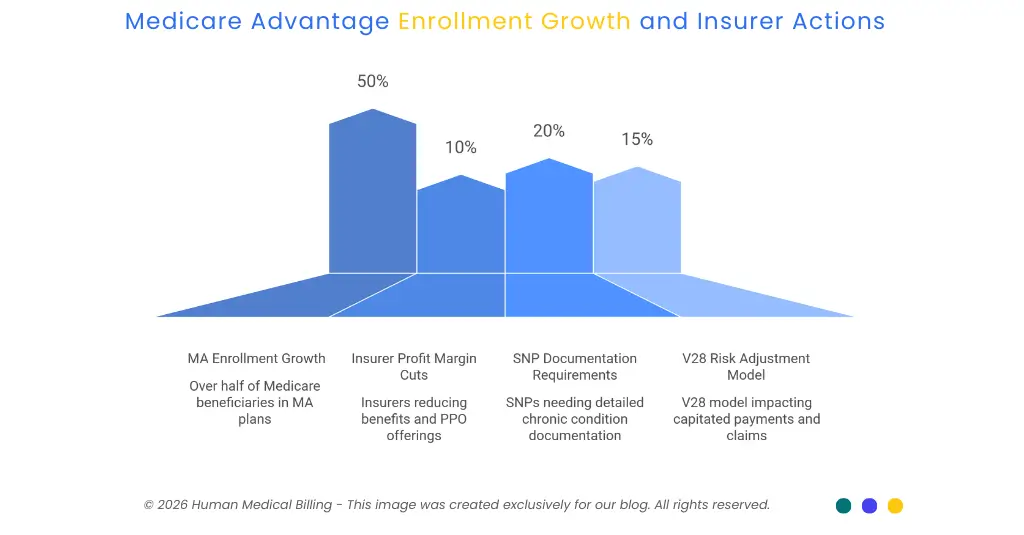
The number of Medicare Advantage (MA) beneficiaries who are enrolled for 2026 is an issue of cash flow for practices, hospitals, and billing offices.
- Average growth in Medicare Advantage (MA) has slowed; however, over one-half of all Medicare beneficiaries are enrolled in an MA plan, and this number is expected to continue growing.
- Insurers have cut back on additional benefits, cut back on their PPO offerings, and exited entire counties to maintain their profit margins.
- The cutting back by the insurer is usually due to stricter prior authorization, narrower networks for specialists, and a closer review of high-cost imaging, procedures, and post-acute care.
Medical billing services at human medical billing allow practices to rely upon medical coding services and medical accounts receivable services to remain knowledgeable about the payer edits, appeal patterns and authorization rules that vary per plan and market.
SNP Growth Increases Documentation Obligations
- SNPs and CSNPs will require detailed documentation of the chronic condition(s), functional limitation(s) and social risk factor(s) to provide an accurate reflection of the member's level of acuity on their claims and risk scores.
- The absence of clear diagnoses or vague diagnosis codes will impact both capitated payments and claim approvals for these members; particularly when the V28 Risk Adjustment Model is phased in fully for 2026 and beyond.
- Avoiding inaccurate or missing coding for Diabetes, Heart Failure, Kidney Disease and other targeted conditions that qualify members for C-SNP status and support Care Management efforts are critical to ensure proper reimbursement for services provided to these members.
Therefore, providers who have a partner that understands the role of AI medical billing, and manual review will be able to identify potential issues related to diagnosis and modifiers prior to submitting them for processing. The use of Human Medical Billing supports clinicians with healthcare revenue cycle services that link quality of documentation, accuracy of coding and payment of claims across SNP and Non-SNP plans.
Practical steps for practices in 2026
Beginning Steps For Providers - In Three Areas: Contracts, Workflows And Analytics.
1. Review payers mix and contracts
- Review the 2025 payer mix to determine how the carrier landscape changed in 2026 and who the winners and losers were within your panel.
- Identify counties where a major plan exited or cut benefits — then determine which SNP or regional plans acquired that membership, particularly those tied to Medicaid.
- Prioritize reviewing contracts with plans that represent the largest proportion of your Medicare Advantage enrollment volume and high acuity SNP members.
If your team requires help with creating a map of your panels and claims history and tying that to a review of our medical billing services, we at Human Medical can review your panels and claims history and tie that to our medical billing services to provide an accurate representation of your MA and SNP exposure.
2. Tighten front end workflows
- Take time to train all staff that register patients and schedule appointments to ensure that when patients register or schedule appointments, you are capturing the specific MA plan type, i.e., whether the patient has a D SNP, C SNP, or I SNP product.
- Develop pre-visit checklists that outline what referrals, authorizations, and member benefits require for each plan; e.g., what Humana pays for under one SNP design may not equal what UnitedHealthcare, Regional, or Provider Sponsored pay.
- Ensure that this workflow is coordinated with your Medical Credentialing Services so that providers are properly contracted and credentialed for each MA and SNP plan they treat.
Human Medical Billing can coordinate eligibility checks with our how our services works framework to help your practice prevent surprise denials at the back-end and maintain patient satisfaction.
3. Improve denial tracking and coding depth
- Track denial rates by payer and plan type. Pay particular attention to spikes in denial rates following contract changes, reduction of benefits, or introduction of new authorization policies related to MA and SNP products.
- Emphasize coding audits focused on chronic condition documentation for SNP populations, in order to document the total amount of each year, paying close attention to HCC relevant diagnoses.
- Use denial patterns from denials to inform clinician documentation training and template development. This loop allows clinicians to understand specifically which phrases, codes, or missing information will result in denials.
We at Human Medical Billing use these same models for our denial management services and medical accounts receivable services. We also use the Xpert Billing Blog to educate providers about how to address MA policy changes and risk adjustment changes.
How Human medical billing supports Medicare Advantage and SNP success
Practices that experience a "day-to-day" effect due to Medicare Advantage enrollment are the focus for Human Medical Billing. Our goal is to provide practical assistance for busy clinical workflows while remaining compliant with CMS regulations and using recognized policy sources.
We accomplish this through the following services:
- Revenue cycle management services that include eligibility checks, coding support, claim submissions and appeals for MA and SNP plans.
- Credentialing services to maintain provider status with rapidly changing networks as they enter and leave counties and modify their SNP portfolio offerings.
- Coding services focused on accurately identifying specific diagnoses related to chronic diseases and dual eligibles based upon Medicare and HCC guidelines.
- Denial management services that will identify payer trends, develop effective appeals and decrease write-offs associated with MA and SNP plan rules.
- Ai-based billing solutions that combine with expert reviewers to leverage technology for routine processes while allowing experienced billers to process complex payer responses and nuances.
If you would like to view examples of how this process works in a real-world example, we have posted success stories of groups which were able to improve their cash flow and reduce the amount of MA denials they received. We also provide answers to commonly asked questions regarding working with Human Medical Billing through our FAQs and About Us Pages. You can find our team on the contact us Page or get additional information on how to work with us by visiting the Xpert Billing Blog, which covers current policy changes as well as billing strategies for both Medicare Advantage Enrollment and Special Needs Plans.

Contact Human Medical Billing to schedule a compliance readiness review or learn more about our end-to-end billing and regulatory support services.