


What medical billing services cost in California depends on practice size, specialty, payer mix, and the work involved. California also adds its own variables, including Medi-Cal’s billing rules and the state’s health plan regulations. Understanding these costs is critical for practices trying to keep collections strong and overhead low.
TL;DR:
Medical billing services in California are usually priced as a percentage of collections, a fee per claim, or a flat monthly fee. The right model depends on your claim volume, specialty and payer mix. Always ask for a written quote that lists what is and is not included, and compare it with the full cost of your in-house billing, including salaries, benefits, software, training and denial rework.
Practices in the Los Angeles, San Diego, and San Francisco regions can face higher staffing costs and more complex payer processes, which can affect both in-house and outsourced costs. Denied claims also add rework and delay payment, and a billing partner with strong denial management can reduce that burden.
Quick Answer
California billing companies typically charge a percentage of collections, a fee per claim, or a flat monthly fee. Outsourcing can replace much of the overhead of in-house billing, but whether it costs less depends on your practice. Compare a written quote with your full in-house costs, and look for a partner that understands California’s payer mix and Medi-Cal rules.
Common Medical Billing Pricing Models:
Most billing companies in California use one of three pricing models. Ask each company to put its pricing in writing.
| Pricing Model | How It Works | Often Chosen By |
|---|---|---|
| % of Collections | The billing company is paid a share of the payments it collects. | Practices of all sizes |
| Per Claim | A set fee for each claim submitted. | High-volume specialties |
| Flat Fee | A fixed amount each month, regardless of collections. | Larger groups |
Outsourcing vs. In-House Billing in California:
Outsourcing replaces most in-house billing costs with a fee, but whether it costs less depends on your practice. Compare the full cost of each option.
In-House Billing Costs:
- Salaries and benefits for billing staff
- Training and credentialing
- Billing software and clearinghouse fees
- Staff time spent on denial rework
Outsourced Billing Costs:
- The billing company’s fee (percentage, per claim, or flat)
- Any setup or onboarding fees (ask whether there are any)
- Charges for extras such as credentialing or patient statements (ask what is included)
In Los Angeles, San Francisco, and San Diego, in-house staffing and office overhead can be higher, so it is worth comparing both options carefully.
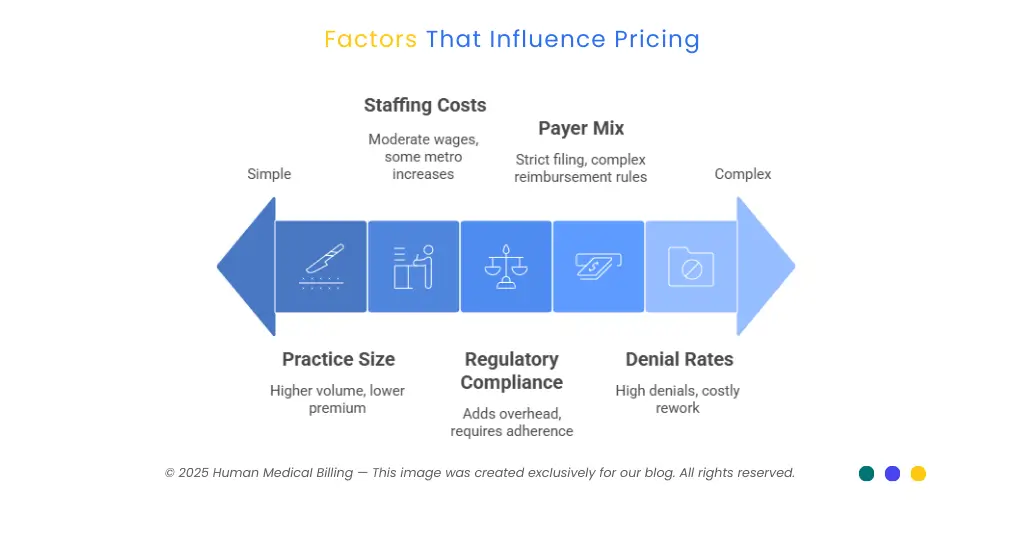
Factors That Influence Pricing:
- Practice Size & Specialty – Higher-volume practices such as pediatrics and primary care, and specialties with complex coding such as Cardiology, orthopedics, neurology, and emergency medicine, may be priced differently.
- Payer Mix – Medi-Cal has its own billing rules, including a six-month billing limit and Treatment Authorization Requests (TARs) for some services; Blue Shield & Anthem have their own reimbursement rules.
- Denial Rates – Practices with more denials need more rework, which adds cost.
- Regulatory Compliance – HIPAA and California’s Confidentiality of Medical Information Act (CMIA) apply to patient data. The Knox-Keene Act regulates California health plans, not billing companies, but its rules affect how those plans handle claims.
- Staffing Costs – Billing specialist pay varies by region and is often higher in large metro areas such as Los Angeles and San Francisco.
Geographic Cost Variations in California:
- Higher-cost markets: San Francisco Bay Area, Los Angeles Metro, San Diego. Staffing and office costs can be higher.
- Other regions: Central Valley, Inland Empire, Sacramento. Costs can differ from the large coastal metros.
The Hidden Cost of Denials in California:
Denials are a significant driver of the cost of medical billing services California practices experience. Across specialties, every denied claim means rework and delayed payment, and denials left unmanaged can lead to lost revenue. A billing partner that uses payer-specific knowledge can help reduce avoidable denials.
Authorization rules are a common source of denials. Medi-Cal managed care plans, for example, have their own authorization requirements that need specialized knowledge.
Advanced Technology and AI Integration:
- Automated Coding Assistance: Can help flag coding errors and speed up claim submission.
- Predictive Denial Management: Identifies high-risk claims before submission.
- RPA: Automates repetitive manual tasks.
AI tools can add cost, but they may also reduce denials and improve cash flow. Ask any billing partner how it uses AI and how its staff review the results.
Trends Affecting Costs:
- Value-Based Care: More quality reporting and risk adjustment coding.
- Medi-Cal Updates: Billing and authorization rules change over time, so check current guidance from DHCS.
- Coding and Telehealth: ICD-10-CM and ICD-10-PCS remain the U.S. diagnosis and inpatient procedure code sets, with annual updates. Telehealth billing rules continue to change.
- AI and Automation: Ask billing partners how they use AI and how humans review its work.
How to Choose the Right Billing Partner in California:
| What to Look For | Red Flags to Avoid |
|---|---|
| Medi-Cal billing and TAR expertise | Quotes far below other bids |
| Knowledge of California health plan rules (Knox-Keene Act) | Hidden fees |
| Local payer experience (Blue Shield, Anthem, Medicare Advantage) | Long-term contracts |
| HIPAA-compliant infrastructure and CMIA awareness | Poor communication |
| Transparent SLAs (how quickly claims are submitted and denials are worked) | Outdated technology |
| Real-time reporting dashboards | — |
How Human Medical Billing Keeps Costs Affordable
The price of billing service for California practices is influenced by practice size, specialty complexity, payer mix, and California’s highly regulated environment. Practices that keep billing in-house often have hidden expenses, from labor and technology to the cost of reworking denied claims. Outsourcing can reduce or replace many of those costs, though savings depend on your practice and contract.
For California practices, the question is not only whether outsourcing is cheaper, but which company has the right knowledge. A billing firm that understands Medi-Cal billing and TAR requirements, California health plan rules under the Knox-Keene Act, and payer specifics can be the difference between revenue leakage and steady growth. Practices in Los Angeles, San Francisco, and San Diego, where staffing costs and payer complexity are high, may find outsourcing worth a close look.
We’ve spent over 20 years helping California practices turn billing into a scalable, predictable revenue engine. We aim to help practices lower operating costs, get paid faster and strengthen compliance, all without long-term agreements.
Sources and Last Reviewed
Last reviewed: November 2, 2026. Pricing varies by practice, so this article does not list average fees or savings. Ask any billing company for a written quote based on your claim volume and specialty.
- CMS: ICD-10 codes
- CMS MLN Fact Sheet: Health Care Code Sets (MLN900943, September 2026)
- California DMHC: Laws and Regulations (Knox-Keene Act)
- California DHCS Policy Letter 08-002: Medi-Cal six-month billing limit
Frequently Asked Questions
Most billing companies charge a percentage of collections, a fee per claim, or a flat monthly fee. Ask for a written quote and compare it with your in-house costs.
It depends on your practice. Compare the full cost of in-house billing, including salaries, benefits, software and denial rework, with a written quote from a billing company.
They can. Medi-Cal’s billing rules, California health plan regulations under the Knox-Keene Act, and privacy laws such as HIPAA and CMIA add work for billing teams, which can affect pricing.
Pricing can differ by specialty. Specialties with complex coding or authorization needs, such as cardiology, orthopedics, neurology and emergency medicine, may be priced differently.
It varies. Ask a billing company what timeline to expect and how it measures results.
Pricing varies by practice, specialty and payer mix, so ask for a quote based on your claim volume.