



The clock is already ticking if you are working in medical billing/revenue cycle management in California, New York, Illinois, Massachusetts, Michigan, Ohio, or West Virginia; On January 29, 2026, CMS finalized the Medicaid provider tax rule of 2026, officially titled "Preserving Medicaid Funding for Vulnerable Populations - Closing a Health-Care Related Tax Loophole" (FR Doc. 2026-02040), and this will go into effect April 3, 2026.
The rule will close the loophole for funding Medicaid Managed Care Organizations (MCOs) with seven states taxing them at much higher rates than other businesses and using the revenue generated to pull in billions in additional federal matching dollars; as such, the effects of the new regulation on MCO contracts, reimbursement rates, and state directed payments for billing professionals will be direct and immediate.
What Does the Medicaid Provider Tax Rule 2026 Change?
- CMS no longer allows states to impose a higher rate of taxation upon their Medicaid MCOs than comparable non-medical business under 42 CFR 433.68
- Seven states will be impacted directly: California, New York, Illinois, Massachusetts, Michigan, Ohio, and West Virginia
- States must unwind non-compliant tax structures on a phased schedule running from December 2026 through state FY 2028
- CMS estimates that the total Federal cost savings will exceed $78B over the next 10 years.
- Revenue cycle teams in affected states should begin MCO contract and payment structure reviews now
How the Medicaid MCO Tax Loophole Actually Worked
To understand the significance of the Medicaid provider tax rule 2026, one first needs to understand the Medicaid provider tax loophole that it will close. In accordance with Section 1903(w), states may charge health care-related taxes on providers and apply the revenue generated from these taxes towards their portion of Medicaid spending, and the federal government will then match those dollars by paying them as part of the Federal Medical Assistance Percentage (FMAP).
The loophole functioned as follows: State's imposed an excessive Medicaid MCO tax rates; collected that money; received federal matching funds based upon the amount collected. The MCO was paid for their services through increased Medicaid reimbursement. The excess money was retained by the state, which could use the money to fund programs unrelated to Medicaid.
The difference in California's Medicaid MCO tax structure is a good example of the difference in the tax structure. Medicaid recipients pay $274 per month per recipient, whereas similar commercial plans pay $1.75 per month per recipient. Thus, the Medicaid rate differential is greater than 150 to 1, yet it met the former statistical test under 42 CFR 433.68 (e) (2). CMS estimated that state's using loophole taxes produce over $24 billion in annual state revenue.
What the Final Rule Actually Does
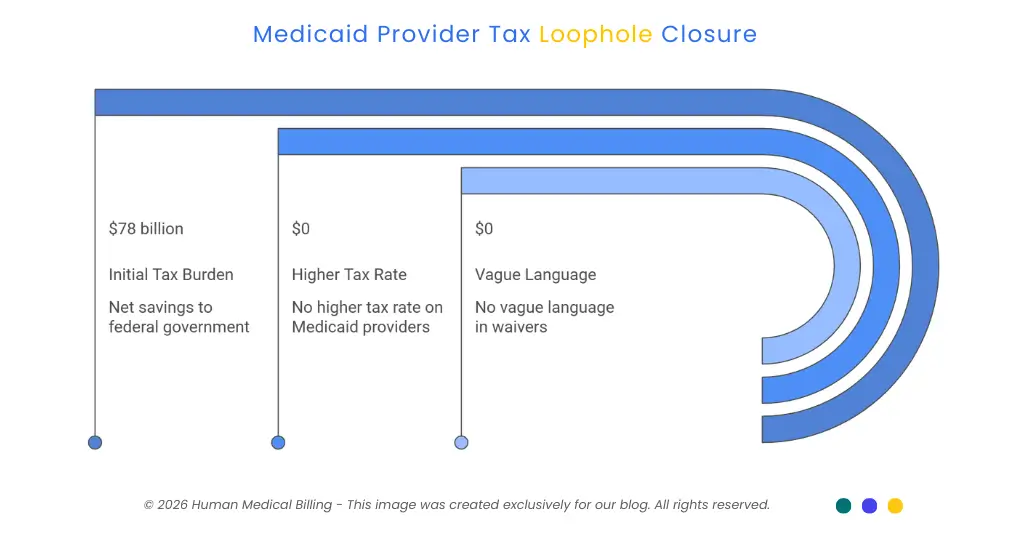
The Medicaid provider tax rule of 2026 is closing what CMS refers to as an "unintended loophole," in the statistical test that determines if a non-uniform provider tax is generally redistributive. Prior to this, states developed their tax programs so they would technically meet the test (on paper) and yet placed almost all of the cost burden of those taxes on Medicaid business.
The rule has a couple of very specific functions. It first states that no state may impose a higher tax rate on Medicaid providers compared to other businesses. In addition to this, the rule states that no state may use vague, proxy or ambiguous language in their waivers to attempt to conceal taxes which would disproportionately target Medicaid. Finally, the rule introduces an additional requirement for "generally redistributive" at 42 CFR 433.68(e)(3), which could be used by CMS to deny a waiver request as long as the older statistical tests are technically met.
CMS Administrator Dr. Mehmet Oz has said as follows: "States who have been utilizing loopholes to shift their responsibility for the care of Medicaid patients to U.S. taxpayers undermined the intent of the law." The final rule will reflect the policies Congress established through the Working Families Tax Cut Act (Public Law 119-21) which was signed into law on July 4, 2025. CMS estimates closing this loophole will result in a net savings to the federal government of more than $78 billion over the course of the next ten years.
Impact on Revenue Cycle Teams in Affected States
Here is how this translates into real-world impacts for billing specialists. The funds, provided by states to support hospital-based payment arrangements, higher-capitated rates for medical services and other safety-net programs are funded through these MCO tax structures. When there are decreases in the available funding, MCOs will modify their reimbursement models and when they do so, health care providers will see those changes in their fees and contract terms.
New York’s MCO Tax is expected to result in a total of $3.7 Billion in State Savings for FY 2026; The monies will be used to fund increased hospital and nursing home rates. California’s MCO Tax results in approximately $7.5 Billion per year in net revenue and through voter approval (Proposition 35) in November of 2024 will be made permanent as part of California state law. With both states having approved compliance deadlines and funding structures that are currently baked into their budget, these states now find themselves at odds.
State level Medicaid redesigns are creating problems for billing teams. If an MCO contract references enhanced or supplemental payments tied to state directed arrangements then states will likely negotiate these contracts when they alter their tax structure. Billing teams can anticipate changes to reimbursement rates and therefore to denial patterns. Therefore, billing teams who have a strong denial management service will be able to identify these changes before they result in additional write offs.
In this environment it is no longer optional to remain current with your healthcare revenue cycle management services. The billing consequences of state-level Medicaid redesigns move faster than most practices expect.
What Does This Mean for Patients and Payers?
The effects of managed care organization (MCO) taxes on coverage and accessibility for patients will have a real impact. The MCO tax money is used to fund more than just administrative costs. The money generated by MCO taxes also help to support the hospital rate pools, nursing facility quality improvement programs and expansion of coverage. As this money continues to contract, states are being forced to make difficult decisions as to whether they cut coverage for people who need it most; reduce payments to providers or find alternative ways to generate funding.
The KFF’s 2025 – 2026 survey of Medicaid directors found that 18 states indicated a plan to raise their current provider taxes in fiscal year 2026, primarily from hospital providers. As the 2026 Medicaid provider tax rule blocks or rolls back some of these structures, it is possible that state Medicaid directors plans to generate additional revenue will be cancelled.
Many MCOs will have a multi-state compliance obligation as each state has its own unique waiver history, fiscal year, and deadline for compliance. Therefore, MCOs will have to examine their managed care contracts, capitation agreements, and actuarially sound filings prior to the due date(s) established by each state.
What Should Your Billing Team Do Before April 3?
Don’t wait for your state agency to push out formal compliance guidelines. The compliant dates are already set.
Steps for Billing Professionals & Revenue Cycle Teams
1. Determine Your State Compliance Deadline.
Identify if your state is 1 of the 7 states that will be directly impacted. Any state that has a MCO tax waiver that was approved within the last two years of April 3, 2026, must be compliant by December 31, 2026. Any state that has an existing waiver prior to this approval date has until the end of their state Fiscal Year 2027 to be compliant. All other provider class taxes have until the end of their state Fiscal Year 2028 to be compliant.
2. Review of MCO Contract
Review all of your current MCO contracts which include "enhanced payment" language. Contracts referencing "state directed pay" or "supplemental rates" need to be placed on hold and reviewed prior to your deadline.
3. Watch For Rate Change
Watch for rate change notices and contract amendments. When MCO's revise their actuarial models they will send out amendments, do not allow these to go unreviewed by your billing department.
4. Audit Denial Trends
Audit your denial trends by payer immediately. Denial patterns created by new payment structures can quickly create lost revenue. Experienced Medicaid billing companies are a valuable asset at this time.
5. Stay close to your State Medicaid Agency
CMS has made a commitment to provide technical assistance to states for the transition period; therefore, it is important that revenue cycle leaders be aware of when their state agencies will have updated information about redesigning waivers.
6. Track Secondary Rule Changes
The One Big Beautiful Bill Act has set an upper limit on Federal Fiscal Year 2028 on the maximum amount of provider tax rates. The 2026 Medicaid provider tax rule is just one layer. There are additional restrictions to come in a separate timeline.
We are tracking the compliance timelines for each of the seven affected states here at Human Medical Billing and would be happy to assist with assessing your exposure prior to the implementation of these new policies affecting your reimbursement.
Frequently Asked Questions
The Medicaid provider tax rule of 2026 is the "Preserving Medicaid Funding for Vulnerable Populations - Closing a Healthcare Related Tax Loophole" Final rule that will be effective on April 3, 2026. On January 29, 2026 CMS finalized the rule as FR Doc. 2026-02040. The Rule prohibits States from imposing taxes on Medicaid MCO's at a rate greater than or equal to that imposed on other (non-Medicaid) businesses, and it also closes a loophole in the statistical test at 42 CFR 433.68.
CMS identified seven states which have already received a waiver for the loophole: California, New York, Illinois, Massachusetts, Michigan, Ohio, and West Virginia; each state will have to comply with their MCO tax structures, on a phased schedule.
Companies which received an MCO tax waiver in less than two years from April 3, 2026 must file their return by December 31, 2026. States with older MCO waivers required to file their return by the end of state fiscal year 2027. All other provider classes are required to file their return by the end of state fiscal year 2028.
When companies begin to re-design their tax systems, Medical Care Organizations ("MCO") will adjust reimbursement rates as well as state directed payments. Companies should review all MCO contracts, monitor MCO contract rate changes and analyze denial patterns per payor. By working with a company that is familiar with both medical coding services and Medicaid compliance, you can minimize your liability.
The Bottom Line
Providers are required to file a claim for Medicaid services by April 3, which is just weeks away; this is a deadline that needs to be acted upon now, as billing professionals in California, New York, and the 5 other affected states will have to complete contract reviews, track waivers, and audit their reimbursements immediately, or risk being impacted when the first adjusted claims come back from CMS.
Regulatory changes like this often cause a delay in provider and revenue cycle teams ability to take advantage of them, not a head start on compliance with them. If you would like to discuss how this new rule may expose your Medicaid billing practices reach out to us. As states move toward developing their own compliance timelines we will continue to update you on those developments via the Xpert Billing Blog.

Contact Human Medical Billing to schedule a compliance readiness review or learn more about our end-to-end billing and regulatory support services.