



Between January 2018 and January 2026, 152,200 independent physicians were displaced into hospitals or employed by corporations as shown by data from Avalere published by Medical Economics. Most people will tell you this was due to burnout. But I am here to tell you that the true issue is numbers. Today's economic reality for an independent medical practice depends almost entirely upon what type of jobs can be done internally by the practice and those that need to be outsourced and not if there is still some degree of clinical enthusiasm.
Physician Medicare reimbursement rates have decreased 33 percent since 2001 when adjusted for inflation according to the AMA; meanwhile, costs related to personnel, technology and complexity with payers continue to rise. Those practices that remain independent are those that operate their internal billing, staffing and overhead based on a business model rather than an after-thought.
Quick Answer
- The number of Independent Physicians fell to 120,900 as of January 2026; this was a decrease from approximately 273,100 independent physicians in 2018. This information can be found on avalere.com, and medical economics.
- Nearly two-thirds (63.9%) of U.S. Practices are owned by non-physicians; nearly one-third (29.8%) were owned by non-physicians in 2018.
- Payments to Medicare Physicians have decreased 33% from 2001 when adjusting for Inflation, and payments under the CY 2027 Proposed Rule will be reduced an additional 1.68%.
- A way to remain an Independent Physician Practice typically includes developing a clear Keep-or-Outsource Plan for Billing, Credentialing, Collections, etc.
Why So Many Practices Are Giving Up Independence
The transition away from independent medical practice was not a one-day event. According to data provided by the American Medical Association (AMA), using its Physician Practice Benchmark Survey, as of 2024, the percentage of practicing physicians who own their own independent practices has fallen from 60.1% in 2012 to 42.2%, while the AMA also reports an overall decline in independent practice owners as of 2024 to 46.7% based on its 2022 survey data. Further data published by Avalere shows there were approximately 120,900 physicians in independent practice as of January 2026. This represents a significant drop compared to when Avalere estimated there were roughly 273,100 physicians in independent practice in 2018.
During 2024 and 2025, hospitals have added around 44,000 new physicians to their payrolls. However, that rapid growth occurred primarily during 2025. In terms of purchases of physician-owned practices, corporate buyers (insurers, private equity firms and pharmacies) purchased nearly twice as many physician owned-practices as hospital systems did in 2024-25; however, those corporate purchasers increased their physician workforce only slightly (up only 0.9%) from the time they made their purchase. Therefore it appears likely that at least a portion of those newly-acquired physician-owned practices experienced a loss of physicians immediately after acquisition rather than acquiring new physicians.
What Changed in the Math for 2026
Two factors have evolved simultaneously: the physician services (and specialties) that will be reimbursed under the system, and the cost to operate an independent medical practice.
Physician reimbursement has declined by 33% since 2001 when adjusting for inflation as reported by the American Medical Association. In addition, the Centers for Medicare & Medicaid Services (CMS) released its proposal for the CY 2027 Physician Fee Schedule in July 2026. The standard, non-qualifying conversion factor was proposed to decrease 1.68% to $32.84. A portion of this reduction is due to the expiration of a one-time 2.5% increase that Congress implemented for calendar year 2026. Alternative payment model physicians who qualify are expected to see a less severe reduction of approximately 1.19%.
Neither of these changes represent long-term solutions; rather, they reflect a transition back to prior conditions. As such, any independent medical practice budgeting based upon the current conversion factor may experience a financial shock if there are no additional legislative or regulatory fixes enacted before the start of 2027. This represents another paradigmatic shift in the economic dynamics facing independent medical practice heading into 2027.
The average expense for employed physicians, per full-time equivalent (FTE) employee was approximately $315,358 in the 4th QTR. 2025. According to Kaufman Hall as cited in Becker’s Hospital Review. This number reflects only expenses that are related to keeping an employed doctor working – and represents a 4 percent increase from 2023.
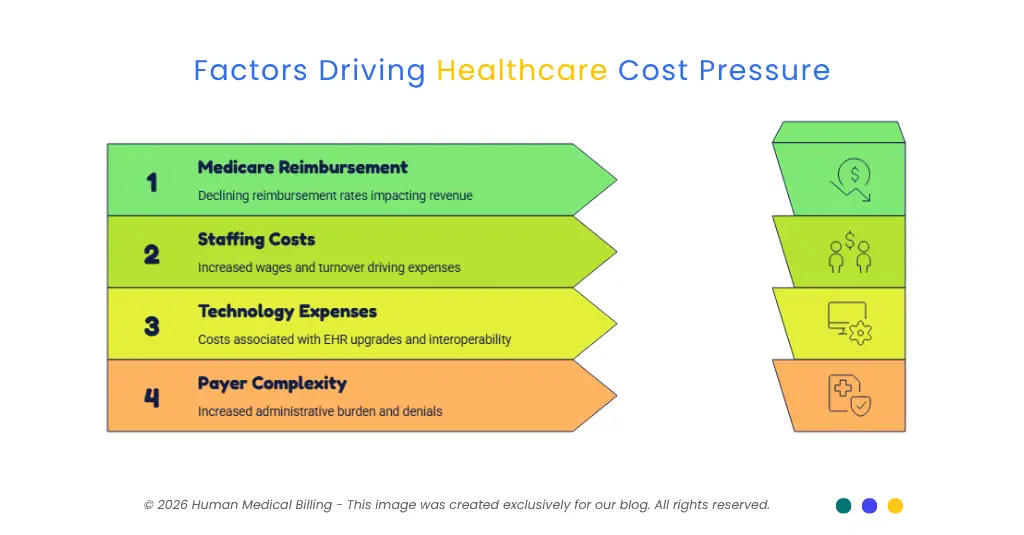
| Cost pressure | Why it's happening |
|---|---|
| Medicare reimbursement | 33% inflation-adjusted decline since 2001; CY 2027 rule proposes another cut |
| Staffing | Wage growth and turnover in front desk and clinical roles |
| Technology | EHR upgrades, interoperability rules, prior authorization portals |
| Payer complexity | More documentation and appeals per claim, more denials to work |
Impact on Billing Teams: What to Keep, What to Outsource
Most of the practices working to remain independent don’t work on all aspects of their business independently. Instead, they determine, piece by piece (function by function), what will be kept within the walls of their office and what will be outsourced.
Practices typically keep front desk scheduling, clinical documentation and the physician-patient relationship internal because those are the things that patients experience, and it is difficult to outsource them without giving up part of why a practice exists in the first place.
However, when it comes to billing, coding, credentialing, and accounts receivable, practices operate with a completely different philosophy. While both consume valuable staff time and affect patients indirectly, errors made during billing, coding, credentialing, etc., result in direct financial loss due to lost claims, late payment and/or non-renewal of payer contracts. As such, many independent practices hire third party revenue cycle management companies (sometimes just for medical coding services) or even for complete cycles including denial management services and medical accounts receivable services.
Credentialing has also become worthy enough of its own line item. Delays in credentialing can result in physicians being unable to bill for months. Payer credentialing timelines continue to grow as payers add additional steps to verify credentials. Therefore, when practices begin falling behind on credentialing, they tend to utilize third-party credentialing services instead of absorbing delays internally.
The decision regarding whether or not to perform a certain function is not based upon determining which functions are less important. Rather, it is centered around determining if a five- or ten-person practice has sufficient resources to provide adequate staffing, training and auditing for each function while still maintaining operations as a functioning clinic. Most do not have the ability to handle all of the functions simultaneously.
Impact on Patients and Payers
As physician-owned and independent practices are sold, or closed down, their patients will likely see loss of access to care, as they do in rural America. In fact, today nearly 85% of all rural physicians are employed by hospital systems or large health groups; over 66% of all rural medical offices are not physician owned. Delays from credentialing processes for new staff members added to the existing staffing shortages in these environments, will be the reason why many of them cut back on patient hours, prior to cutting services.
With fewer independent, smaller community based medical office owners, there will be fewer smaller communities that have negotiating power with insurance companies regarding networks and access. None of this has to occur. If physicians who own practices that are being sold off or closing, decide how to "run lean" and still keep the ownership of their practice.
What Should Your Practice Do Now?
None of these steps require new software or an ongoing consultant on retainer. They just require actually reviewing your numbers which most practices already have.
Steps to protect your position
- Run your real numbers. Gather last years' overhead, staffing expenses, and collections (by payer) for a picture of how you are spending your money. Guessing about where money is leaking costs more than finding out how much it is really costing you.
- Separate front-office work from back-office work. Determine which billing and coding tasks are actually required to be done in person within the building and which do not need to be completed in-person.
- Track denial rate by payer and code, not just overall. A 12% denial rate on one payer can mask an easily correctable coding issue.
- Create a credentialing calendar. Missing renewal dates will cost more than the actual credentialing costs due to lost billing days.
- Compare the cost of outsourcing a function against fully loaded staffing expenses including turnover & training for that function.
- Re-review this list every year. Even with only the cy 2027 rule payment side changes enough to shift the math again.
Frequently Asked Questions
For those that have managed their overhead and outsourced all functions which drain staff time but add no additional income; yes. The physicians leaving independent medical practice are typically the ones that have had difficulty managing the financial aspects of an independent medical practice.
Congress passed a temporary 2.5% conversion factor increase for 2026. This temporary increase is set to expire at the end of 2026. CMS has released its proposed CY 2027 regulation. It proposes to lower the standard conversion factor by 1.68% (to $32.84) when compared to the 2026 conversion factor.
If a physician is new to a payer and has not been credentialed by the time he/she delivers a service, they cannot bill the payer for those services. This results in lost revenue on the delivery of services that are past due for payment.
The majority of practices retain all internal scheduling, but outsource all back-end operations such as coding, denial follow-up, and AR. Practices that have large volumes of claims (such as Cardiologists and Orthopedic Surgeons) will benefit the most from outsourcing their Accounts Receivable because their aging claims grow at an accelerated rate compared to other specialty areas.
Being Independent in 2026 is based on understanding your data (and) better than the practices that sell. Human Medical Billing has developed an additional tool - The Practice Revenue Cycle Benchmark Review - to compare your denial rates, collection timeframes, and overheads with similar sized medical offices; allowing you to determine where the most efficient use of your resources is by identifying which areas can be outsourced. If you have billing, credentialing, or accounts receivable taking up too much of your employee’s work hours contact us to schedule a review, and/or see our Xpert Billing blog for information about changes going forward through 2027.

Contact Human Medical Billing to schedule a compliance readiness review or learn more about our end-to-end billing and regulatory support services.