



CMS has created an opportunity for all Billing Teams in the United States to consider a significant change. On July 14th, 2026, CMS announced its intent to seek Public Comments regarding a potential change towards using FHIR (Fast Healthcare Interoperability Resources) based quality reporting within the Quality Payment Program. Currently, quality submissions are completed manually. A change could be made so that automated data can be collected directly from Certified Electronic Health Records.
At this time, CMS will not finalize this proposal; however, CMS is seeking comments as part of a Request for Information (RFI). This RFI proposes a transition plan over a period of two years. The initial phase would begin during the 2028 Performance Period with mandatory reporting beginning no later than 2030. Although this may appear to be far into the future, for those currently completing quality reporting, it is already relevant.
Quick Answer
- The proposed CY 2027 Physician Fee Schedule has included in it an RFI (Request for Information) regarding moving Quality Payment Program (QPP) quality reporting towards use of FHIR-based quality reporting.
- CMS intends to have a "two year phase in" plan for this, beginning with the CY 2028 performance year, making it mandatory by the CY 2030 performance year.
- CMS will be using a phased-in approach to begin with a limited number of quality measures prior to expanding the requirements.
- As of now, nothing is finalized as CMS has extended comments until Sept. 14th, 2026; they would need to issue another rule prior to proceeding.
What FHIR-Based Quality Reporting Actually Means
Right now, billing and quality teams submit MIPS data through a combination of claims, registries and electronic clinical quality measures (ecqms). Each format pulls information from the system differently. Each also has its own unique "flaws" for extraction and validation.
FHIR stands for Fast Healthcare Interoperability Resources. This is an industry standard that allows for the exchange of clinical information between systems in a consistent way.
CMS wants to have quality data automatically generated from certified ehr's using FHIR rather than having practices manually generate reports or work with a vendor to use a reporting tool. The idea behind this is that if the ehr system is built on top of FHIR it should be able to directly access the patient record and submit the quality data without going through a separate reporting process.
That's the sell. Whether this will actually play out as clean as the sell depends on how ready the ehr providers are to implement FHIR and how prepared the practice is to take advantage of this new feature which is why CMS is proposing this plan in order to determine that.
What’s New in the CY 2027 Proposed Rule
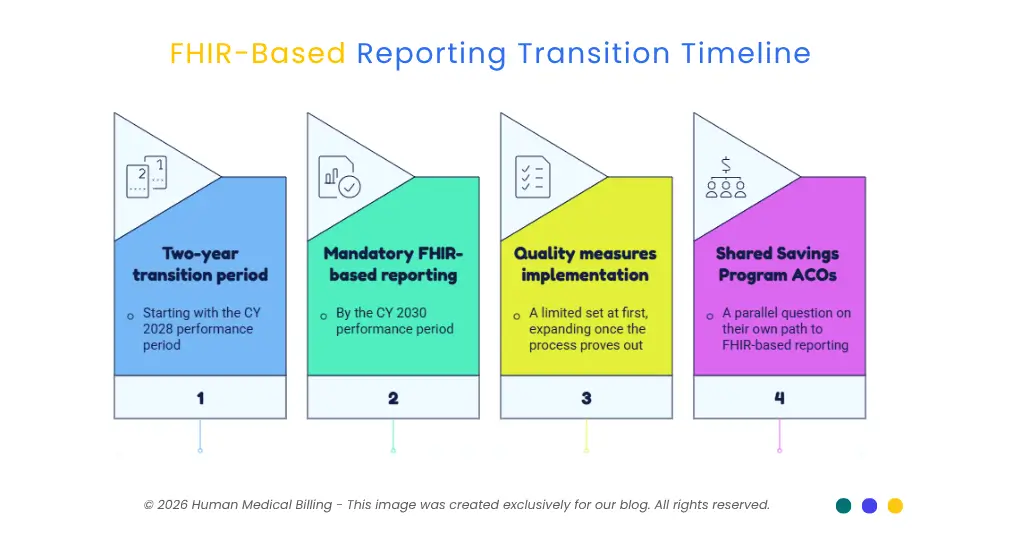
The CY 2027 Proposed Rule to CMS’s Physician Fee Schedule was published July 14, 2026; and as part of this release is an open Comment Period of sixty (60) days ending Sept 14, 2026. In addition to the Proposed Rule is a Request For Comments (not a requirement); soliciting comments from stakeholders regarding their opinion regarding the potential use of FHIR based Digital Quality Measurement across all of MIPS, MVPs and other CMS quality reporting programs.
Here is what CMS floated:
- Beginning with CY 2028 a two year transition time frame to begin mandatory use of FHIR based reporting.
- Mandatory FHIR based reporting will be required of all MSSP participants beginning in CY 2030.
- Initially the Medicare program is planning to require only a small number of quality measures (a "limited set") that are reported using FHIR. The plan is to expand this list as it becomes clear how effective and efficient the process is.
- There will also be an opportunity for shared savings program ACO's to report data via FHIR and have a separate question (in addition to the question related to Medicare) about the ACO's progress toward FHIR.
The current Request For Information (RFI) will be released at the same time as additional quality reporting changes that were also included in the same regulation. The traditional MIPS reporting pathway is slated to end after the CY 2028 performance year. Starting in the CY 2029 performance year, clinicians outside MIPS Alternative Payment Models would report via MIPS Value Pathways (MVPs). Three new MVPs focused on disease management for diabetes; management of hypertension; and hospitalist care are scheduled to go into effect for 2027 and there will be additional "core" measures added to each of the existing MVPs.
What This Means for Billing and Coding Teams
Quality reporting already takes the time of hospital staff every quarter. Some of this work will be transferred from an employee to the EHR as we transition to extracting our quality information via FHIR. However, as we go through this transition there are many other questions that come about.
Will your EHR vendor support FHIR-based quality reporting currently? There are several vendors who have made some progress toward supporting FHIR-based quality reporting but support for automated pull of quality data from the EHR has yet to develop fully throughout the entire health care industry. Therefore, practices using older versions of their EHR or highly customized versions may need additional time to prepare.
Additionally, billing teams should anticipate having tighter relationships between clinical documentation and quality scores. Because quality reporting pulls directly from structured data fields, incomplete or inconsistent documentation shows up in the quality score quicker than it does now. This means that clean coding and complete documentation will mean more than ever before. The team responsible for medical coding services on a daily basis can identify these gaps before they result in lost quality points.
The pattern of denials tells a similar story. Practices that have struggled historically with clean claims also tend to struggle with clean quality data because both rely on the same foundational clinical documentation. A practice that has control over its denial management services is probably closer to being ready for FHIR than it realizes.
What This Means for ACOs and Value-Based Care Groups
CMS is looking at whether or not ACOs as well as individual clinicians are prepared for the transition to FHIR based digital quality measurements as part of their shared savings program participation.
Additionally, in the proposed rule CMS allows ACO’s to attest to meeting Certified Electronic Health Record Technology (CEHRT) requirements via one of three methods – FHIR enabled health IT. This is a smaller step in preparation for what is coming down the road, however both the RFI for quality measures and the proposed rule point towards a future where quality data is moved digitally versus being done manually and in paper form.
Thus, for ACOs, if all participating practices have different levels of data capability (some having stronger systems then others), the practice with the least capable data infrastructure will be the bottleneck that determines when and if the ACO as a whole can fully adopt new forms of quality measurement.
What Should Your Practice Do Now?
You do not have to make significant changes before September 2026. Taking a few proactive steps can help position you ahead of practices that wait until the Mandate is enforced.
- Ask your EHR vendor if they currently support FHIR-based quality reporting and provide information on how they plan to approach this with regards to 2028.
- Take stock of the cleanliness of your current documentation and coding. If quality reporting shifts toward real time data pull from electronic health records (EHRs), poorly documented data becomes a much larger issue than it was previously.
- Watch the comment period. The comment period is an opportunity to express concerns regarding the two year transition and/or the 2030 deadline and is due by September 14, 2026.
- Discuss denial patterns with your billing partner as soon as possible. The same data gaps that create denials will most likely be evident in future quality scores.
- Do not delay starting the conversation about potential mandates. Requirements for Mandatory Reporting as indicated through CMS Requests for Information may show where requirements for mandatory reporting are heading.
Frequently Asked Questions
FHIR-based quality reporting is a proposed way to do quality reporting that uses the Certified EHR System (CEHRS) to send quality data in the FHIR format. Instead of doing this manually, or through some other registry, practices can simply use their CEHRS to get these reports sent out automatically.
A two year phase-in period begins with the CY 2028 Performance Period. The Mandatory Phase In will begin with the CY 2030 Performance Period. This is currently a "Request For Information," and NOT A FINAL RULE
No, but it will. The same Proposed Rule that will end traditional MIPS reporting (after CY28) will also be the first to require reporting of MVPs beginning with CY29; thus, there are two paths of Quality reporting being altered at the same time.
Billing Teams should begin by confirming their vendors have been prepared for what they will report; reviewing current documentation requirements; and waiting to see how CMS Finalizes its RFI from which comments close on September 14, 2026.
CMS is taking its time on this one but clearly in what direction. The future of quality reporting is to be completely automated using FHIR-based data pulls from EHR systems. As such, those who are maintaining high-quality documentation and have good coding practices will see these changes sooner than most. We work every day to ensure all billing claims and quality data align prior to becoming an issue. We'd like for your practice to take a close-up view of how your documentation is going prior to 2028 arriving. Please Contact Us and we can go over it together.

Contact Human Medical Billing to schedule a compliance readiness review or learn more about our end-to-end billing and regulatory support services.