


The cost of care is increasing, and continued affordability of insurance remains out of reach for many Americans. As a result, the Centers for Medicare & Medicaid Services (CMS) and the Department of Health and Human Services (HHS) will initiate a large-scale expansion of catastrophic health plans for the year 2026. It enables many more individuals to obtain these affordable, high-deductible plans that cushion them against severe health crises.
Practitioners, practice managers, and medical billing professionals must be knowledgeable of these changes. These changes will impact which patients will be covered, will affect the flow of money, and will require modifications of billing practices. This article discusses what catastrophic health plans are, explains the 2026 expansion, and provides information on how providers can prepare operations and finances to accommodate that new business.
What Are Catastrophic Health Insurance Plans?
Catastrophic plans intend to pay for the high bills of severe injury or illness. Catastrophic plans have the following:
- Reasonable monthly payments to make insurance more affordable.
- The members must pay high deductibles before they get full coverage.
- The Affordable Care Act requires the inclusion of some of the major health benefits.
- Free prevention services with no cost-sharing.
- Three primary care visits before the deductible is triggered.
Earlier catastrophic plans were against three primary groups:
- Young adults are below the age of 30.
- Members who qualify due to the hardship exemption since they have problems affording typical health coverage.
- Individuals who have affordability exceptions due to income or special circumstances.
The plans have high costs that people must pay themselves before getting full benefits. They are good for healthy individuals who want to be protected in case something bad happens but cannot pay or do not want to pay higher premiums for more complete plans.
2026 Expansion Details: What Has Changed?
Starting November 1, 2025, for plans that have a start date of January 1, 2026, CMS and HHS will greatly enlarge catastrophic health plan eligibility by changing hardship exemption requirements. Major highlights include the following:
- There are now hardship exemptions for adults under 65 who were previously not eligible.
- Eligibility is no longer age-limited to under 30 but is expanded to moderate-income adults that have incomes above premium tax credit levels.
- People whose incomes range from less than 100% to more than 400% of the federal poverty level (FPL) may apply for hardship exemptions to join catastrophic plans.
- You may file hardship exemptions online quickly and easily or by mail, making it easier to navigate the procedure.
| Before 2026 Eligibility | After 2026 Eligibility Expansion |
|---|---|
| Under 30 years old or hardship exemption | Adults under 65 with expanded hardship exemptions |
| Limited income-related hardship groups | Includes those with income below 100% or above 400% of FPL |
| Enrollment during open enrollment | Same, beginning Nov 1, 2025, with broader eligible population |
| Smaller enrollee pool | Estimated millions more consumers could qualify and enroll |
The CMS is looking forward to the expansion bringing relief to those who could otherwise not afford the cost of the conventional ACA plans with the increased premium and the expanded subsidies coming to an end by the end of 2025.
Why This Matters for Healthcare Providers:
The construction of catastrophic health plans will have several direct effects on medical billing professionals and health practitioners:
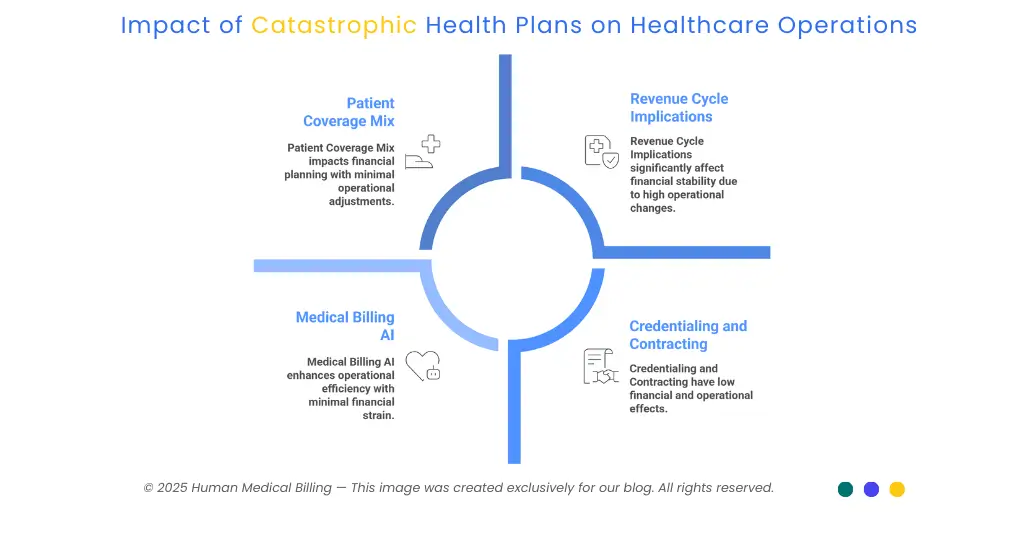
1. Shifts in Patient Coverage Mix
Providers will see a drastic rise in patients with catastrophic plans that will impact both the payer mix and reimbursement level. Premiums being lower, the high deductible translates to patients paying high cost-sharing that has an impact on the patient payment responsibility and financial counseling requirements.
Out-of-pocket expenses have been found to be a primary financial burden on the majority of insured patients - particularly those who have high-deductible plans - warranting greater provider involvement for planning of payment.
2. Revenue Cycle Implications
Verification of these plan eligibilities will be more necessary at the point of intake with the increased hardship exceptions.
The providers may encounter delayed reimbursement or more denials if the deductible obligations are not communicated clearly or comprehended properly.
Proper denial of claims management services will be needed to quickly resolve disputes over coverage claims concerning these plans.
3. Credentialing and Contracting
As the pool of insured diversifies, payers must have up-to-date contracts and medical credentialing services with payers who provide catastrophic plans so that reimbursement does not get delayed according to new terms of policy.
4. Codification and Billing Modifications
Clear coding that indicates if services have a deductible or if they are covered is necessary. Medical coding specialists must frequently update the regulations by the insurance regarding catastrophic plans to decrease claim denial and delay.
5. Account Receivable and Patient Collections
Those with catastrophic plans will likely pay more out of their own pockets. Effective services for managing medical bills, transparency of financial obligations, and AR management services will be crucial to retain steady cash flow and uphold patient confidence.
6. Medical Billing Artificial Intelligence
Next-gen medical billing by AI can classify plan types, instantly validate eligibility, track deductible amounts, and alert against potential issues on claims at an early point of time. This automation increases accuracy, speeds up claim submission, and lowers revenue cycle errors.
Data Insights into Catastrophic Coverage and Cost Impact
New studies of the sector reveal an alarming tendency: despite increased insurance coverage, high health expenses remain a heavy burden on the insured. It is predominantly due to outpatient medication and high co-payments. For instance:
- In most OECD countries, outpatient care medicines account for over 75% of extremely high health expenditures by low-income individuals.
- High-deductible plans, like catastrophic coverage, put more financial burden on consumers directly, typically at the sacrifice of postponed care or non-compliance with medication.
- Insurance design changes bring responsibilities for providers to make sure patients can afford care while also improving claim payments.
The CMS explanation is that carriers nationwide have requested an average 2026 rate hike of 15% due to increasing medical expenses. This hike, paired with the expiration of additional financial assistance, makes catastrophic coverage more consequential as a fallback by many individuals who lack the ability to pay typical coverage.
Frequently Asked Questions (FAQs)
Adults younger than 65 who have hardship exemptions, including those whose income is below 100% or above 400% of the federal poverty level.
These plans are lower cost per month but have extremely high deductibles. These plans are for the worst-case scenario. Bronze plans have more coverage and smaller deductibles.
You get free preventive services and three free primary care visits with catastrophic plans.
By maintaining credentials up-to-date, denial management, accurate coding, and the use of AI-driven billing automation to validate claims accurately.
How Human Medical Billing Supports Providers Through These Changes
Human Medical Billing provides complete healthcare revenue cycle management services that effortlessly integrate new regulations, including the extension of the 2026 catastrophic plan. We have experience in:
- Denial management services to reduce claim rejection due to emerging plan complexities.
- Successful medical credentialing services ensure that provider networks comply with regulations.
- Correct medical coding services that meet payer needs.
- Live medical billing solutions that improve cash flow.
- Next-gen medical billing software that accelerates speed and enhances accuracy.
We collaborate directly with health care practitioners to develop solutions that make billing a breeze, no matter the changing rules of insurance. Learn how our services can assist your practice.
Conclusion & Key Takeaways:
The 2026 development of catastrophic health plans has pros and cons: it provides millions more with access to cheap plans but forces health care providers and billing specialists to adjust the way they operate, improve their techniques, and get ready for further financial adjustments.
Knowing what catastrophic plans include, seeing the expanded broader eligibility, and getting operationally prepared - specifically denial management, credentialing, coding, and receivable accounts - can enhance revenue cycles and enhance the patient experience.
Working with experts like Human Medical Billing can make these changes easier. They use top tools and have a lot of experience to help your practice stay financially strong during ongoing healthcare changes.
Adhering to this new catastrophic coverage regulations will allow health practitioners to succeed as the practice of health insurance progresses in the year 2026 and beyond.