



If your practice issues prescriptions for orthotics, power mobility devices (PMDs), or other expensive medical supplies, you have been notified that an update to your compliance process has taken place.
The U.S. Centers for Medicare & Medicaid Services (CMS) published a significant Federal Register Notice (CMS-6097-N) on January 13, 2026, which contained two important updates to CMS Master List of items potentially subject to strict payment rules and the list of items requiring a required face-to-face encounter prior to delivery and a written order prior to delivery (Required WOPD).
Although this may seem like a lot of technical jargon, the immediate impact of non-compliance is loss of payment on all of these items, beginning with the effective date of the update.
Below is what you need to know about the January 13 update and how you can protect your practice's revenue.
What Just Happened? (The Jan 13, 2026 Update)
- The Event: On Tuesday, January 13, 2026, the Centers for Medicare & Medicaid Services (CMS) issued document CMS-6097-N.
- The Key Change: This CMS Notice adds items to both the Master List (a list of items that have the potential to be vulnerable) and updates the Required Face-to-Face Encounter and Written Order Prior to Delivery (F2F/WOPD) List.
- The Effective Date: For all items added to the "Required List," the new rules take effect on April 13, 2026. That provides approximately 90 days for practices to prepare.
The "Required List" Explained
A clear understanding of what distinguishes the Master List from the Required List helps explain the significance of this update. The Master List includes all items being reviewed by CMS. The Required List represents the items upon which the rules apply.
As such, for any item on the Required F2F/WOPD List, in order for Medicare to provide reimbursement, there are two very specific conditions of payment that must be met prior to any payment being made to the provider or supplier:
1. Face-to-Face Encounter:
The treating practitioner must see the patient in person (or via a Medicare-approved telehealth visit) within 6 months before the order is written. The medical notes must explicitly document why the device is medically necessary.
2. Written Order Prior to Delivery (WOPD):
The supplier (DME company or pharmacy) must have a complete, signed Standard Written Order (SWO) in their possession before they hand the item to the patient.
As a result of the changes made by CMS on January 13, 2026, many DME products have been added to the “Required List.” As such, what used to require nothing but a phone call from your doctor to obtain a prescription; beginning in April will require a face-to-face encounter between your doctor and yourself.
Why Did CMS Do This?
Payment Integrity is the driving force behind this. According to the OIG and CERT, there are several DMEPOS items that have very high error rates for improper payment.
CMS will enforce face-to-face encounters with beneficiaries to confirm that a provider has actually seen the beneficiary; and by enforcing Written Order Prior to Delivery (WOPD), CMS will confirm that the product was delivered to a beneficiary who needed it - rather than being diverted or otherwise used for purposes of waste and abuse.
Therefore, for those practicing honestly, it means more stringent documentation requirements. Which is why it's so important to partner with healthcare revenue cycle management companies to track the Federal Register notices, and flag new CPT/HCPCS codes prior to billing them.
Operational Impact: What Changes for You?
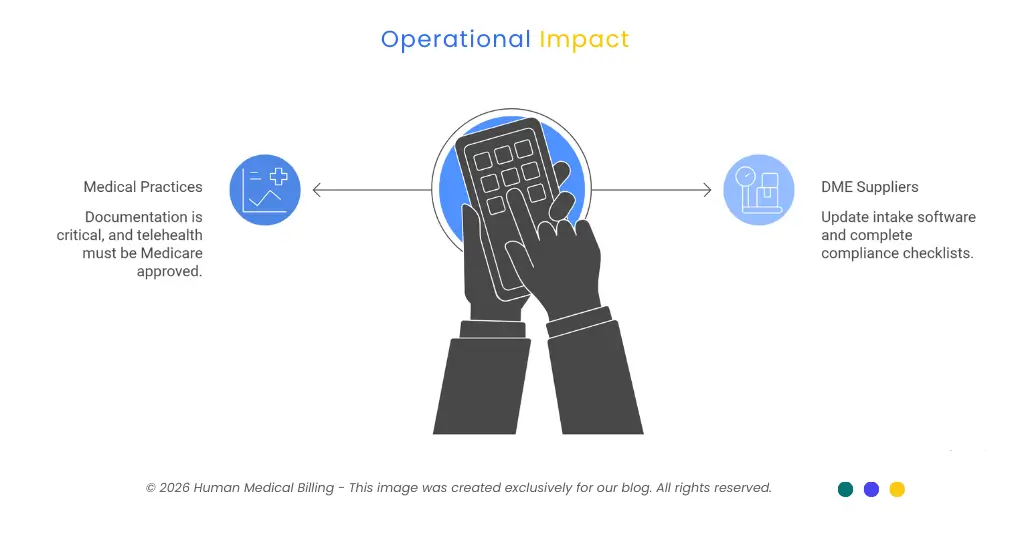
The operational changes will depend upon your position within the health care ecosystem.
1. For Medical Practices (prescribers):
- Documentation is Critical: You can't simply enter a piece of equipment into the patient's plan of care. Your clinical staff must be educated on how to document what the specific medical reason is for which the patient needs the item (e.g., "patient has ankle instability causing decreased ability to ambulate independently thus the patient requires an L-code XXXX").
- Telehealth Precision: If you are using telehealth to perform the face to face encounter, confirm that you have used a Medicare approved telehealth platform and that the encounter meets all of the current Medicare requirements for coverage. Phone calls alone do not meet the telehealth criteria for Medicare.
2. For DME Suppliers:
- The "Hold" Rule: Update your intake software to recognize when a new code from the required list in the CMS-6097-N notice arrives. When this occurs, the software should automatically "hold" the shipment until it receives and verifies the WOPD.
- Inventory Checks: Look at the specific HCPCS codes that were added to the required list in the CMS-6097-N notice. If you carry inventory of these items, complete compliance check lists as soon as possible to remain compliant with the changes.
Financial Risk: The "Condition of Payment" Trap
The biggest problem with this update is the fact that F2F and WOPD have become requirements for payment.
An example of how this works is if an audit occurs regarding your claim, and the WOPD is stamped as completed after the date the patient was discharged, the claim is denied for non-payment. Unlike a medical necessity denial where you can argue clinical judgment, a date error is a factual failure that is incredibly difficult to overturn on appeal.
You typically cannot "fix" this retroactively because you cannot change the historical record of when an order was written and when the product or service was actually provided, you can't change those historical events.
That is why some denial management companies have shifted from fixing errors to prevent them. At Human Medical Billingwe review the dates involved prior to submitting the claim to the MAC (Medicare Administrative Contractor) so that potential problems are identified before they become an issue.
Step-by-Step Compliance Plan (90-Day Countdown)
You have until April 13, 2026, to align your workflows.
1. Download the Notice:
Access CMS-6097-N and review the specific HCPCS codes moving to the Required List.
2. Update EMR Templates:
Put an alert into your Electronic Medical Record (EMR) if you are using one. When a provider chooses a code off the Required List, have this question appear on the screen: "Was a face-to-face encounter with the patient within the past six (6) months?"
3. Educate Your Staff:
Both your nurse and front desk staff will have to be informed that these orders are not like other orders. The order will need special handling so that the medical coding services department can get the information they need to bill.
How Human Medical Billing Can Help
As long as there are new rules from the federal register, the need to comply will always exist. The task of keeping current while managing the needs of patients can be overwhelming to many practices.
At Human Medical Billing, we function as your regulatory shield.
1. Pre-Claim Audits:
We ensure your WOPD dates are aligned with your delivery dates to eliminate the potential of receiving technical denials.
2. Coding Accuracy:
We ensure the codes listed on your order match the diagnosis listed in your Face-to-Face Note.
3. Supplier Coordination:
If you are a practice that dispenses DME, we manage the critical hand-off between clinical documentation and billing.
We do not simply submit claims; we protect your revenue integrity.
Frequently Asked Questions
Any claim with a Date of Service on or after April 13, 2026, for an item on the updated Required List will be denied if it lacks a compliant WOPD or Face-to-Face encounter note.
Yes, a Nurse Practitioner (NP), Clinical Nurse Specialist (CNS), or Physician Assistant (PA) can perform the encounter, provided they are treating the beneficiary for the condition that requires the item and it is within their scope of practice.
Technically, this is a Medicare rule. However, many commercial payers follow CMS guidelines for high-cost DMEPOS. It is best practice to apply these standards universally to avoid confusion and potential recoupments.
Final Thoughts
CMS's January 13, 2026 release of CMS-6097-N clearly demonstrates CMS is taking tighter control over DMEPOS payment claims. You have a window of opportunity before the strict enforcement begins in April.
Don’t allow administrative missteps to put at risk your medical practice’s financial health. The loss from a claim denial because of an incorrect date can be avoided by having the proper controls in place.
If you are unsure whether or not your documentation meets the minimum requirements of the new Required List, claim your free practice analysis here so we can assist you in reviewing your DMEPOS process prior to the April deadline.