



Beginning with the announcement of the new CMS Ambulatory Specialty Model (ASM) 2027 as moving into effect, it is a fact that proposals have turned into realities. This was confirmed when CMS announced their list of participating practices for this required Medicare payment model; and, if your practice has heart failure patients and your cardiologists are on this list, you will want to understand how these changes affect your cardiology group. Beginning January 1st, 2027, selected general cardiologists will be subject to payment adjustments based upon the performance of quality, cost, care coordination, and interoperability.
There will be NO option for cardiologists that meet the requirements to opt out. If you do not begin having conversations about this now, you may find yourself struggling in 2029 after the first round of payment adjustments take place.
Quick Answer:
- The CMS Ambulatory Specialty Model 2027 will require some general cardiologists who treat heart failure patients in specified geographic areas to take part, beginning on January 1, 2027.
- Participation is required. Participating doctors cannot decline to be a participant.
- CMS will score physician performance over four areas: quality, costs, improvement activities and promoting health information exchange (interoperability).
- Physician scores for 2027 set the amount of a payment adjustment that will be made in 2029; the adjustments can range from a decrease of up to nine percent and an increase of up to nine percent in the first two years of the model.
What Is the Ambulatory Specialty Model?
CMS concluded development of the Ambulatory Specialty Model (ASM) on October 31, 2025, pursuant to the CY 2026 Physician Fee Schedule final rule. The target conditions under which the model will be tested include heart failure and low back pain. Heart failure is estimated to account for approximately $10 to $13 billion in annual Medicare expenditures; CMS believes that reducing that rate of expenditure can be accomplished through providing incentives for specialists and primary care physicians to work together more effectively.
Similar to MIPS Value Pathways, the model utilizes a value pathway-based approach to determine how to score participating providers. However, unlike MIPS Value Pathways, the measure set utilized by the ASM includes only measures related to a provider’s treatment of heart failure. Providers are measured based upon their performance relative to other providers who treat the same condition. Five performance years comprise the duration of the model beginning January 1, 2027 and continuing through December 31, 2031. Similar to APMs, there is no option for group participation and providers cannot opt-out of participation if they meet all of the requirements to participate.
According to CMS, a significant problem exists when patients experiencing heart failure are referred among various clinicians without having a single clinician responsible for coordinating the patient’s care. This lack of coordination contributes to repeated hospitalizations, redundant testing and increased costs associated with those tests, without contributing positively to the patient’s overall health outcome. In contrast to simply documenting the coordination of care through check boxes within a patient’s medical record, the ASM bases a physician’s reimbursement from Medicare on whether or not such coordination was performed.
CMS Finalized the 2027 Participant List
CMS put out an initial listing of participants in early 2026 using 2024 claim information. A new final listing will be posted when CMS puts together its information for 2025 and this final listing is what actually will determine who starts reporting as of January 1, 2027.
In order to make the cut, a physician would need to meet all three requirements. In addition to having a Medicare specialty designation for General Cardiology listed via PECOS; physicians also needed to have their practices located within one of the mandated Geographic Areas (approximately one-quarter of Core-Based Statistical Area). Physicians were required to bill at least 30% of their Part B services related to 20 or more Heart Failure Episodes billed annually.
CMS made sure to exclude Intervential Cardiology, Electrophysiology, Advanced Heart Failure, and Transplant Cardiology from the Heart Failure Cohort. Don't assume that if you are part of a multi-specialty cardiology team, each physician is included. Get the ASM Participant dataset from Data.CMS.Gov and go down the list of NPIs to see where each individual physician stands.
How This Hits Your Billing Team
The practice will typically miss a key detail: The payment adjustment does NOT only relate to the claims for heart failure. A flagging of an ASCM member cardiologist indicates that all claims under Medicare Part B by this cardiologist will be adjusted for the entire year that such adjustment is applied (regardless of the underlying diagnosis).
| Performance Year | Payment Year | Adjustment Range |
|---|---|---|
| 2027 | 2029 | -9% to +9% |
| 2028 | 2030 | -9% to +9% |
| 2031 (final year) | 2033 | -12% to +12% |
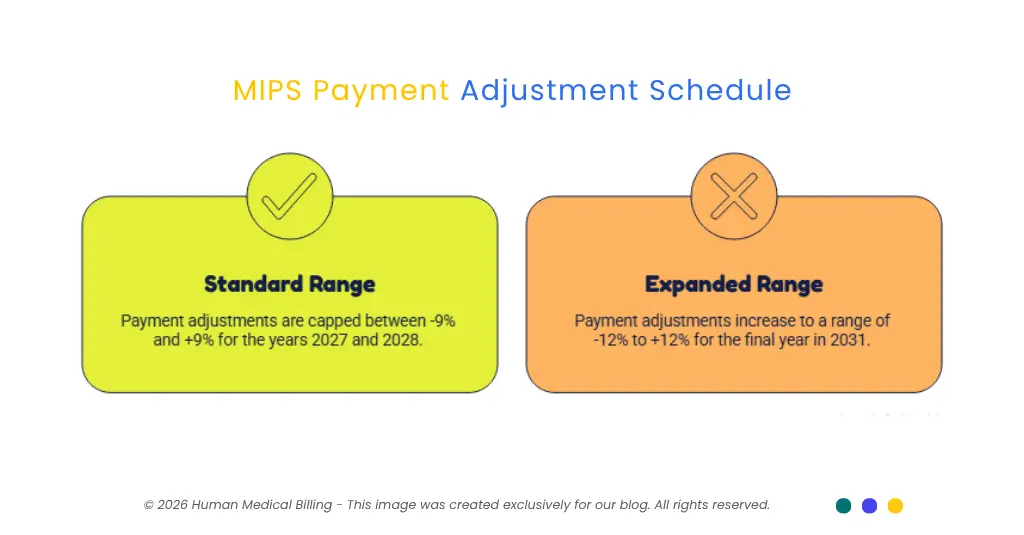
A 2-year gap exists between when cardiologists perform their duties (e.g., documentation, closing of care gaps), and when those performance metrics are reflected in payments. Cardiologists' decisions made in 2027 regarding their documentation and/or the speed at which they can close gaps in care, etc. will appear on a cardiology provider's remittance advices in 2029. In many cases, billing staff may not find the issue with their payment data before the performance year has ended, thereby leaving the billing team with only one option to intervene – correcting errors prior to the end of the performance year.
The coding accuracy is much larger of an influence for this type of provider compared to the traditional fee-for-service model. Documentation that is accurate and complete are used to determine quality metrics such as blood pressure management and rates of avoidable hospitalizations. An example of a missed diagnosis code or an unassociated encounter can result in a physician’s overall scores to be lowered without anyone noticing the trend until after several months have passed.
A five-doctor cardiology group will report on the same four performance areas (as a hospital employed practice which employs 50 practitioners) and therefore the comparison of how these two practices perform will compare physicians based upon peer groups who treat the same disease process.
What This Means for Patients and Payers
In addition to using Collaborative Care Arrangements (CCA) among cardiologists and primary care physicians for heart failure patients, ASM will be able to identify who has responsibility for each part of the care as well as the process by which both cardiologists and PCPs can exchange information regarding the care of these patients. The CCA identifies what aspects of care are owned by the cardiologist versus the PCP; therefore, all parties involved in this process are required to utilize certified EHRs to ensure the continuous flow of information between both parties.
As far as payers and patients are concerned, the main effects include structured hand-offs between specialist and primary care physician visits and increased reporting requirements from specialists. While patients may see very little changes to their daily lives with regard to their treatment for their heart failure; however, the level of detail associated with documenting their treatment will increase dramatically.
The payer is not a participant with respect to the payment adjustments made in ASM like it would be with respect to other forms of value based reimbursement. The payment adjustment is paid by CMS as an offset on all subsequent Medicare Part B claims. As such, no commercial payer is bound by the rules or requirements of the ASM; however, many practice’s that have developed good care coordination skills through their participation in the program will also find themselves applying similar documentation and coding standards to their commercially reimbursed claims.
What Should Your Practice Do Now?
90-Day Readiness Checklist
- Check the participant dataset. Find the participants in the dataset of the physician. Look up the NPI in ASM participant on data.cms.gov to find out who in your practice will be at risk due to being listed.
- Verify PECOS specialty designations. Pull specialty information from PECOS. If a cardiology provider has been designated with a different specialty than they have, correct this designation via CMS 855 prior to the determination that affects eligibility.
- Pull 2025 heart failure episode volume. Fetch the 2025 Heart Failure Episode Volume. Determine the number of episodes attributed to each physician in advance of CMS doing so. Small errors made in coding may impact whether or not a provider meets the required amount of episodes (20) to become eligible.
- Start collaborative care conversations. Collaborate on developing plans for quality improvement. Contact your Primary Care Partners NOW, do not wait until January of the first Performance Year.
- Audit documentation for the four scoring categories The Quality, Cost, Improvement Activities, and Interoperability scores will be based on the documentation that is contained within the patient’s charts – NOT how much was billed for the services provided.
- Loop in your coding team early. Your Coding Team should be engaged early. Correctly identifying diagnoses in your claims will result in increased reimbursements two years from now. Waiting to address coding issues in 2028 may cause problems with future payment.
Frequently Asked Questions
The ASM 2027 is a mandatory Medicare payment model; it will adjust Part B reimbursement for certain General Cardiologists for how they manage their Heart Failure patients beginning in the 2027 Performance Year.
No. All physicians who meet the specialty, geographic, and volume of episodes criteria are required to participate. There is no opt out option.
Payment adjustments for 2029 based on 2027 performance begin after a two year wait.
General Cardiology is included; Interventional Cardiology, Electrophysiology, Advanced Heart Failure and Transplant Cardiology are excluded.
Our team has analyzed the structural comparison of ASM’s Scoring Model to the MIPS Value Pathway (MVP) Transition on the Xpert Billing Blog. If you don't want to go through that process yourself as far as finding eligibility lists or updating PECOS, we can work with you in regards to cardiology billing services so we will determine whether or not you are eligible for ASM. We can also assist with cleaning up potential service gaps in your medical coding prior to those impacting your quality score.
We will be able to maintain Denial Management Services for you until the payment lag is resolved. Contact us about conducting a readiness review prior to the end of the first Performance Year.

Contact Human Medical Billing to schedule a compliance readiness review or learn more about our end-to-end billing and regulatory support services.