



The 2027 Proposed Rule for Medicare Physician Fee Schedule (MPFS) was released by CMS on July 14, 2026. While there are 3 new MIPS Value Pathways (MVP), the real story here is what will happen to the existing 27. CMS intends to revise each of those pathways prior to opening the reporting period in 2027. So if your practice has already selected an MVP pathway and established a process around it, that process is going to be changing.
In addition to changes made to Measure Selection and Scoring, there are also changes related to Core Measures; all of these changes apply regardless of whether you report as part of Traditional MIPS or through an MVP. Comments regarding the proposed rules are due to CMS by September 14, 2026, with a Final Rule expected later in 2026.
Quick Answer
- The CMS will begin to update or revise ALL 27 of the current Merit-based Incentive Payment System (MIPS) Value Pathways (VPS), in addition to creating three new VPS, beginning with the 2027 performance year.
- A total of 30 VPS will be available; three are new – Diabetic Disease, Hypertension, and Hospitalist.
- Every single VPS will require a MIPS core measure as at least one of their four required quality measures. Small practices can request exemptions from this rule.
- The traditional MIPS program will no longer exist after the 2028 performance year, thus MIPS Value Pathway reporting will become the primary way physicians report on MIPS Quality Measures beginning in 2029.
Why MVPs Are Getting a Second Look
CMS developed MIPS value pathways (MVPs) as a replacement for the original "pick your own" model of MIPS. With the original model, clinicians could choose whichever quality measures they wanted to meet; but, with the new MVP model, clinicians are required to participate in a specific pathway based on their medical specialty or patient population. Initially, there were about 7 different pathways available. Over time this number expanded to include 27 different paths for areas such as Cardiology, Ophthalmology, Behavioral Health and many others.
Clinicians who have chosen a path will be able to assume the measures within the path will remain relatively stable. However, the stability is short lived because CMS has announced that traditional MIPS reporting will cease at the end of the 2028 performance year. In the 2029 performance year, clinicians who are not participating in an advanced alternative payment model (APM), will be required to either participate in an MVP or use the APM Performance Pathway. Clinicians have no other options for reporting. Additionally, virtual groups, which currently do not have access to an MVP under the existing regulations, will also have the option of using an MVP in 2029. As a result of this timeline, CMS will need to identify issues in each MVP prior to making participation optional. This way when the participation is mandatory, the issues may already have been resolved and the participants will experience fewer if any disruptions during the first year of participation.
What CMS Is Changing in Each MVP
The New Proposed Rule does not modify the new Medial Value Pathways (MVP) nor leave the previous 27 as is. However, CMS plans to revise all of the current pathways in three different manners. They will first add a MIPS Core Measure Selection to each of the pathways. Next, they plan to add additional measures that cover more specialty areas or clinical areas within that MVP. Finally, they plan to delete or replace those measures that do not remain valid. Additionally, one of the MVP's is being renamed.
The Rehabilitative Support for Musculoskeletal Care MVP will be renamed to the Rehabilitative Support MVP. This is simply to reflect what this pathway currently covers.
| New MVP for 2027 | Who It's For |
|---|---|
| Diabetic Disease | Primary care, endocrinology |
| Hypertension | Primary care, cardiology |
| Hospitalist | Hospital medicine |
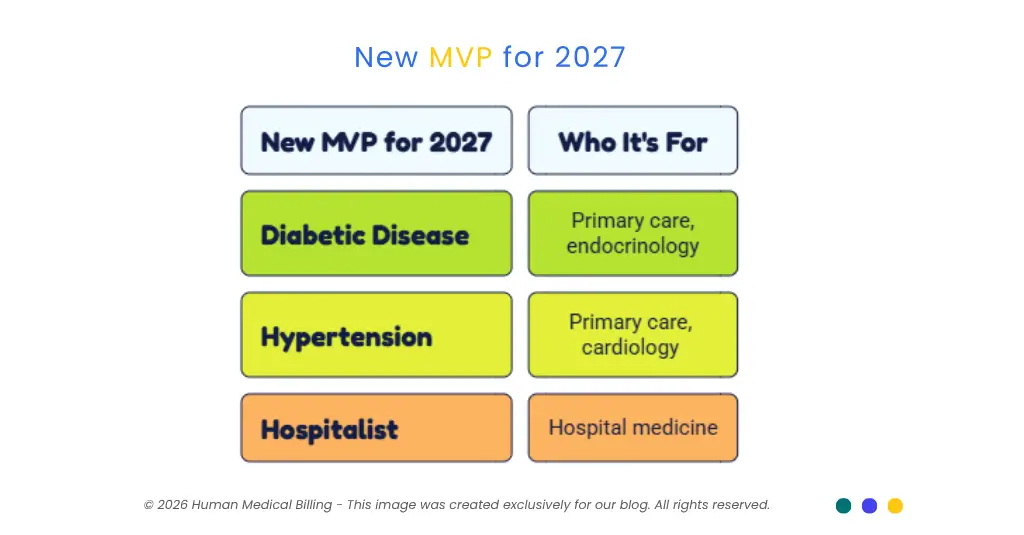
This gives the 2027 MVPs a total of 30. Overall, CMS proposes 180 total measures across all of the quality measure inventory for 2027. That represents a decrease from 190 total quality measures proposed by CMS for 2027. There are currently twenty (20) measures being eliminated as well as forty-three (43) measures which will be modified in some fashion.
What This Means for Billing Teams
The Core Measure Rule is what billing groups must initially develop a strategy for. At present, clinicians are required to submit at least one Outcome Measure, or a High Priority Measure if there is no applicable Outcome Measure. CMS desires to remove the current rule of reporting an outcome measure as a substitute for the core measure and replace it with a core measure requirement.
If accepted, under the proposed rule, MVP reporters will be required to submit one (1) core measure out of their four (4) quality measures. Similarly, traditional MIPS reporters will be required to submit one (1) core measure out of their six (6). This proposed rule does NOT apply to small group practices. If a reporter cannot find a core measure that applies to them for their MVP, they can select another measure in lieu of submitting a core measure. In either case, by selecting an alternative measure, the clinician must provide attestation; failure to do so results in zero (0) points for the selected measure.
Billing teams will need to review their current Measure Set with reference to the "removed" listing as well. The proposal is to remove seven older functional status measures in use for orthopedic patients and replace them with five newer measures based on the use of patient reported outcomes. If one or more of the measures you report currently from your practice appears on this removed listing; begin planning to identify a replacement prior to the opening of the 2027 Performance Period, not after.
The 2029 Deadline Is Closer Than It Looks
Practices have a couple of performance years (2027 and 2028) to select an appropriate MVP and develop reporting standards for it. It may appear as though they have enough time to take these actions; however, the actual process has several specific components. The first step is to select a path to follow for MVP selection. Next, practices will be required to determine what measures in their specialty are able to report. In addition, staff members will require training on new documentation requirements. Lastly, practices will need to complete a full reporting period prior to being forced into mandatory changes in 2028.
The 75-point performance target set by CMS for 2027 remains unchanged. As such, the bar to prevent a reduction in payments also continues to remain unchanged. However, the method through which a practice reaches this target has changed. Core measures topped at 7 points will no longer fall under the previous 7 point maximum. A clinician who achieves 100 percent (or nearly 100 percent) on one of the core measures, can now potentially receive up to 10 points toward their total score if CMS establishes the proper benchmark for that measure.
What Should Your Practice Do Now?
Four Steps to Take Before the Comment Period Closes
1. Obtain your current MVP (or measure)
Check your current measure set against the removal list (if you still have time). As a reminder, any measure scheduled for removal should be backed up by a new measure now and not in December.
2. Review proposed core measures within your MVP
If none of these apply to your specialty, you need to plan on how you will complete the attestation process that CMS is proposing.
3. If your practice has not selected an MVP
The three options listed above offer two more primary care grounds that didn’t have a clean fit with previous measure sets – Diabetic Disease & hypertension.
4. Discuss a mid-year reporting check with your billing company.
Human medical billing’s MIPS reporting services track all changes to measures throughout the year so clients don’t get left behind when the final rule drops after only a few months remain in the performance period
Frequently Asked Questions
CMS has proposed ending MIPS at the close of the 2028 performance year. Clinicians that are not part of a MIPS APM will submit their data via an MVP (MIPS Value Pathways) or the APM Performance Pathway starting in 2029.
Yes, however the measures within your current MVP may be different. CMS is also recommending changes to each of the 27 current MVP's by selecting additional core measures and adding other measures and possibly removing others.
CMS has proposed to exempt small practice groups from reporting on a core measure as well as the required attestation process.
At this time No; however CMS has also proposed allowing virtual groups to start reporting MVPs in 2029 at the same time as traditional MIPS will end.
Comments are due by September 14th, 2026. The proposals outlined in the above could change before the final rule is published this fall.
Core Measures Rule; Measure Removals (see below); and a Proposed Rule with a 2029 Deadline - This time of year can be chaotic for those who manage MIPS reporting. It makes sense to get a head start on tracking and making necessary adjustments to your reporting workflow regarding the 2027 MVP proposals now so when CMS publishes the final rule there will be less to surprise you about. At Human Medical Billing we help providers monitor proposals such as these and update their reporting work flow prior to deadlines. We provide medical coding services based upon the specific measures that your specialty typically reports. Do you need someone to review your MVP measure set? Please contact us.

Contact Human Medical Billing to schedule a compliance readiness review or learn more about our end-to-end billing and regulatory support services.