



Automatically downcoded claims may be paid by the payer yet still leave a claim short. Additionally, many practices dealing with automatically downcoded claims will never experience an appeal denial, receive a denial notice, or have any type of indicator on their work queues. The payer will pay for a 99213 level of service even though the provider billed at the 99214 level; however, all other elements of the remittance appear normal.
In order to find the problem, one simply needs to compare the CPT codes the provider submitted versus those that were actually paid. This document outlines the methods by which this comparison can be made through the claim, the Electronic Remittance Advice (ERA), and the Explanation of Benefits (EOB).
Quick Answer
- A downcoded claim occurs when a Payer makes payment for a service at a lesser level of billing than what was originally billed to them.
- Claims are treated like paid claims (i.e., denied) because they land in the Denied Queue, and therefore will be missed.
- You should review your submissions to payers with their corresponding payments on a monthly basis, by each individual payer, code, and provider.
- The MGMA's proposal to prohibit downcoding in Medicare Advantage is still a Draft Proposal and has no current legal standing.
What Automatic Downcoding Medical Claims Look Like on a Remittance
The process of downcoding occurs when a payer reduces the CPT coding billed by an individual provider to a lower level than what was originally coded. For example, if you submitted a claim for 99214 but it was paid out at 99213, the claim would be closed as paid.
For this example we'll use some fictitious claims to help illustrate how downcoding works. Your actual contract rate may vary from ours.
- Your contract pays you $130 for billing a 99214.
- Your contract pays you $90 for paying a 99213.
- The difference in pay is $40 per visit.
- If you are having 25 downcodes per month, you are losing $1000 per month, or $12,000 annually.
Is a lower payment always due to improper downcoding? Absolutely Not. Some cases support the lower level of care documented. In other instances, the services were bundled together, and/or the fee schedule for the physician's group has been adjusted. Anytime there is a different CPT code listed on the same service line (or lines) indicates potential downcoding occurred, so a medical records review will determine whether the coding changes were warranted.
Here is how four common outcomes compare:
| Outcome | What the payer does | What the ERA often shows | Where you catch it |
|---|---|---|---|
| Downcoding | Pays a lower-level CPT code for the same service | A different paid code, sometimes CARC 150 | Submitted versus paid comparison |
| Denial | Pays nothing on the line | Zero payment and a denial reason | Denial work queue |
| Bundling | Folds one code into another code’s payment | Often CARC 97 on the bundled line | Edit and modifier review |
| Contractual adjustment | Cuts the charge to the contract rate | Group code CO with CARC 45 | Expected write-off |
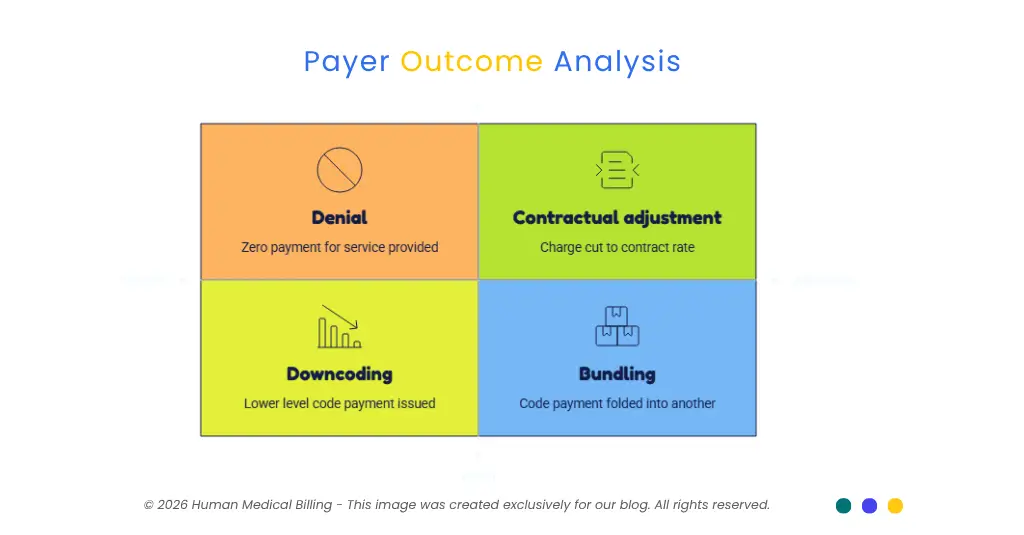
Payers label these differently, so treat the codes as clues, not proof.
What Changed: MGMA’s Draft Bill on Automatic Downcoding
The MGMA has created proposed legislation that would prevent Medicare Advantage Plans from automatically adjusting (downcoding) physician submitted charges. According to MGMA Associate Director of Government Affairs, Madison Hynes, who spoke at the September 27th Annual Conference of the MGMA, she is currently "shopping" this bill to Congressional Staff on both sides of the aisle.
Translation. This is simply a draft proposal, not a new law; therefore, nothing needs to be done by anyone today.
There are two drafts written by the MGMA. In the first (clean) version, there is complete prohibition against any form of automatic downcoding. In the second (fallback), the MGMA will permit a Plan to use an automatic downcoding system once it can demonstrate that a Physician is billing above a predetermined level. Hynes expressed her belief that any such policy should only remain effective for 90 days, and only apply to Physicians whose bills exceed established thresholds.
Just because a Payer uses an "automatic" process does not mean they utilize Artificial Intelligence (AI). An example of how this occurs, is if a Payer creates a rule that automatically downcodes all claims submitted that carry a specific CPT/ICD-10-CM Code, regardless of whether or not an algorithm or AI was used. MGMA's Draft includes Automatic Protocols, Algorithms and AI so that the Ban applies to any type of Automated Process. Do not assume that just because an AI is utilized in your Payers' process, that the Payer utilizes AI in their Downcoding Algorithm.
As to why MGMA wants to take action now? MGMA identified Prior Authorization, Denials and Downcoding within Medicare Advantage as being among the Top Five Administrative Burdens for Medical Groups in their 2026 Regulatory Burden Report. According to Hynes, Downcoding is the issue that Members complained about the most. Hynes characterized Downcoding as happening "in the dark of night", which she explained meant that Practices seldom receive notification from Payers when Downcoding takes place.
How Medicare Advantage Downcoding Hurts Your Billing Team
A Denial will provide you with a code, a queue and a deadline. An E/M Downcoded payment does NOT. According to Hynes, there are NO notification given to the practice regarding a downgrade from 4 to 3 for the claim OR through the portal.
The only method to identify a down-coded E/M payer is to review the Paid Code on EVERY LINE.
Not all Payers have published their Down Coding Policies. One example was given by Hynes which identified 4 Codes that could be reduced from Level V to Level III and provided no additional detail. Cignas' policy has been covered in Cigna's New E/M DownCoding Reimbursement Policy: Oct. 2025.
This can cost staff Time. Those staff members that examine each individual line for payments (for the purpose of identifying down coded claims) spend Hours performing tasks assigned to them by NO Queue. Small Practices frequently skip this process as a result of this time commitment and therefore this short fall occurs repeatedly.
What It Means for Patients and Payers
Patients also are impacted by an allowable. The allowable will directly impact how much of a co-insurance the patient is required to pay on their statement; therefore, review each patients' statement as part of your review process.
MGMA states that some payers claim these programs will be directed at outliers for billing practices but does state that there are still many gray areas with respect to what constitutes an "outlier" and the appeals processes. Your data is the most credible data you have when discussing anything related to a payer.
What Should Your Practice Do Now?
Next Steps. Auditing for underpayments requires a practice to have a spreadsheet (not new software) to conduct a payer underpayment audit. Practices that successfully appeal may be able to identify their issue, but many times, the practice does not know what they are looking at until they have run the routine to fix the issue. The routine will provide a method to ensure consistency in catching automated downcoding on all medical claims prior to closing of the appeal window.
Run a monthly audit comparing submitted versus paid charges (codes).
- 1. Take the CPT codes (current procedural terminology) for each service line billed in claims from your claim files.
- 2. Take the paid CPT code(s) from ERA. If your ERA does not contain details about the line item, pull from the explanation of benefits (EOB).
- 3. Create a flag for all lines where there is a difference between what was submitted and what was paid. The submission vs. Payment CPT code comparison is the core of an ERA downcoding audit.
- 4. Sort by payer, code, provider, & type of service.
- 5. Retrieve the documentation for each flagged patient visit and compare to the billing level at which you billed the patient. Include medical coding services as needed if you do not have sufficient coder hours; correct your own error; do not add to any note after the visit to increase billing level.
- 6. Appel when supporting documentation exists for the billing level. Attach the note, payers policy and contract language. Have the same process run each Appeal denial claim as you would with denied claims or turn over to denial management services if you are outsourcing this portion of your business.
- 7. Document the result of the Appeal and dollars recovered per Appeal. Your accounts receivable reports should reflect recovery dollars either processed internally or by outsourced medical accounts receivable services partner.
- 8. Run the same cycle every month. With each cycle you will sharpen your view of which payers downcode which codes
How often should you run it? Monthly. Appeal windows vary by contract, so older gaps get harder to recover.
What if the payer was right? Then fix the coding or documentation habit that caused the gap.
Frequently Asked Questions
Automatic Downcoding occurs when an insurer's system reduces the CPT Code billed on a claim (and thereby pay at the reduced rate) via rule/algorithm rather than after review of that record. In most cases, this would be represented as a payment (not a denial).
MGMA has proposed banning downcoding as part of their proposed amendments; however, these are merely proposed and not yet laws. Therefore, what constitutes a valid challenge to a specific payer policy will depend upon your contract, the type of plan being contracted, and/or your state laws.
If there was a difference in the CPT codes for which you submitted claims versus what was actually paid on the ERA or EOB, that would indicate the payer downcoded your claims. If both were on the same service line, then that indicates downcoding.
Yes. Please provide the visit note, evidence of meeting the level criteria you have provided as well as proof of how the payer's policies were applied to your claim. Only appeal when there is documentation supporting the level of care at which you charged.
Getting paid does not always equal getting paid properly. Running an automated monthly audit is a couple of hours of work and will show you how the automatic down coding on your medical claim is costing you money and could have been denied. If your staff doesn't have enough time to manually check each line of their submissions, Human Medical Billing can perform the submitted versus paid analysis and address all of the subsequent appeals. MGMA's new billing rules may make some changes in the future. In the meantime, it will protect you. Take last months ERA reports and go through them to see what you are missing. We would be happy to assist you by analyzing your payer mix.

Contact Human Medical Billing to schedule a compliance readiness review or learn more about our end-to-end billing and regulatory support services.