



Billing teams have a new set of codes to work with in their planning. In total there are 58 additional 2027 Category III cpt codes; in addition, there will be revised language for three (3) previously-existing codes. Approval by the american medical association was made as part of the cpt editorial panel meeting in february, 2026; however, these new additions will become effective on January 1, 2027 and will include an initial six-month "lead-in" period that begins on July 1, 2026.
These new codes will stand separately from the previously-announced Category III code release with a total of 28 codes that many coders have been aware of. These codes primarily focus on liver allograft perfusion; this is the method used to maintain a functioning donor liver outside of the recipient's body prior to transplantation.
Quick Response to AMA
Category III Codes Added in 2027 CPT Book
- In addition to the 58 new Category III codes (see the list below), there are three revised Category I codes for CPT 2027.
- The new codes were approved by AMA at its meeting in February 2026; they will be effective as of January 1, 2027.
- Most of the new Category III codes pertain to hypothermic oxygenated perfusion for liver allografts and mirror those used for normothermic perfusion.
- Category III codes monitor new technologies/procedures. These new codes alone do not mean that you will get paid.
What Are Category III CPT Codes?
Category III codes were developed as an interim solution for reporting services related to new technologies or medical treatments until enough information has been collected to support assignment of a permanent Category I code.
Category III codes carry no Relative Value Units (RVUs), which essentially provides no standard payment amount for each code. While coders may use Category III codes to indicate a service was provided, the decision on coverage will be made individually by payers.
Updates are released twice annually regarding Category III codes in order to provide timely coding options for rapidly evolving specialties such as organ transplantation, which is experiencing an influx of new device technology and methodologies at a rate that exceeds the capacity of the regular annual CPT update process.
What Changed for 2027
1. Normothermic Liver Perfusion Codes
Three codes that describe Normothermic Liver Perfusion were updated with a new descriptor (0894T, 0895T, and 0896T) The three codes include cannulation; connecting the liver to the perfusion equipment; and continuing monitoring of a liver allograft while it is being kept viable by use of a normothermic perfusion device.
2. New Hypothermic Oxygenated Perfusion Codes
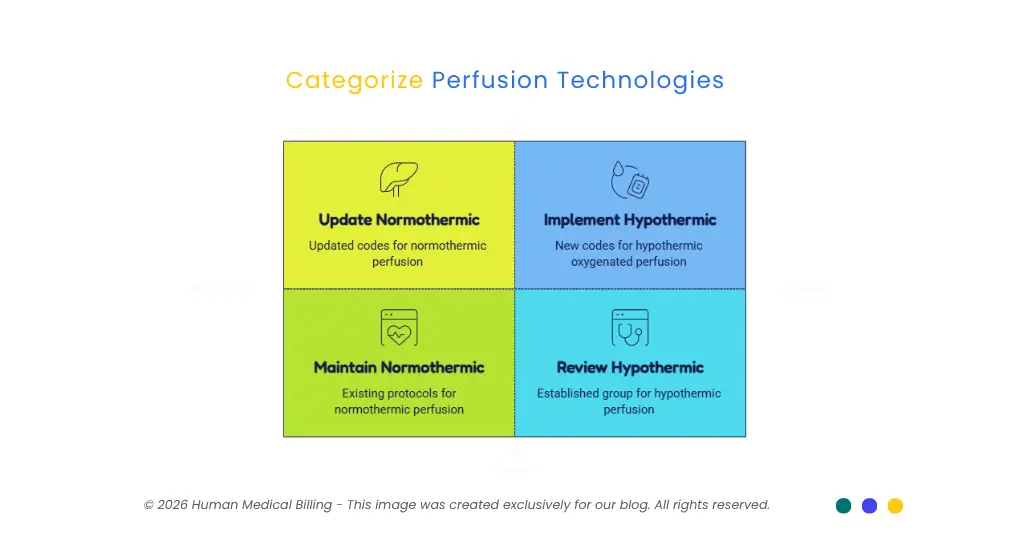
There are 58 new codes that create an additional group for hypothermic oxygenated perfusion which is another type of technology used in order to keep a donor liver viable. This group of sixty-one code is in addition to the already established group for normothermic perfusion. There are new codes added to this group from 1074T through 1076T in all aspects as they relate to each other.
| Function | Normothermic Perfusion Code | Hypothermic Oxygenated Perfusion Code |
|---|---|---|
| Cannulation | 0894T | 1074T |
| Connection and initial monitoring | 0895T | 1075T |
| Ongoing monitoring | 0896T | 1076T |
The remaining New codes in the 1054T-1078T ranges complete additional related monitoring and add-on services to support these procedures. They will both become effective simultaneously at the start of the year January 1, 2027.
What This Means for Providers and Billing Teams
The updates to ICD-10-CM coding will be a priority for providers who are involved in transplant surgery, organ procurement, or perfusion services. Coder's will need to choose the appropriate perfusion code to reflect the specific perfusion methodology used (hypothermic vs. normothermic) as these procedures will have unique code families based upon whether they were performed using a hypothermic device versus a normothermic device.
In addition to selecting the correct perfusion code; coder's will also require documentation from either the surgeon or perfusionist to indicate what device type(s) were utilized during the patient's procedure and how many hours post-operatively the perfusionist monitored the patient. If an operative note is written by the surgeon, it should clearly state what device type(s) were used and how many hours the perfusionist monitored the patient. An operative note simply stating 'perfusion' does not provide sufficient information to support the coder's selection of the most accurate code family.
This is important because while Category III codes do not guarantee reimbursement, payers reserve the right to deny payment if they deem that particular category III code as experimental. Therefore, before submitting a claim to a payer for reimbursement, check your payer's policy regarding Category III codes.
What This Means for Patients and Payers
The expansion of CPT coding categories for Hypothermic Oxygenated Perfusion (HOPE) is indicative of increased adoption in the community at large, as it signifies an expanded utilization of this technology within transplant programs. Coding categories are now more specific which will provide payers with much needed information regarding frequency of utilization and cost.
Category III claims for services have been used historically to determine if a service will ultimately be granted Category I status with a fixed fee schedule. Due to the Category III designation, HOPE claims may continue to require prior authorization and medical necessity review on a case-by-case basis.
What Should Your Practice Do Now?
What does this do for you in terms of what you are doing as an employer/employee? Start looking at your Fee Schedules/Payer Contracts by the time that the lead-in period starts (July 1, 2026).
- Update your Charge Master and Coding Software so it reflects the New Codes (the new 1054T through 1078T range) and also update all the Revised Descriptors (0894T, 0895T, and 0896T).
- Check with each Major Payer regarding their coverage and Prior Authorization Rules for Hypothermic Oxygenated Perfusion Codes.
- Train Coders/Clinical Documentation Staff regarding how to identify Normothermic vs. Hypothermic Perfusion Coding.
- Flag Claims submitted with these codes for a Second Review (before they are submitted), as most Category III Denials are due to Missing Documentation.
- Keep up to date with AAPC & AMA updates as the Bi-Annual Release occurs again, because Category III codes change twice per year.
Teams working with a full claims queue will often use outside assistance to handle both of these issues. In many cases, this is when medical billing companies provide both medical coding and denial management to identify potential discrepancies prior to them becoming actual denied claims. Frequently Asked Questions
Frequently Asked Questions
Category iii codes are no-guarantee payment codes. There is no minimum payment amount for category iii codes. Each category iii code will be covered by each payer as per their individual policies regarding the specific service or procedure described in the category iii code.
The new 2027 category iii codes will go into effect January 1, 2027. This follows an initial six-month phase-in from July 1, 2026 to January 1, 2027.
The AMA revised category iii cpt codes 0894t, 0895t and 0896t. These revisions clarified the normal temperature perfusion descriptors to have them describe services/ procedures in consistent language with the newly created hypothermic perfusion codes.
Transplant center Coders and billing staff; opo (organ procurement organization) coding/billing staff; any medical billing office that bills for liver perfusion services.
The Bottom Line
58 new codes & 3 revisions: while the total number of new/revised codes may seem insignificant compared to an entire year’s worth of updates to CPT, these changes will have a direct impact on how liver perfusion services are billed by transplant billing departments beginning with cy-2027. Take action now. Make sure your system is updated prior to the July 2026 lead-in. Confirm that payers will be accepting claims using these new codes before you submit them.
Human medical billing tracks changes such as these as part of its regular ongoing healthcare revenue cycle management services. Therefore, our clients do not need to wonder which code will apply on January 1st. If you want to learn how these changes will affect your specialty contact us and we’ll walk you through what they mean.

Contact Human Medical Billing to schedule a compliance readiness review or learn more about our end-to-end billing and regulatory support services.