



Sixty-three percent of health care organizations are using artificial intelligence (AI) for their revenue cycle processes. However, only fifteen percent of those organizations have seen a positive ROI as a result. The reason is that most of these organizations purchased the new technology before they were able to establish benchmarks or metrics to measure how well the technology was working.
Therefore, if your billing department has recently implemented an AI tool and you don’t know whether this action impacted one single number on your practice’s financials, you are not behind. You are with the majority. Here are the trends based upon recent adoption data of AI tools in the health care industry; why there appears to be such a large gap between implementing an AI tool and seeing a profit from its implementation; and a checklist of items to review prior to signing the next vendor agreement.
Quick Answer
- A majority (63%) of hospitals and health systems currently utilize Artificial Intelligence (AI) in some aspect of the Revenue Cycle, however only a small minority (15%) have reported Positive Return on Investment according to a 2024 survey conducted by HFMA & FinThrive that polled 101 hospital/health system organizations.
- Coding/documentation was the single most commonly used application of AI with 48% of surveyed organizations utilizing this method.
- Only a small percentage (27%) of organizations are currently using AI across all aspects of an organization, while the remaining organizations are pilot testing.
- Two major factors limiting Return on Investment for those using AI are lack of sufficient IT Infrastructure to support large-scale adoption of AI technology; limited budgets; and challenges related to integrating new technologies into existing business operations rather than issues with the AI model itself.
Where the Adoption Numbers Actually Come From
HFMA & FinThrive conducted a survey on behalf of 101 U.S. based Healthcare Organizations with varying numbers of employees from Oct-Nov. 2024. The survey asked if the organization had used AI or Automation in "some" aspect(s) of the Revenue Cycle. Sixty-Three (63%) of respondents stated they had already integrated AI or Automation in "some" aspect(s) of the Revenue Cycle. Only Fifteen (15%) of those who responded yes reported a positive Return On Investment (ROI). Another 38% were still developing work or are in the pilot phase. More than one-third of the industry has not measured the ROI for an investment made in this area.
Coding was cited as the most popular use case for automation. Forty-Eight (48%) of all respondents reported using coding in some way. This is not unexpected as coding provides the most obvious input and output variables, thereby providing a very predictable set of data to be automated. Additionally, there are many ways to measure coding. It is much more difficult to determine when appeals writing is complete or whether negotiations have been completed successfully with payers.
FinThrive Vice President Jonathan Wiik describes the current thinking about AI/Blockchain/ etc. in terms of how organizations think about these technologies today. There was a time (a couple years ago), where discussing AI was met with eye rolling; similar to discussions regarding Blockchain. Today, he states that AI is the only subject being discussed by everyone in the Revenue Cycle. Mr. Wiik predicts that the ROI will increase quickly; he estimates that organizations will see a positive ROI of approximately thirty (30%) per quarter, or within two quarters after the date of the survey.
Why So Few Practices See a Return
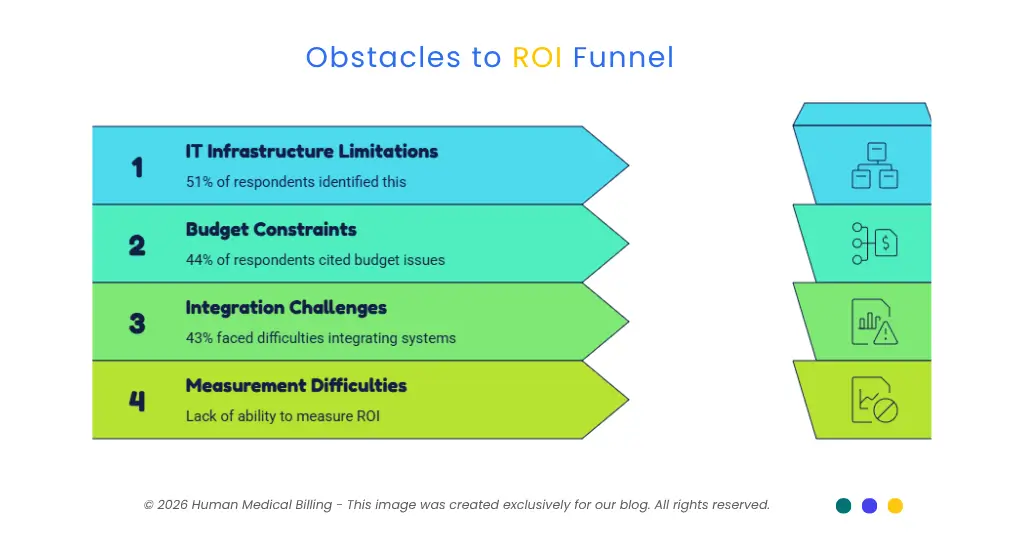
The same survey was also used to ask providers to identify the major obstacles to achieving Return On Investment (ROI) from those tools. In order, respondents identified the following as obstacles to ROI:
- IT Infrastructure Limitations – 51%;
- Budget – 44%
- Integration Challenges with Existing Systems – 43%; and
- Lack of ability to measure and document ROI for that solution
This last item merits additional consideration. The inability to collect data on your pre-implementation denial rate, average days in Accounts Receivable (A/R), and clean claims rates will leave you without the necessary evidence to support that these new tools resulted in positive changes post implementation. A vendor provided dashboard showing all "green" does not equate to increased collections by your practice.
Vendors themselves may add to this confusion. An HFMA survey completed in February 2026 (based upon input from 95 Finance and Revenue Cycle Leaders) indicated that 37% of the participants reported that while their current vendor relationship is functional, they consider it increasing in complexity. Another 19% report having vendor relationships that are fragmented and difficult to manage. Most providers currently work with two or more vendors utilizing artificial intelligence (AI) solutions throughout various segments of the revenue cycle. This creates added complexities regarding determining where improvements originated.
The Scale Problem: Pilots Versus Production
What was apparent from the same February 2026 HFMA survey - and clearly shows how adoption and scale are distinct entities - is that only 27% of responding organizations have deployed AI at scale to several (if not all) revenue cycle functions. Thusly, the remaining 53% of respondents indicated they are testing or piloting in specific functional areas.
The gap between readiness and actual preparedness is significant. It appears only around 7% of those surveyed believe their organization has its team(s) "very" ready for what it will require in terms of deploying AI in a revenue cycle. Furthermore, another 44% described themselves as "somewhat" ready; this translates to roughly half of the healthcare financial management industry having some level of uncertainty, but most definitely insufficient preparedness.
It is critical to recognize that a pilot does not fail the same way as a production deployment. Although a pilot may be deemed successful with a limited, curated subset of claims, it fails when it expands to include the higher volumes of claims typically experienced by a larger-scale organization, combined with less-than-perfect documentation, and varying levels of payers. It seems probable that the reported 15% ROI figure cited above includes many organizations that went beyond just piloting and implemented full-scale deployments. As such, if your organization is currently piloting the use of AI within a particular function or department, it is possible that the demonstrated success in your pilot would result in a comparison to these vendors’ best case scenarios rather than the reality of your organization’s current scale and operational complexity.
What This Gap Means for Your Billing Team
The Denial Problem: Why RCM Tools Get So Much Attention
No one operates in a bubble. That’s true in most areas of business but especially so when it comes to AI Revenue Cycle Management. Denials are rising and that’s why AI Revenue Cycle Management is getting all of this attention. More than half of the U.S. healthcare organizations reporting in MGMA’s 2024 Benchmark Report on Denials and Appeals reported a denial rate over 10%. HFMA’s own data from its Pulse Surveys says that on average, each hospital loses about 4.8% of its net revenue annually to denials, with larger health systems losing tens of million dollars.
The accepted range for denial rates, as defined by HFMA, is 5-10%. Any organization operating below 5% would be considered to be performing very strongly. For many practice groups, they fall far outside these ranges - and it’s just as much reason to have vendor after vendor come out touting their "fix" using AI at conferences across the country. While there may be little evidence proving that any given vendor has been successful in alleviating the pressure for you, if your group spends hours per week working through denied claims; that is what denial management services were developed to do (regardless of whether those solutions use AI, processes or some combination thereof). Likewise, the same can be said for improving coding accuracy. If your denial pattern appears to stem from coding inaccuracies (as opposed to payer behavior), then a medical coding service that focuses on your specialty will improve the number more quickly than any general purpose AI solution will.
The Payer Side of the Same Fight
The unspoken portion of this. Payers have adopted AI for faster claim review and denial, compared to the speed of response from many providers’ billing teams. From 10.15 percent in 2020 to 11.99 percent through Q3 2023, (with inpatient claim denials at 14.07), the rate of denial rose by roughly 20 percent per year, as reported by HFMA. The lastest numbers on denial rates indicate that we may be headed toward an average denial rate of around 12 percent in the health care industry by 2025.
The reality is, in order to stay competitive or keep pace in billing, a manual billing process will lose to an automated payer process because payers have been automating their processing of claims while the majority of providers continue to use a manual billing process.
What Should Your Practice Ask Before Buying an AI Billing Tool?
Run through this list before any contract gets signed.
1. Pull your own baseline first.
First pull your own baseline data so you have documentation of your current denial rate, A/R Days and clean claims rates prior to meeting with vendors. No matter how good the vendor may demonstrate improvement in any of these areas, there is no way to verify without knowing your starting point.
2. Name the exact function.
Identify exactly what function the vendor is offering. Ask them specifically what type of issue or problem does their product solve. Example: coding accuracy is an entirely separate issue from denial prediction. The vendor should know which one they are fixing and able to describe both if necessary.
3. Ask for references that match you.
Request reference sites similar to yours. Case studies about a 500 bed hospital system don’t provide any insight into the problems or challenges of a small 12 provider cardiology practice. Be sure to request reference sites that match your specialty and payers.
4. Ask how the tool handles your current vendor stack.
Find out how the new tool communicates with all of your existing vendor tools (stack). As stated by Black Book Research, 37% of organizations consider their existing vendor relationships as “complex”, therefore, ask the vendor how the new tool will communicate with each of the other tools currently running in your organization.
5. Set a 90-day checkpoint.
Establish a written agreement for performance metrics in 90 days. In your written agreement, establish the criteria for measuring success at the 90 day mark based on your original baseline metrics not the percentage projection provided by the vendor.
6. Push for outcome-based pricing where you can.
When possible, seek outcome-based pricing. If the vendor’s product improves performance to the level described in their marketing materials, then they should be willing to tie some portion of their price structure to measurable outcomes.
Frequently Asked Questions
Yes it can, as long as the organization uses it for a specific measurable problem. The organizations that have seen a Return on Investment (ROI) were the ones that had an actual measurement (baseline) to measure their results from.
As reported by the HFMA and FinThrive, documentation and coding are being utilized by 48 percent of respondents. This is typically where many organizations start with AI applications as the input and output are clearly defined.
While there are no standard timelines based on the research, there was a clear division among the 53 respondents as to how much time they have spent piloting their use of AI versus when they can expect to begin seeing some level of return; a 90 day evaluation period from a baseline prior to the deployment of the technology would be a good starting point.
42% of those surveyed by HFMA stated that difficulty measuring ROI was the main reason why their organization did not experience a return. The most common cause for this lack of measurable ROI was due to never having established a baseline prior to the introduction of the new technology, rather than the failure of the tool itself.
No. Only about 27% of businesses use AI extensively. Much of this business has yet to figure things out. Because you’ve established a baseline by today and you are ahead of the 53% who are currently pilot testing with no baseline; you don’t have to wait to start.
The Human Medical Billing process evaluates a medical practice before adding any new technology into the billing process. As such there are already established baseline numbers from which you can measure your own denial patterns and payer mix. Your staff may want us to review a vendor contract or help resolve a long-standing denial issue. Simply contact us and we will evaluate both and discuss the solution options with you.

Contact Human Medical Billing to schedule a compliance readiness review or learn more about our end-to-end billing and regulatory support services.