



CMS released your 2025 MIPS results at the end of September 2026. Now it is your MIPS Final Score from 2025 that will determine if every Medicare Part B claim you submit in 2027 will be paid higher than, lower than, or equal to the fee schedule amount. If your MIPS Final Score was less than 75 points, this could result in an adjustment of up to 9% lower payment; if you scored 75 or greater, you will receive an adjustment but the maximum amount of the increase is limited by the need for CMS to maintain budget neutrality.
CMS also has the authority to conduct a Targeted Review for up to approximately 60 days after release of your MIPS Final Score. After this time period all Targeted Reviews are considered FINAL. Therefore, action needs to happen NOW -- not in January. The purpose of this document is to assist billing staff and practice management with understanding what changes occurred (in terms of reporting requirements), identifying areas where errors can occur, and filing timely appeals prior to the deadline.
Quick Answer
- CMS issued 2025 MIPS Final Scores & Performance Feedback on the QPP Website around Late September 2026.
- Your Score will determine your 2027 Medicare Part B Payment Adjustment (Applies to each claim filed from Jan. 1st – Dec. 31, 2027).
- Earning an exact score of 75 points results in no adjustment. Earning a score of 18.75 points or less will trigger a reduction of 9%.
- The Targeted Review Window will close 30 days after CMS issues your 2027 Payment Adjustments. CMS anticipates issuing these approximately one month after Final Scores are released.
How Your 2025 MIPS Final Score Turns Into 2027 Payments
MIPS has a 2-year lag in terms of when data is available. The MIPS data that were due by March 31st, 2026 (for the 2025 performance year) will be used as an adjustment factor by CMS in the 2027 payment year.
There are four areas to your overall score. In general, for most clinicians in the 2025 MIPS reporting year, Quality made up 30% of their total MIPS score, Cost also represented 30%, and Promoting Interoperability was worth 25% while Improvement Activities accounted for 15% of the total score.
In the CY 2025 Physician Fee Schedule Final Rule, CMS established the 75 point performance threshold for the 2025 performance period; this is the same as they have used for both 2023 and 2024. Why do these details matter? CMS' adjustments are tied to TIN / NPI combinations, rather than being tied to individual clinicians. Thus, if a physician billed Medicare under two TIN's in 2025, then he/she may receive two different MIPS scores in 2027.
What's New This Cycle
Timing of publication changed first. On August 17, 2026, CMS stated on practice pages that they anticipated publishing their final scores for 2025 by late September, with payment adjustments made for 2027 roughly one month thereafter. This is confirmed by the QPP website; final scores from 2025 are available online and there will be an approximate 60 day time frame for participants to submit a targeted review request.
The timing of this new window also will be determined by the timing of when payment adjustments are published. Assuming these will be posted at the end of October, expect the 30-day cut-off date to be late November.
Several 2025 scoring rules also deserve a second look in your feedback:
- When improvement activities were devalued in weight, almost all of the reporting entities required only one or two (of those) improvements.
- Because clinical social workers automatically had no Promoting Interoperability re-weighted; they either required Promoting Interoperability data OR had to have an approved exception.
- The Cost Scoring Method that CMS rolled out for use during 2024 was continued for use with the 2025 data set. The Median Cost is weighted as it relates to the Performance Threshold.
- CMS has established a re-weighting opportunity for practices whose third party intermediary did not provide data. In order to receive re-weighting on your 2025 data set, you must file this request by November 1, 2026.
What the Score Means for Billing Teams
Here is what that means in dollars. The CY 2025 final rule fact sheet lays out the scale.
| 2025 Final Score (Points) | 2027 Payment Adjustment |
|---|---|
| 0.00 to 18.75 | Negative 9% |
| 18.76 to 74.99 | Negative, between 9% and 0%, on a linear sliding scale |
| 75.00 | Neutral (0%) |
| 75.01 to 100.00 | Positive, subject to a budget neutrality scaling factor |
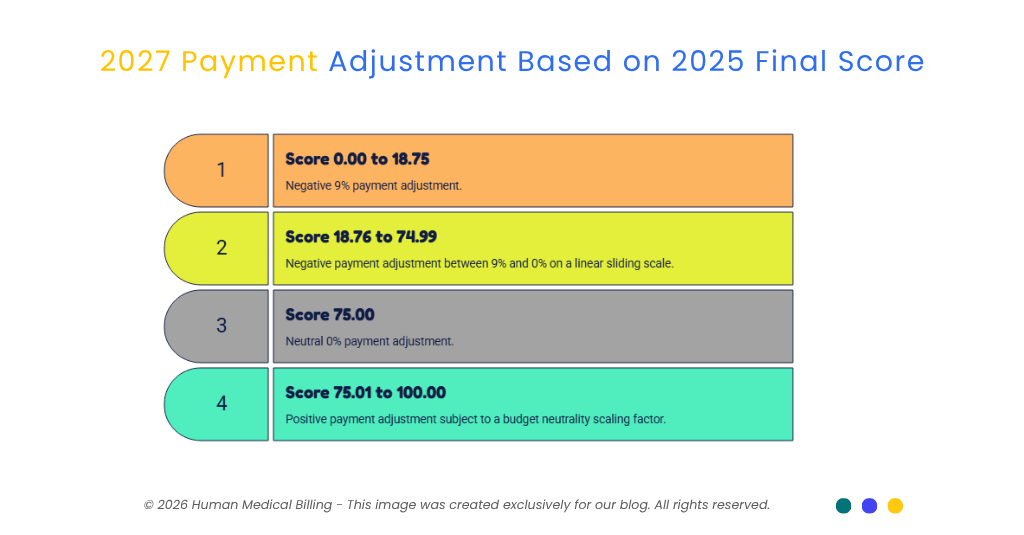
What will you have lost by having a lower than average MIPS score? A maximum loss of 9% of all Medicare Part B payments made in that calendar year. The Centers for Medicare & Medicaid Services (CMS) uses the Medicare-paid amount as the basis for calculating this adjustment, rather than the allowed amount. Additionally, CMS calculates the reduction prior to sequestration. For example, if a provider collects $800,000 per year from Medicare Part B, they could potentially lose up to $72,000 as a result of the penalty.
CMS is less predictable when awarding positive adjustments. Since MIPS has to remain budget-neutral, CMS can either increase or decrease bonus amounts depending upon how few of the clinicians participating in MIPS scored below 75. As fewer clinicians participate in MIPS and score below 75, the highest scoring participants receive smaller bonuses.
The adjustment will be seen by your posting team on a remittance advices. Under Group Code CO, the 2026 Payment Year Guide for CMS lists CARC 144 with RARC N807 as the CARC/RARC for Positive Adjustments and CARC 237 with RARC N807 as the CARC/RARC for Negative Adjustments. Practices which post their own medical A/R service staff may need to add this code to posting rules prior to January.
What Patients and Other Payers Will See
MIPS adjustments do not affect how much a patient owes. CMS makes these MIPS adjustments after the deductible and coinsurance, therefore the amount of the patient’s responsibility remains the same for Original Medicare beneficiaries.
While Original Medicare beneficiaries will likely see some type of adjustment displayed on their quarterly Medicare Summary Notice (MSN) for claims impacted by MIPS adjustments, they can expect to receive a simple explanation from front-desk staff regarding the reason why the line-item reads: “Quality Reporting Program Adjustment” when calling to inquire.
Medicare Advantage is structured differently than other plans. For in-network providers, an MA organization’s contract will determine if a MIPS adjustment can be applied (or not). For payment made for services provided by out of network professionals, CMS refers MA organizations to another guidance memo.
What Should Your Practice Do Before the Targeted Review Window Closes?
This review process addresses calculation errors that were incorrectly entered into the system. It does not address reconsideration of your choice of MIPS measures. If you have concerns with data accuracy or integrity issues that could impact your scoring, the issue should be sent to the QPP Service Center instead.
Your 2025 MIPS Score Review Checklist
1. Sign in and pull feedback.
Log into qpp using your harp login information and go to the Performance Feedback screen. Click on “clinicians” and “groups,” and view the scores of all of the clinicians and groups within your organization.
2. Download the Payment Adjustment CSV.
Once CMS posts the 2027 adjustments, this will be the last opportunity to see what final score and adjustment will be for every clinician in your practice.
3. Match each clinician to the right TIN/NPI.
The data that was submitted with incorrect tin or npi can qualify for correction. Compare the clinician's scores to how you have reassigned them through your pecos account, and reach out to anyone at your company who is responsible for credentialing as well (i.e., those individuals who are responsible for verifying clinician credentials) to ensure that the clinician's medical credentials Match up with their assigned pecos account.
4. Confirm special statuses and reweighting.
Review whether you should receive a small practice, hospital based, ASC based or non- patient facing designation. Also Confirm whether you meet the criteria for an approved extreme and uncontrollable circumstance or pi hardship exception.
5. Verify QP status.
A qualifying alternative payment model participant (qualifying apm participant) should not receive a MIPS adjustment. If one appears, file an appeal.
6. Submit early with documentation.
In most cases, when filing an appeal, CMS requires supporting documentation, therefore, file early and allow ample time for additional documentation or support that may need to be submitted.
7. Update payment posting rules.
Identify how to Map CARC 144, carc 237 and RARC N807 so that your team knows which adjustments to book from the first 2027 remit.
Frequently Asked Questions
CMS will stop accepting appeals 30 days after the 2027 Payment Adjustments are released. CMS had stated they would make these payments approximately 1 month after Final Scores were issued. Please look to the QPP Listserv for the official date.
No. Once an appeal has been denied there are no further levels of appeal.
No. The Medicare payment (after deductibles and co-insurance) will be reduced by the percentage of the MIPS adjustment, but your charges to your patients are unaffected.
The first score that avoids a negative MIPS adjustment is a 75 point performance. A score greater than 75 gets a positive MIPS adjustment; however, the scaling factor determines how large it is.
Get Your Score Right While You Still Can
Here is the bottom line, an incorrect Taxpayer Identification Number (TIN), a lack of required reweighting or a failure to correctly apply Quality Payment Program (QP) status could result in one full year of Medicare revenue being lost. Additionally, once the window has closed, no one will be able to correct this issue. Review and pull your feedback by the end of the week. Compare that to your enrolment records, and submit all requests along with documentation. At Human Medical Billing, we review MIPS feedback as part of the additional services we offer regarding medical billing and healthcare revenue cycle management. As such, we identify issues related to adjustments prior to your remits. Do you need a second opinion on your 2025 MIPS Final Score? If so contact us to have a review performed for MIPS payment adjustment purposes.

Contact Human Medical Billing to schedule a compliance readiness review or learn more about our end-to-end billing and regulatory support services.